- Company Articles
- Products and Technology
- Product knowledge
- Turning Angle Code 4040 in Aerospace Manufacturing: Precision Requirements

Turning Angle Code 4040 in Aerospace Manufacturing: Precision Requirements
Related Product
Turning Angle Code 4040
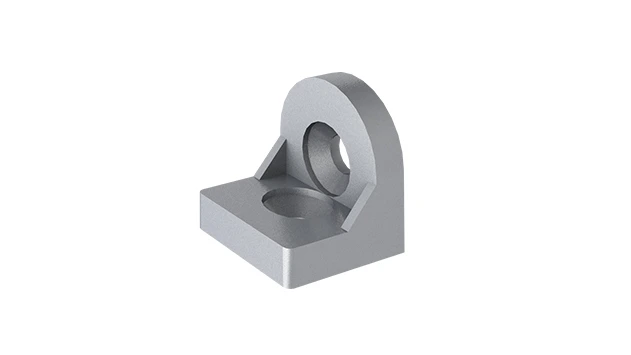
The turning angle aluminum profile connector provides a 90 degree hidden corner connection. 4040 it is means this size is used for 40 series aluminum profile.The corner code comes with set screws that allow for quick, easy connections.
In the high-stakes world of aerospace manufacturing, where the margin between success and catastrophic failure can be measured in microns, every component—no matter how seemingly small—carries immense responsibility. From the bolts that secure an engine to the brackets that hold avionics systems, precision isn't just a goal; it's a non-negotiable standard. Among these critical components, one that often flies under the radar but plays a pivotal role in structural integrity and assembly efficiency is the Turning Angle Code 4040. This unassuming connector, part of the broader ecosystem of aluminum extrusion profiles, is a workhorse in aerospace production, enabling the creation of modular, rigid, and highly accurate structures that form the backbone of aircraft assembly jigs, material handling systems, and workstation setups.
What is Turning Angle Code 4040?
At its core, the Turning Angle Code 4040 is a specialized connector designed to join aluminum extrusion profiles at precise angles—most commonly 90 degrees, though its design often allows for minor adjustments to accommodate unique assembly needs. Crafted from high-grade aluminum alloys, it features a T-slot compatible design that integrates seamlessly with standard 40mm x 40mm aluminum profiles, a dimensions widely used in industrial manufacturing for its balance of strength, weight, and versatility. The "4040" designation refers to the profile's cross-sectional dimensions (40mm by 40mm), while "turning angle code" highlights its primary function: to facilitate stable, repeatable angular connections between profiles.
What sets the Turning Angle Code 4040 apart from generic connectors is its focus on precision. Unlike off-the-shelf brackets that may have loose tolerances, this component is engineered with tight dimensional controls—often within ±0.05mm for critical surfaces—to ensure that when two profiles are joined, they align exactly as intended. This level of accuracy is achieved through advanced manufacturing processes, including CNC machining for hole placement and surface finishing, and heat treatment to enhance material strength without compromising dimensional stability.
Why Precision Matters in Aerospace Manufacturing
Aerospace manufacturing is a domain where precision is the bedrock of safety, performance, and compliance. Aircraft components must align with microscopic accuracy to ensure aerodynamic efficiency, structural integrity, and compatibility with other systems. For example, in wing assembly, even a 0.1mm misalignment in a jig's support structure can translate to uneven stress distribution across the wing, potentially leading to fatigue cracks over time. Similarly, in engine mounting systems, the precision of brackets and connectors directly impacts vibration dampening, which in turn affects engine longevity and passenger comfort.
The Turning Angle Code 4040 addresses these demands by serving as a "precision anchor" in assembly tools and workstations. When used in jigs for airframe assembly, it ensures that reference points remain consistent across shifts, operators, and production runs. This consistency reduces variability in part fitment, minimizes rework, and accelerates the transition from component manufacturing to final assembly. In avionics rack construction, where sensitive electronics must be secured against vibration and thermal expansion, the angle code's rigid connection prevents micro-movements that could disrupt signal integrity or damage delicate components.
Beyond safety and performance, precision in components like the Turning Angle Code 4040 also drives operational efficiency. In an industry where production delays can cost millions, the ability to quickly reconfigure workstations or jigs using modular aluminum extrusion profiles and angle codes reduces downtime. Unlike custom-welded structures, which are fixed and time-consuming to modify, a system built with 4040 angle codes can be disassembled, adjusted, and reassembled in hours, adapting to new aircraft models or design changes with minimal disruption.

Aluminum Extrusion Profile: The Foundation of Precision
The Turning Angle Code 4040 does not operate in isolation; it is part of a larger system centered on aluminum extrusion profiles. Aluminum, chosen for its exceptional strength-to-weight ratio, corrosion resistance, and malleability, is extruded into standardized profiles with T-slots—longitudinal grooves that allow for easy attachment of connectors, brackets, and accessories. This extrusion process itself is a marvel of precision: heated aluminum billets are forced through dies under extreme pressure, producing profiles with consistent cross-sectional dimensions and surface quality.
For aerospace applications, the aluminum extrusion profile is typically made from alloys like 6061-T6 or 7075-T6, known for their high tensile strength and fatigue resistance. The T-slots, which are critical for interfacing with the Turning Angle Code 4040, are extruded simultaneously with the profile, ensuring uniform width and depth. This integration eliminates the need for secondary machining, reducing the risk of dimensional errors and ensuring that the angle code's fasteners (often part of aluminum profile accessories like socket head cap screws) seat securely, with no play or looseness.
The synergy between the extrusion profile and the Turning Angle Code 4040 is what makes the system so effective. The profile provides the structural backbone, while the angle code acts as the "glue" that holds the structure together with precision. Together, they form a modular framework that can be scaled to meet the needs of large-scale aircraft assembly or compact avionics mounting, all while maintaining the tight tolerances aerospace demands.
| Angle Code Type | Material Thickness (mm) | Max Load Capacity (kg) | T-Slot Width (mm) | Typical Aerospace Application |
|---|---|---|---|---|
| Turning Angle Code 4040 | 5.0 | 800 | 8 | Airframe assembly jigs, wing component fixtures |
| Turning Angle Code 3030 | 3.0 | 450 | 6 | Avionics racks, small component workstations |
| Turning Angle Code 2020 | 2.0 | 200 | 4 | Instrument panel mounting, lightweight tooling |

The Role of Turning Angle Code 4040 in Lean System Practices
Aerospace manufacturing has long embraced lean system principles to eliminate waste, streamline processes, and enhance productivity. Lean, rooted in the idea of "doing more with less," emphasizes flexibility, continuous improvement, and customer value. The Turning Angle Code 4040 aligns perfectly with these goals by enabling modular, reconfigurable production systems that adapt to changing needs without the waste of custom tooling.
Consider a typical scenario: a manufacturer shifts production from a narrow-body aircraft to a new wide-body model. Traditional fixed tooling would require a complete overhaul, with new jigs and fixtures designed, built, and tested—often taking months and costing hundreds of thousands of dollars. With a modular system using 4040 angle codes and aluminum extrusion profiles, the same base structure can be reconfigured.,,,,60%.,,.
,,4040.,.,,——.
Even in material handling, the angle.("turnover trolley and rack")4040,.,,,,.
:
4040,,.:,(AMS-QQ-A-200/11),.,,.
.4040CNC(),.,,,,±0.05mm.,(CMM),.
.""(),.,,,.,,,.
.4040,:
- :,,.
- :,,.
- :,.
- :,.
,——,.,AS9100()NADCAP().
:
4040,: stabilizer ., stabilizer .,,,.
4040,., stabilizer ,. stabilizer ,,,,——,.,:,±0.5mm,±0.1mm,.
,4040.,.,,,±0.02mm/m——.
4040,..CNC,,.,,.
.,.4040,,.
,4040.:RFID,,4.0.(3D):,3D,,.
.,,,.,,,,.
:,
,4040,.,,.,,.
————.4040,,.,,""——,.