- Company Articles
- Products and Technology
- Product knowledge
- Turning Angle Code 4040 vs Adjustable Connectors: When to Choose Fixed Angles

Turning Angle Code 4040 vs Adjustable Connectors: When to Choose Fixed Angles
Related Product
Turning Angle Code 4040
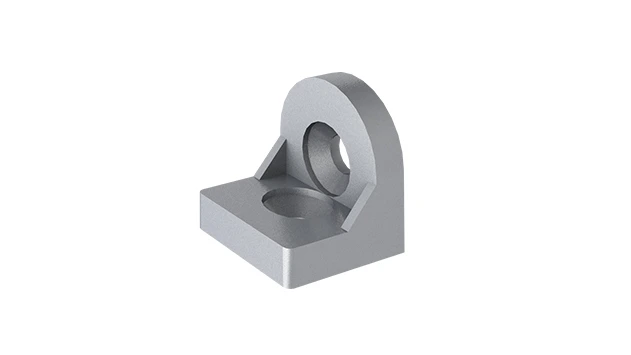
The turning angle aluminum profile connector provides a 90 degree hidden corner connection. 4040 it is means this size is used for 40 series aluminum profile.The corner code comes with set screws that allow for quick, easy connections.
Walk into any modern manufacturing facility, and you'll notice a silent hero holding everything together: the connectors that link aluminum profiles into workbenches, material racks, and assembly lines. These small but critical components dictate how sturdy, flexible, and efficient your workspace can be. Among the many options, two stand out for their ability to shape your operation's backbone: the rigid reliability of the Turning Angle Code 4040 and the adaptable versatility of adjustable connectors. Choosing between them isn't just about hardware—it's about aligning your tools with your workflow. Let's dive into when fixed angles make sense, and when flexibility should take the lead.
What Is the Turning Angle Code 4040, Anyway?
If you've worked with aluminum profiles , chances are you've encountered the 4040 series—the workhorse of industrial framing. These profiles, named for their 40mm x 40mm cross-section, are prized for their balance of strength and lightweight design, making them ideal for everything from workbenches to heavy-duty material racks. But even the sturdiest profile is only as good as the connector holding it in place. That's where the Turning Angle Code 4040 comes in.
Think of the Turning Angle Code 4040 as the "no-nonsense" connector. It's a compact, metal fastener designed to lock two 4040 aluminum profiles at a fixed 90-degree angle (though some variants handle 45-degree or 135-degree angles, the 90-degree is the most common). Made from hardened aluminum or steel, it's built to resist bending or loosening under pressure. Unlike adjustable connectors that rely on hinges or sliding parts, this code uses a simple bolt-and-groove system: you slide it into the T-slots of the profiles, tighten the bolts, and—boom—your angle is set, and it's not going anywhere.
What makes it special? Consistency. Every time you install a Turning Angle Code 4040, you get the exact same angle. No guesswork, no (fine-tuning) needed. For manufacturers who need precision—say, aligning a workbench with a conveyor belt or building a material rack where shelves must sit perfectly level—this consistency is gold. It's also part of a broader ecosystem of aluminum profile accessories , meaning it pairs seamlessly with end caps, gussets, and other components to create a unified, professional setup.
Adjustable Connectors: The Chameleons of Framing
If the Turning Angle Code 4040 is the steady hand, adjustable connectors are the flexible thinkers. These are connectors designed to let you tweak angles after installation—sometimes by a few degrees, sometimes by a full 180. Think of them as the hinges, swivels, and ball joints of the industrial world. Common examples include lean pipe joints (used in flexible lean manufacturing systems), hinge connectors, and multi-angle brackets that let profiles pivot or tilt.
Adjustable connectors thrive in environments where change is the only constant. Let's say you're prototyping a new assembly line layout: one week, you need a 10-degree incline for a roller track; the next, you need it flat to test a different workflow. An adjustable connector lets you loosen a bolt, reposition the angle, and retighten—no need to buy a new part. They're also popular in dynamic settings like packaging facilities, where product sizes change, or in labs where equipment configurations shift based on experiments.
But flexibility comes with trade-offs. Most adjustable connectors have more moving parts, which can mean slightly higher costs and a tiny bit more installation time. They also tend to have lower load capacities than fixed connectors like the Turning Angle Code 4040. A hinge that lets you swivel a shelf might wobble under the weight of 500kg, whereas a fixed angle code would hold it steady. That's not a flaw—it's just a design choice: adaptability over raw strength.

Fixed vs. Adjustable: The Key Differences (At a Glance)
| Factor | Turning Angle Code 4040 | Adjustable Connectors (e.g., Lean Pipe Joints) |
|---|---|---|
| Angle Rigidity | Fixed (90°, 45°, or 135°—no movement after installation) | Variable (adjustable angles, often 0°–180°) |
| Load Capacity | High (handles 500kg+ per connection in 4040 profiles) | Moderate to high (typically 200kg–400kg, depending on design) |
| Installation Time | Fast (bolt-on, no alignment tweaks needed) | Slightly longer (may require angle measurement/alignment) |
| Cost | Lower (simpler design, fewer parts) | Higher (moving parts, precision engineering) |
| Best For | Static setups, heavy loads, precision alignment | Dynamic workflows, frequent reconfigurations, prototyping |

When to Choose the Turning Angle Code 4040: The Case for Fixed Angles
Let's get practical: when does a fixed-angle connector like the Turning Angle Code make more sense than an adjustable one? It all boils down to three factors: stability, consistency, and long-term reliability. Here are the scenarios where fixed angles shine.
1. Heavy-Duty Workstations and Material Racks
Imagine a workbench in an automotive repair shop where mechanics torque bolts all day, or a material rack in a warehouse stacked with 20kg boxes. These setups need to stay rock-solid. A slight wobble in the frame could throw off measurements, damage parts, or even cause safety hazards. The Turning Angle Code 4040 excels here because its fixed 90-degree lock eliminates play between profiles. When paired with 4040 aluminum profiles, it creates a rigid frame that resists twisting, even under repeated stress.
Take Material Rack B (3 row and 3 floor) —a common industrial setup for storing tools or components. Each shelf must support hundreds of kilograms, and they need to line up perfectly to slide bins in and out. Using Turning Angle Code 4040 connectors ensures every vertical post and horizontal beam stays at exactly 90 degrees, so shelves don't sag or tilt over time. Adjustable connectors, while flexible, might loosen slightly under constant load, leading to misalignment down the line.
2. Precision Assembly Lines
In electronics manufacturing, where components are tiny and tolerances are tight, even a 1-degree misalignment can ruin a product. Assembly lines for circuit boards or medical devices often use conveyor belts, inspection stations, and workbenches that must align with millimeter precision. The Turning Angle Code 4040's fixed angle ensures that, for example, a conveyor track stays perfectly parallel to a workbench, so parts glide smoothly without getting stuck.
Adjustable connectors, while useful for testing new layouts, can introduce variability. If a worker accidentally bumps an adjustable joint, the angle might shift, leading to production delays while the line is realigned. Fixed connectors remove that risk—once installed, they stay put, letting teams focus on output rather than constant adjustments.
3. Long-Term, Static Setups
Not every workspace needs to change. A quality control station in a food processing plant, a packaging line that runs the same product for years, or a lab bench for routine testing—these setups are designed to stay consistent. For these, the Turning Angle Code 4040 is a cost-effective choice. Its simple design means fewer parts to wear out, and since you're not paying for adjustability you don't need, it's often cheaper than adjustable alternatives.
Plus, fixed connectors are easier to maintain. There's no need to lubricate hinges or check for loose pivot points—just tighten the bolts during routine inspections, and you're good to go. Over time, this simplicity translates to lower upkeep costs and less downtime.
When Adjustable Connectors Steal the Spotlight
Fixed angles are reliable, but there are times when flexibility matters more. Adjustable connectors—like lean pipe joints or swivel brackets—are the better choice when your workflow demands adaptability. Here's when to reach for them.
1. Prototyping and Short-Run Production
Startups and product development teams rarely stick to one layout. One month, they're testing a new gadget on a small workbench; the next, they're scaling up to a mini assembly line. Adjustable connectors let them reconfigure their space without buying new parts. For example, a lean pipe joint that connects aluminum profiles at variable angles can turn a static workbench into a U-shaped assembly station or a mobile cart in an hour.
In these cases, the extra cost of adjustable connectors pays off in agility. Instead of waiting for custom fixed-angle parts, teams can tweak angles on the fly, test new workflows, and iterate faster. It's like having a workshop that can "learn" and adapt as your needs change.
2. Dynamic Material Handling
Roller tracks, conveyor systems, and turnover trolleys often need to navigate corners or adjust to different product heights. Adjustable connectors shine here. For example, roller track connectors that let you angle a track by 10 degrees can help products flow smoothly around a corner, reducing jams. Similarly, swivel casters (paired with adjustable joints) let trolleys pivot in tight spaces, making it easier to move materials between workstations.
Fixed angles would limit these systems to straight lines or rigid corners, which might not fit the layout of every facility. Adjustable connectors turn material handling into a flexible dance rather than a rigid march.
3. Collaborative or Shared Workspaces
Makerspaces, tech incubators, and university labs are shared by people with wildly different projects. One day, a student might need a low workbench for 3D printing; the next, a researcher might need a tall shelf for lab equipment. Adjustable connectors let the space evolve with its users. A single set of aluminum profiles can become a standing desk, a storage rack, or a display shelf—all by loosening a few bolts and reangling the joints.
The Verdict: It's About Balance
At the end of the day, choosing between the Turning Angle Code 4040 and adjustable connectors isn't about which is "better"—it's about which fits your workflow. Fixed angles are the backbone of stable, high-load, long-term setups. They're the quiet reliability that keeps production lines running and workbenches steady. Adjustable connectors, on the other hand, are the innovators—they let you adapt, experiment, and reimagine your space without starting from scratch.
Many facilities use both. A factory might rely on Turning Angle Code 4040 for its main assembly line (fixed, heavy-duty) but use adjustable lean pipe joints for auxiliary stations that change seasonally. The key is to assess your needs: Do you need precision or flexibility? Heavy loads or frequent reconfigurations? Once you answer those, the choice becomes clear.
So, the next time you're building or upgrading your workspace, take a moment to think about the connectors. They might be small, but they're the difference between a setup that just works and one that works for you . And if you're ever in doubt? Start with fixed angles for the foundation—you can always add adjustable connectors for the parts that need to move.