- Company Articles
- Products and Technology
- Product knowledge
- Turnover Trolleys: Using Four Way Straight Lean Pipe Joint for Mobile Material Handling

Turnover Trolleys: Using Four Way Straight Lean Pipe Joint for Mobile Material Handling
Related Product
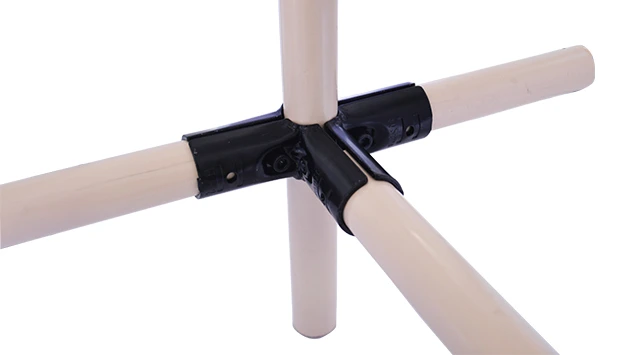
Four Way Straight Lean Pipe Joint
Four way lean pipe joint for 4 pcs 28MM lean pipe connection in straight angle, which used widely in workbench, flow rack, hand trolley frame connection.
Walk into any bustling manufacturing plant, warehouse, or assembly facility, and you'll quickly notice a silent but critical player in the daily rhythm of operations: the turnover trolley. These unassuming wheeled frames glide between workstations, carry raw materials to production lines, and transport finished goods to storage—keeping the entire workflow from stalling. But not all turnover trolleys are created equal. The difference between a trolley that bends under pressure and one that becomes the backbone of your efficiency often comes down to a small but mighty component: the four way straight lean pipe joint.
What Makes Turnover Trolleys Indispensable?
Before diving into the nuts and bolts of joints and pipes, let's take a step back. Why do facilities rely so heavily on turnover trolleys? Imagine a scenario without them: workers hefting heavy bins of components across the floor, tripping over loose cables, or struggling to navigate narrow aisles with awkwardly shaped materials. Not only does this slow down production, but it also increases the risk of injuries and errors. Turnover trolleys eliminate these headaches by putting mobility at the forefront. They're designed to carry loads of all sizes—from small parts bins to bulky machinery components—and their wheeled design means even a single worker can move hundreds of pounds with ease.
But here's the catch: to truly serve their purpose, turnover trolleys need to be adaptable . Every facility has unique needs. A food packaging plant might require trolleys with non-slip surfaces and easy-to-clean frames, while an electronics manufacturer needs ESD-safe (electrostatic discharge) models to protect sensitive components. This is where lean pipe systems shine—and at the heart of that system is the humble joint.
The Four Way Straight Lean Pipe Joint: Small Part, Big Impact
If lean pipe is the "bones" of a turnover trolley, then the four way straight lean pipe joint is the "joint" that holds those bones together—literally. This unassuming component is a small, often metal or plastic connector designed to link up to four lean pipes at 90-degree angles, creating a sturdy, multi-directional frame. Unlike rigid welding or fixed brackets, these joints are modular: you can twist, lock, and reconfigure them without special tools, making it easy to adjust the trolley's size, add shelves, or repair damage on the fly.
Let's break down why this matters. Suppose your assembly line starts producing a new, larger product. With a traditional welded trolley, you'd either have to buy a whole new trolley or hack apart the old one (risking structural damage). But with a trolley built using four way straight lean pipe joints? You simply unscrew a few joints, add longer pipes, and reattach the shelves. It's like building with advanced Lego blocks—for grown-ups who mean business.
Key Benefits of the Four Way Straight Lean Pipe Joint
- Structural Stability: By distributing weight across four connection points, these joints reduce stress on individual pipes, making the trolley frame more resistant to bending or warping—even under heavy loads.
- Customization Freedom: Need a trolley with three shelves instead of two? Want to add side rails to prevent items from sliding off? The four way joint lets you branch out in any direction, no redesign required.
- Quick Assembly & Repair: No welding, no drilling, no waiting for a maintenance crew. Most joints lock into place with a simple hex key or hand twist, so you can assemble a basic trolley in under an hour.
- Cost Efficiency: Instead of replacing entire trolleys when needs change, you just swap out pipes or add joints—saving money on new equipment and reducing waste.

Building Your Trolley: Lean Pipe, Casters, and Everything In Between
Of course, the four way joint doesn't work alone. To build a high-performing turnover trolley, you'll need a few key components—starting with the lean pipe itself. Most lean pipes are made from steel or aluminum (like the aluminum lean pipe you might see in modern facilities), often coated in a durable plastic or powder finish to resist scratches and corrosion. Thickness matters here: a 1.5mm pe coated lean pipe is lightweight enough for easy maneuvering but strong enough to handle daily use, while heavier loads might call for 2.0mm stainless steel pipe series.
Then there are the casters—the "feet" of your trolley. A turnover trolley is only as mobile as its wheels, so choosing the right caster wheel is critical. Swivel casters with brakes are a popular choice: they let you pivot the trolley in tight spaces, and the brake locks the wheels in place when loading or unloading, preventing accidental rolling. Caster accessories like shock-absorbing rubber wheels can also reduce noise on factory floors, making the workplace quieter (and less stressful) for everyone.
To bring it all together, let's visualize the assembly process. Start with a base frame: use four way joints to connect four lean pipes into a rectangle. Add vertical pipes at each corner (again, using four way joints) to form the "legs." Then, attach horizontal pipes between the legs at your desired shelf heights—each shelf supported by, you guessed it, more four way joints. Finally, bolt on casters to the bottom, and you've got a functional trolley. Need to add a handle? Screw a two way lean pipe joint onto one side and attach a pipe—done.
Comparing Lean Pipe Joints: Why Four Way Stands Out
Not all lean pipe joints are created equal. While the four way straight joint is a workhorse, other joints serve specific purposes. Let's compare the most common types to see why four way is a favorite for turnover trolleys:
| Joint Type | Design | Best For | Limitations |
|---|---|---|---|
| Four Way Straight Lean Pipe Joint | Connects 4 pipes at 90° angles (up, down, left, right) | Main frames, shelves, cross-bracing, multi-level trolleys | Bulkier than simpler joints; overkill for straight-line builds |
| Three Way Lean Pipe Joint | Connects 3 pipes (e.g., two horizontal, one vertical) | Corners, L-shaped frames, simple shelves | Limited to 3 directions; less stability for heavy loads |
| Two Way Lean Pipe Joint | Connects 2 pipes in a straight line | Extending pipes, handles, straight rails | No branching; only useful for linear connections |
| 90° Crossing Lean Pipe Joint | Connects 2 pipes crossing at 90° (e.g., one over the other) | Overhead supports, under-shelf storage | Does not add vertical support; weakens under heavy overhead loads |
As you can see, the four way joint offers the most versatility for building sturdy, adaptable frames—exactly what you need for a turnover trolley that might need to evolve with your business.

From Factory Floor to Bottom Line: Real-World Impact
Talk is cheap—let's look at how turnover trolleys built with four way straight lean pipe joints actually improve operations. Take a mid-sized automotive parts manufacturer I worked with a few years back. They were using old, wooden carts that were heavy, prone to splintering, and impossible to customize. Workers spent 20 minutes per shift just wrestling these carts from the warehouse to the assembly line. When a new part size was introduced, the carts couldn't fit the bins, leading to parts being stacked precariously (and occasionally falling, causing delays).
The solution? Switching to turnover trolleys built with 1.5mm pe coated lean pipe and four way straight joints. Within a week, they'd assembled 10 custom trolleys: some with tall shelves for large bins, others with short, wide shelves for small parts. The modular design meant they could add dividers to separate different part types, and the lightweight frames made pushing the trolleys effortless. Workers reported saving 15 minutes per shift, and part damage dropped by 40%. Best of all, when they introduced another new part size a month later, they reconfigured two old trolleys in an hour—no new equipment needed.
This isn't an isolated case. Warehouses using these trolleys report faster order fulfillment, distribution centers see fewer workplace injuries, and small workshops love how they can start with a basic trolley and expand as they grow. The four way joint isn't just a connector—it's a catalyst for efficiency.
Choosing the Right Components: Tips for Success
Ready to build your own turnover trolley? Here's what to keep in mind:
- Start with the load: How much weight will the trolley carry? Heavier loads need thicker lean pipe (2.0mm instead of 1.2mm) and reinforced joints (look for metal, not plastic, four way joints).
- Think about terrain: Smooth factory floors work with standard caster wheels, but uneven surfaces need larger, shock-absorbing wheels. If you're moving trolleys between rooms, consider casters with brakes to prevent rolling on ramps.
- Don't skimp on joints: A cheap plastic joint might save a few dollars upfront, but it'll crack under stress. Invest in high-quality metal joints (like chrome-plated steel) for longevity.
- Partner with a reliable supplier: Sourcing lean pipe, joints, and casters from a single lean pipe supplier simplifies ordering and ensures compatibility. Look for suppliers who offer samples—test a joint and pipe before buying in bulk.
Beyond Trolleys: The Versatility of Lean Pipe Systems
While we've focused on turnover trolleys, the beauty of lean pipe and four way joints is their versatility. Once you've mastered trolley building, you can expand into other tools: workbenches (perfect for assembly lines), flow racks (for gravity-fed material storage), or even turnover trolley and rack combinations for organized storage. It's a modular system that grows with your needs—no more buying one-off equipment that becomes obsolete in a year.
Conclusion: Small Joint, Big Results
In the world of manufacturing and logistics, it's easy to get excited about high-tech robots or fancy software. But sometimes, the most impactful innovations are the simplest: a well-designed joint, a sturdy pipe, and a wheel that rolls smoothly. The four way straight lean pipe joint is one of those innovations. It turns ordinary pipes into extraordinary tools—tools that make workers' lives easier, operations more efficient, and businesses more profitable.
So the next time you see a turnover trolley gliding across a factory floor, take a closer look. Chances are, it's held together by four way joints—quietly doing the hard work that keeps the world of production moving. And if your facility isn't using them yet? It might be time to start. After all, in a world where every second counts, why settle for a trolley that can't keep up?