- Company Articles
- Products and Technology
- Product knowledge
- Using Aluminum Profile 3 Way Connectors for Automated Production Lines

Using Aluminum Profile 3 Way Connectors for Automated Production Lines
Related Product
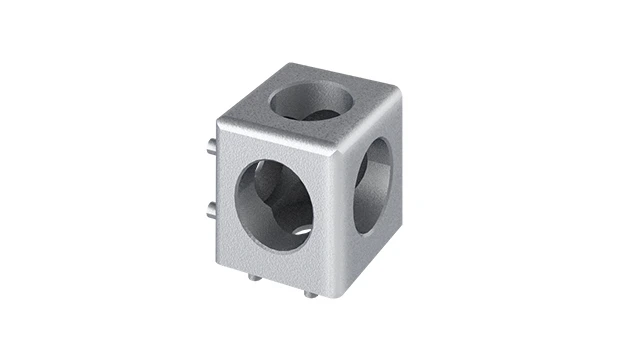
Aluminum Profile 3 Way Connector
The 3 way - squared corner connector is an external fastening method that is typically used to create a corner connection between three profiles. It is a heavy-duty connection that is simple to use and provides a polished look.
Walk into any thriving manufacturing plant today, and you'll notice a quiet revolution unfolding on the factory floor. The rigid, welded steel structures of the past are giving way to sleek, modular setups that adapt as quickly as market demands change. At the heart of this transformation lies a deceptively simple component: the aluminum profile 3 way connector. It's not just a piece of hardware—it's the key to building production lines that can pivot, grow, and evolve without grinding operations to a halt. Let's dive into how these small but mighty connectors are reshaping automated manufacturing, one assembly line at a time.
The Backbone: Aluminum Extrusion Profiles
Before we talk about connectors, let's start with the foundation: aluminum extrusion profiles. These aren't your average metal bars. Created by forcing heated aluminum through a precision die, they emerge with consistent, complex cross-sections—most notably, the iconic T-slots that run along their length. Think of T-slots as built-in highways for accessories: bolts, brackets, shelves, and yes, connectors, all slide in and lock into place without a single drill hole. This design makes aluminum extrusion profiles lightweight (about a third the weight of steel), surprisingly strong (able to support hundreds of pounds), and infinitely customizable. Whether you need a thin rail for a conveyor or a thick beam for a workbench frame, there's a profile for every job.
What really sets these profiles apart, though, is their versatility. In automated production lines, where change is constant, rigidity is the enemy. A welded steel frame might last decades, but if your product line shifts—say, from assembling refrigerators to smart speakers—those steel frames become expensive anchors. Aluminum extrusion profiles? They're more like Lego blocks for adults. And just like Lego needs studs to connect, aluminum profiles need connectors to turn individual pieces into functional systems.
Connectors: The Unsung Heroes of Modularity
Connectors are the glue that holds modular production systems together, but not all connectors are created equal. Some excel at right angles, others at straight-line joins, and a few—like the 3 way connector—are multitaskers, designed to bring three profiles together in a single, sturdy joint. In automated lines, where space is tight and layouts are intricate, this ability to connect multiple directions at once is nothing short of game-changing.
Imagine trying to build a workbench with a shelf above and a tool rack to the side. With basic 90° connectors, you'd need multiple pieces: one to attach the shelf to the main frame, another to add the tool rack, maybe a brace for stability. With a 3 way connector, you can do it in one go—joining the vertical leg, horizontal work surface, and overhead shelf support in a single, secure joint. It's not just about saving time (though that's a big plus); it's about creating cleaner, stronger structures with fewer parts, reducing clutter and potential failure points.

Inside the Aluminum Profile 3 Way Connector
Let's get up close with the star of the show: the aluminum profile 3 way connector. At first glance, it might look like a simple metal block with a few holes, but its design is the result of careful engineering. Most 3 way connectors are made from high-grade aluminum (some heavy-duty versions use steel) to match the profiles they join, ensuring compatibility and reducing corrosion risk. They feature threaded inserts or through-holes that align with the T-slots of the profiles, allowing bolts to pass through and clamp the connector securely in place.
The real magic is in the angles. A good 3 way connector isn't limited to 90° joins. Many are adjustable, letting you set angles between 0° and 180° (for straight lines) or lock into common angles like 45° or 135°. This flexibility means you can build everything from simple rectangular frames to complex, multi-tiered structures. For example, a material rack with sloped shelves (to let parts slide forward) might use 3 way connectors set at 15° angles. A workstation with a tilted monitor mount? 3 way connectors at 30°. The possibilities are as varied as the products rolling off your line.
Installation is refreshingly simple, even for those without advanced engineering skills. No welding torches, no specialized tools—just a hex key (Allen wrench) and a little elbow grease. Slide the connector into the T-slots of the three profiles, align them to your desired angle, insert the bolts, and tighten. If you make a mistake? Loosen the bolts, readjust, and try again. It's a far cry from traditional methods, where a miscalculation might mean cutting new steel or re-welding a joint.

Why 3 Way Connectors Matter in Automated Production
So, what makes 3 way connectors indispensable in automated lines? Let's break it down into five key benefits that directly impact your bottom line:
1. Speed to Adapt : In manufacturing, downtime is money lost. When a new product launch requires a line redesign, or a sudden spike in demand calls for an extra assembly station, 3 way connectors let you build and reconfigure in days, not weeks. A food packaging plant recently used them to add a third packaging line in under 48 hours—simply by repurposing profiles from a low-demand line and repositioning 3 way connectors to form new conveyor supports.
2. Reduced Costs : Traditional retooling often means buying new steel, hiring welders, and paying for installation. Aluminum profiles and 3 way connectors are reusable. That workbench you built for last year's product? Disassemble it, use the profiles and connectors to build a material rack for this year's model. Over time, the savings add up—one automotive supplier reported cutting retooling costs by 60% after switching to modular aluminum systems.
3. Improved Ergonomics : Automated lines aren't just about machines—they're about people, too. Workers who spend hours at fixed-height workbenches often suffer from fatigue or injury. With 3 way connectors, you can adjust workstation heights, add tilting surfaces, or mount tools at eye level in minutes. A electronics manufacturer in Texas saw a 30% drop in worker complaints after reconfiguring their lines with height-adjustable benches using 3 way connectors.
4. Enhanced Safety : Loose bolts, wobbly shelves, and sharp edges are hazards in any factory. 3 way connectors, when installed correctly, create tight, stable joints that minimize movement. Many also feature rounded edges to reduce injury risks, and their compatibility with T-slots means you can add safety accessories like guardrails or light strips without drilling—keeping surfaces smooth and hazard-free.
5. Scalability : As your business grows, your production line should grow with it. 3 way connectors make scaling easy. Need to add a second level to a material rack? Attach new vertical profiles using 3 way connectors. Want to extend a roller track to reach a new station? Join the new section with a 3 way connector at the junction. There's no need to overbuild upfront—start small and expand as needed.
Real-World Applications in Automated Lines
To understand just how versatile 3 way connectors are, let's look at some common applications in automated production lines:
Workbenches with Integrated Storage : The backbone of any assembly line, workbenches need to be sturdy, customizable, and adaptable. With 3 way connectors, you can build a bench with a main work surface, a lower shelf for tools, and an overhead light bar—all connected at the legs. If a worker needs extra space, remove the lower shelf by loosening the 3 way connectors. If the next shift requires a different layout, swap the light bar for a parts bin holder. It's a single structure that transforms with your team's needs.
Multi-Tiered Material Racks : Parts storage is a critical part of flow in automated lines. A well-designed material rack keeps components organized and within arm's reach. 3 way connectors shine here, allowing you to create racks with varying shelf depths, angles, and heights. For example, a rack for small electronic components might have shallow, sloped shelves (using 3 way connectors at 10° angles) to let parts roll forward, while a rack for larger plastic molds could have deep, flat shelves supported by 3 way connectors at 90° angles for maximum stability.
Roller Track Junctions : Roller tracks (or conveyor tracks) keep materials moving from station to station, but they rarely run in straight lines. Merging two tracks, splitting one into two, or redirecting flow around a corner all require precise, strong joints—and that's where 3 way connectors come in. By joining the main track, merging track, and support leg with a 3 way connector, you create a smooth transition that minimizes jams and keeps parts flowing. Add a few roller track accessories like guide rails (easily attached via T-slots), and you've got a custom conveyor system that adapts to your product's path.
Ergonomic Assembly Cells : Modern assembly cells are designed around the worker, not the other way around. That might mean a sit-stand workstation, a tool balancer overhead, and a footrest below. 3 way connectors make it easy to integrate all these elements: the main frame, footrest support, and tool balancer mount can all connect at the base, creating a stable, clutter-free workspace. When a new operator with different height requirements takes over, a quick adjustment of the 3 way connectors lets you raise or lower the entire cell in minutes.
3 Way Connectors and Lean System Principles
Lean manufacturing isn't just a buzzword—it's a philosophy centered on eliminating waste, improving flow, and empowering workers to drive continuous improvement. Aluminum extrusion profiles and 3 way connectors align perfectly with these principles, making them a favorite among lean system adopters.
Take "waste of motion," for example. In a traditional line, workers might walk 10 steps to grab a tool, then 10 steps back to their station. With a modular workbench built using 3 way connectors, you can mount the tool right at the station—no walking required. Or consider "overprocessing": building a custom steel frame for a temporary project, only to scrap it later. With 3 way connectors, that frame can be disassembled and reused, turning waste into value.
Continuous improvement, a cornerstone of lean, is also easier with 3 way connectors. If a team identifies a bottleneck—say, parts are piling up at a certain station—they can quickly reconfigure the roller track using 3 way connectors to add a bypass lane. If a new tool reduces assembly time, they can mount it using T-slots and 3 way connectors without disrupting the line. This ability to experiment, learn, and adjust is what makes lean systems so powerful—and 3 way connectors make it possible without waiting for engineering approvals or contractor visits.
Comparing Connector Types: When to Choose 3 Way
3 way connectors are versatile, but they're not always the best tool for the job. To help you decide when to reach for them (and when to pick another connector), here's a quick comparison of common connector types:
| Connector Type | Primary Use | Load Capacity (Approx.) | Best For | Limitations |
|---|---|---|---|---|
| 3 Way Connector | Joining 3 profiles at angles (0°–180°) | 500–800 lbs per joint | Workbenches, material racks, track junctions | Bulkier than simple connectors; overkill for straight lines |
| 90° Angle Connector | Right-angle joints (e.g., corners) | 600–900 lbs per joint | Square frames, vertical/horizontal joins | Limited to 90° angles; can't connect 3 profiles |
| T-Joint Connector | Adding a perpendicular profile to a main line | 550–750 lbs per joint | Side shelves, tool mounts, branch tracks | Only connects 2 profiles; no angle adjustment |
| Cross Connector | 4-way intersections (e.g., grid structures) | 450–650 lbs per joint | Multi-level shelving, complex frames | Heavy; limited to 90° angles; overkill for simple setups |
As a general rule, 3 way connectors are your go-to when you need to connect three profiles at once or require angle flexibility. For simple right angles, stick with 90° connectors. For adding a single side branch, T-joints work best. The key is to match the connector to the job—using a 3 way where a T-joint would suffice adds unnecessary cost and bulk, while using a T-joint where three profiles meet creates weak, unstable joints.
Installing 3 Way Connectors: Pro Tips for Success
Even the best connectors perform poorly if installed incorrectly. Here are a few tips to ensure your 3 way connectors create strong, reliable joints:
Use the Right Bolts : Most 3 way connectors require bolts that fit the T-slot size of your profiles (common sizes are M5, M6, or M8). Using bolts that are too short won't clamp properly; too long will stick out and create hazards. Always check the connector manufacturer's specs.
Align Before Tightening : It's tempting to tighten bolts as you go, but that can pull profiles out of alignment. Instead, loosely assemble all three profiles and the 3 way connector first, adjust angles and positions, then tighten bolts gradually in a crisscross pattern (like tightening a car tire). This ensures even pressure and a square joint.
Don't Over-Tighten : Aluminum is strong, but it's also prone to stripping if bolts are over-tightened. Use a torque wrench set to the manufacturer's recommended torque (usually 4–6 Nm for M6 bolts) to avoid damaging the T-slots or connector threads.
Add Reinforcements for Heavy Loads : While 3 way connectors are strong, extremely heavy loads (like industrial workbenches holding large machinery) may need extra support. Add gussets (triangular braces) or use two 3 way connectors spaced a few inches apart to distribute weight.
Check for Wobble : After installation, give the structure a gentle shake. A little movement is normal, but significant wobble means something's loose. Recheck bolt tightness and profile alignment—don't ignore it, as wobble can lead to premature wear or failure.
Maintaining Your 3 Way Connectors
Aluminum systems are low-maintenance, but a little care goes a long way in extending their lifespan. Here's how to keep your 3 way connectors (and the rest of your modular system) in top shape:
Inspect Regularly : Once a month, walk your production line and check 3 way connectors for loose bolts, corrosion, or cracks. Pay extra attention to joints that handle heavy loads or vibration (like roller track junctions), as these are more prone to loosening.
Clean T-Slots : Dust, grease, and debris can build up in T-slots, making it hard to adjust connectors later. Use a soft brush or compressed air to clean slots every few months, especially in dusty environments.
Lubricate Threads (If Needed) : If you frequently reconfigure your system, a small amount of anti-seize lubricant on bolt threads can make disassembly easier, especially in humid or corrosive environments.
replace Worn Parts : Bolts and nuts wear out over time, especially if they're loosened and tightened repeatedly. replace any bolts with stripped threads or deformed heads—don't reuse them, as they may fail under load.
The Future of Modular Manufacturing
As automated production lines grow more complex (think collaborative robots, IoT sensors, and AI-driven workflows), the demand for flexible infrastructure will only increase. Aluminum extrusion profiles and 3 way connectors are poised to play an even bigger role, thanks to ongoing innovations like:
Smart Connectors : Imagine 3 way connectors with built-in sensors that monitor bolt tightness or temperature, alerting maintenance teams before a joint fails. Early prototypes are already in testing, and they could revolutionize predictive maintenance.
Lightweight Composites : New composite materials may soon offer the strength of aluminum with even lower weight, making modular systems easier to reconfigure and reducing energy costs for mobile structures like carts.
3D-Printed Custom Connectors : For unique angles or specialized applications, 3D printing could allow manufacturers to create custom 3 way connectors on demand, reducing lead times and opening up new design possibilities.
Final Thoughts: Building for the Future
In the end, aluminum profile 3 way connectors are more than just hardware—they're a mindset. They represent a shift away from "build it once and hope for the best" to "build it to adapt, evolve, and thrive." In a world where consumer demands change overnight and competition never sleeps, that adaptability isn't just a nice-to-have; it's a survival skill.
Whether you're a small manufacturer just starting out or a multinational looking to streamline operations, modular aluminum systems with 3 way connectors offer a path to faster innovation, lower costs, and happier, more productive teams. So the next time you look at your production line, ask: Is this setup holding us back, or helping us move forward? If it's the former, maybe it's time to give 3 way connectors a closer look. Your future self—and your bottom line—will thank you.