- Company Articles
- Products and Technology
- Product knowledge
- Using Flat Rigid Castor Wheels on Conveyors: Fixed Path Precision in Factories

Using Flat Rigid Castor Wheels on Conveyors: Fixed Path Precision in Factories
Related Product
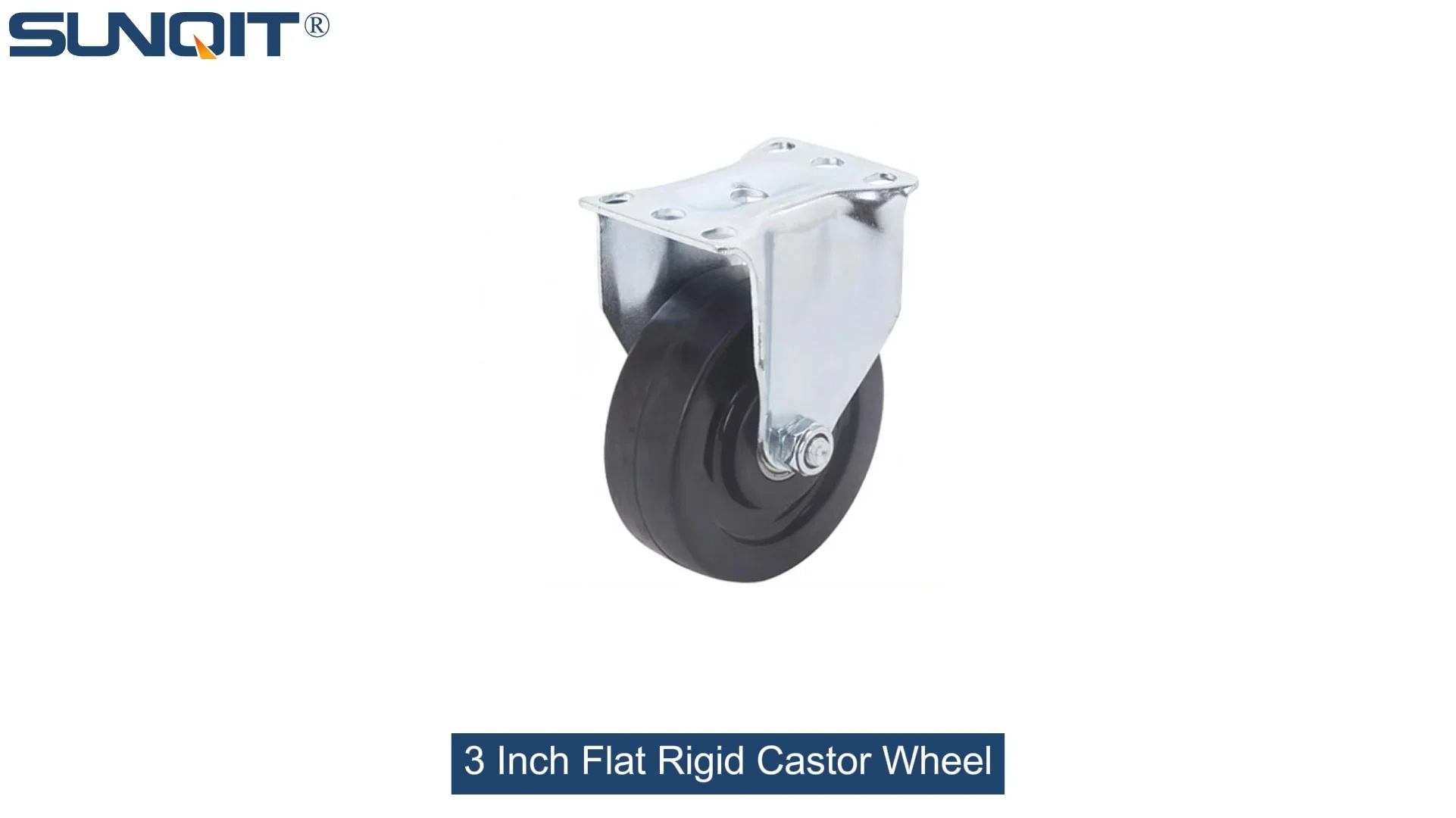
Flat Rigid Castor Wheel
Chair Casters Ball Bearing Wheels Rubber Base. Resistant to abrasion, impact and corrosion. Heavy payload can hold 70Kgs per pcs,which can make it works at a stable and smooth status.
In the heart of every bustling factory, where the rhythm of production hums like a well-tuned symphony, there's an unsung hero working quietly behind the scenes: the humble castor wheel. These small, unassuming components might not grab headlines, but they're the backbone of material movement—ensuring that products, parts, and tools glide seamlessly from one workstation to the next. Among the many types of castors, one stands out for its role in maintaining order and precision: the flat rigid castor wheel. When paired with conveyors, these wheels become the guardians of fixed path precision, turning chaotic workflows into streamlined processes that align with the core principles of lean manufacturing. Let's dive into how flat rigid castor wheels transform conveyor systems, why they're indispensable in modern factories, and how they contribute to the efficiency that keeps production lines running like clockwork.
What Are Flat Rigid Castor Wheels, Anyway?
Before we get into their role on conveyors, let's start with the basics: what makes a flat rigid castor wheel different from the swivel casters you might see on office chairs or shopping carts? First, "rigid" means these castors don't swivel. Unlike swivel casters, which can rotate 360 degrees to maneuver around obstacles, flat rigid castor wheels are fixed in direction—they only roll forward or backward along a straight path. Then there's the "flat" part: the mounting plate, which attaches the wheel to the conveyor or trolley, is designed to lie flat against the surface, providing a stable, low-profile connection that minimizes wobble. Combine these two features, and you get a castor that prioritizes stability, predictability, and load-bearing capacity over flexibility.
These wheels are typically made from durable materials like hardened steel, polyurethane, or rubber, depending on the application. Steel wheels, for example, excel in heavy-duty environments where they might carry hundreds of pounds of machinery parts, while polyurethane wheels offer better shock absorption and noise reduction—ideal for electronics factories where delicate components are in transit. The "flat" mounting plate isn't just for show, either: it distributes weight evenly across the castor, reducing stress on both the wheel and the conveyor frame. This design choice is critical in factories, where even a small imbalance can lead to jams, delays, or worse—damaged products.
Conveyors: The Backbone of Factory Material Flow
To understand why flat rigid castor wheels matter, we first need to appreciate the role of conveyors in modern manufacturing. Conveyors are the arteries of a factory, moving materials, subassemblies, and finished products between workstations, assembly lines, and storage areas. From roller conveyors that let gravity do the work to motorized belt conveyors that transport goods uphill, these systems eliminate the need for manual lifting and carrying, cutting down on labor costs and human error. But here's the thing: a conveyor is only as reliable as the components that keep it moving. If the wheels or tracks fail, the entire line can grind to a halt, costing factories thousands of dollars in downtime.
Consider a typical automotive assembly line. Car frames, engines, and door panels need to move precisely from one station to the next—from welding to painting to final assembly. A single misalignment could mean a door panel doesn't fit correctly, or a wiring harness gets snagged. That's where precision comes in. Conveyors must follow a fixed path with minimal deviation, ensuring that parts arrive at the right place, at the right time, and in the right orientation. This is where flat rigid castor wheels step up: their fixed direction and stable mounting make them perfect for keeping conveyor trolleys or carts on track, even when carrying heavy or awkwardly shaped loads.

Fixed Path Precision: Why It's Non-Negotiable in Factories
"Fixed path precision" might sound like industry jargon, but it's a simple concept with huge implications for factory efficiency. In manufacturing, every inch matters. If a conveyor drifts even a few centimeters off course, it could cause a part to miss a robotic arm's grip, collide with a workstation, or fall off the track entirely. For factories that operate on tight schedules—especially those using lean manufacturing principles—consistency is key. Lean systems, which focus on eliminating waste and maximizing value, rely on predictable workflows. When materials move exactly where they're supposed to, when they're supposed to, there's less waiting, less rework, and more time spent on value-adding tasks.
Flat rigid castor wheels excel at maintaining this precision. Because they don't swivel, they resist the urge to "wander" off track, even when the conveyor hits a bump or the load shifts. Imagine a roller track conveyor used to move circuit boards in a smartphone factory. These boards are tiny, fragile, and expensive—one wrong move could scratch a circuit or dislodge a component. With flat rigid castor wheels, the roller track stays aligned, ensuring each board glides smoothly from the soldering station to the quality control bench. There's no guesswork, no sudden turns, just a straight, steady path that keeps production on schedule.

Flat Rigid Castor Wheels vs. Other Castor Types: A Side-by-Side Comparison
You might be wondering: if swivel casters are so maneuverable, why not use them on conveyors? The answer lies in trade-offs. Swivel casters are great for situations where you need flexibility—like moving a tool cart from one workstation to another—but they're not built for the repetitive, straight-line movement of a conveyor. Let's break down the differences with a quick comparison:
| Feature | Flat Rigid Castor Wheels | Swivel Casters (with Brake) | Swivel Casters (No Brake) |
|---|---|---|---|
| Movement | Fixed direction (straight line only) | 360° swivel; can lock direction with brake | 360° swivel; no locking mechanism |
| Stability | High (low center of gravity, flat mounting) | Medium (can wobble when unlocked) | Low (prone to drifting) |
| Best For | Conveyors, fixed-path trolleys, heavy loads | Tool carts, mobile workbenches, occasional movement | Lightweight carts, temporary storage |
| Precision | Excellent (no deviation from path) | Good (when braked), poor (when unlocked) | Poor (unpredictable direction) |
| Load Capacity | High (up to 1,000+ lbs per castor) | Medium (200–500 lbs per castor) | Low (under 200 lbs per castor) |
As the table shows, flat rigid castor wheels are the clear choice when precision and stability are non-negotiable. Swivel casters have their place, but on a conveyor system that's supposed to move products in a straight line for 8+ hours a day, the last thing you want is a wheel that decides to "take a detour." Flat rigid castors eliminate that risk, ensuring the conveyor stays on track, no matter how long the production run.

How Flat Rigid Castor Wheels Support Lean Systems
Lean manufacturing isn't just a buzzword—it's a philosophy that centers on eliminating waste (muda) and creating value for customers. Waste can take many forms: overproduction, waiting, defects, or unnecessary movement. Flat rigid castor wheels contribute to lean systems by reducing two of these wastes: waiting and unnecessary movement. Here's how:
First, by keeping conveyors moving predictably, flat rigid castor wheels reduce waiting time. When materials arrive at workstations exactly when they're needed, workers don't have to pause production to fetch parts or troubleshoot jams. This aligns with the "just-in-time" (JIT) principle of lean, where inventory is delivered as it's used, minimizing storage costs and waste. Second, their fixed-path design eliminates unnecessary movement. In a lean system, every step should add value; a conveyor that veers off course forces workers to stop, adjust, and possibly rework products—all non-value-adding activities. Flat rigid castors prevent that, keeping the flow smooth and focused on what matters: building quality products.
Take, for example, a food packaging plant that uses roller conveyors to move boxes from the filling station to the sealing machine. If the conveyor's wheels are wobbly or swivel unexpectedly, boxes might tip over, spill their contents, or miss the sealing mechanism entirely. That's waste in action: wasted product, wasted time cleaning up, and wasted labor reprocessing the boxes. By switching to flat rigid castor wheels, the plant ensures boxes move in a straight line, reducing spills by 90% and cutting sealing machine downtime by 2 hours per day. That's lean in practice—small changes to components leading to big improvements in efficiency.
Real-World Applications: Where Flat Rigid Castor Wheels Shine
To really grasp their impact, let's look at a few industries where flat rigid castor wheels are indispensable. These examples show how these small components make a big difference in day-to-day operations:
Automotive Manufacturing
Automotive factories are known for their massive, high-speed assembly lines. Car bodies, for instance, are often moved along overhead conveyors, but smaller components—like engine blocks or door panels—ride on floor-level roller conveyors equipped with flat rigid castor wheels. These conveyors need to align perfectly with robotic arms that weld, paint, or bolt parts into place. A misalignment of even a few millimeters could cause a robot to drill a hole in the wrong spot, ruining the part. Flat rigid castors ensure the conveyor stays on track, so the robot's programming remains accurate, and defects stay to a minimum.
Electronics Assembly
In electronics factories, where components like circuit boards (PCBs) are tiny and delicate, precision is everything. PCB assembly lines often use low-profile roller conveyors with polyurethane flat rigid castor wheels. The soft polyurethane reduces vibration, protecting sensitive electronics from damage, while the rigid design ensures PCBs move in a straight line through soldering, testing, and packaging stations. Without these castors, PCBs might shift, leading to misaligned solder joints or failed quality checks—costly mistakes in an industry where margins are tight.
Warehouse Distribution Centers
While warehouses might not be "factories" in the traditional sense, they rely heavily on conveyors to sort and ship packages. In these settings, gravity-fed roller conveyors with flat rigid castor wheels are common. These conveyors use the weight of packages to move them down a slight incline, and the rigid wheels ensure packages don't get stuck or veer into the wrong sorting lane. During peak seasons like the holidays, when warehouses process thousands of packages per hour, the last thing they need is a conveyor jam. Flat rigid castors keep the flow steady, ensuring packages reach their destinations on time.
Choosing the Right Flat Rigid Castor Wheel for Your Conveyor
Not all flat rigid castor wheels are created equal. To get the most out of your conveyor system, you'll need to choose the right wheel for your specific needs. Here are the key factors to consider:
Load Capacity
First and foremost: how much weight will the conveyor be carrying? Flat rigid castor wheels come in a range of load capacities, from 100 lbs per wheel for light-duty applications (like moving empty boxes) to over 1,000 lbs per wheel for heavy machinery parts. Always err on the side of caution—overloading a castor can lead to premature wear, wheel failure, or even conveyor collapse. A good rule of thumb: calculate the total weight of the conveyor plus its maximum load, then divide by the number of castors to get the required capacity per wheel. Add a 20% buffer to account for uneven weight distribution.
Wheel Material
As mentioned earlier, wheel material depends on the environment. Steel wheels are durable and affordable but can be noisy and may scratch floors. Polyurethane wheels are quieter, non-marking, and offer better traction—great for cleanrooms or facilities with polished concrete floors. Rubber wheels are ideal for outdoor or rough surfaces, as they absorb shocks and handle debris well. For high-temperature environments (like foundries), look for heat-resistant materials like phenolic resin.
Wheel Diameter
Bigger isn't always better when it comes to wheel diameter. Larger wheels roll more easily over uneven surfaces, but they raise the conveyor's center of gravity, increasing the risk of tipping. Smaller wheels are more stable but may struggle with cracks or debris on the factory floor. Most conveyor systems use wheels between 2 and 6 inches in diameter, with 3–4 inches being the sweet spot for general-purpose use.
Mounting Plate Size
The "flat" in flat rigid castor wheel refers to the mounting plate, and its size matters for stability. A larger plate distributes weight more evenly, reducing stress on the conveyor frame. Measure the available space on your conveyor or trolley before choosing a castor—you don't want the plate to hang over the edge, as that can catch on obstacles or cause imbalance.
Maintenance: Keeping Your Castors Rolling Smoothly
Even the best flat rigid castor wheels won't last forever without proper care. Regular maintenance not only extends their lifespan but also ensures they continue to provide the precision your conveyor needs. Here's a quick maintenance checklist to follow:
- Clean the wheels weekly: Factory floors can accumulate dirt, oil, and debris, which can get stuck in wheel bearings or between the wheel and mounting plate. Use a brush or compressed air to remove buildup, and wipe wheels with a damp cloth if they're greasy.
- Lubricate bearings monthly: Dry bearings cause friction, which leads to noise, heat, and premature wear. Use a lithium-based grease or machine oil (check the manufacturer's recommendations) to lubricate the wheel bearings. Avoid over-lubricating, as excess grease can attract dirt.
- Check for wear and tear: Inspect wheels for cracks, flat spots, or uneven tread. If a wheel is worn down more than 10%, replace it immediately—worn wheels can cause the conveyor to wobble or drift. Also, check the mounting plate bolts to ensure they're tight; loose bolts can lead to instability.
- Align the castors annually: Over time, even rigid castors can become misaligned due to frame warping or uneven floors. Use a straightedge to check that all castors are pointing in the same direction. If not, adjust the mounting plate or replace bent components.
By following these steps, you can extend the life of your flat rigid castor wheels from 2–3 years to 5+ years, saving your factory money on replacements and reducing downtime.
The Future of Flat Rigid Castor Wheels: Smart Factories and Beyond
As factories become smarter and more automated, even small components like castor wheels are evolving. Today's flat rigid castor wheels are being integrated with sensors that monitor temperature, vibration, and wear, sending real-time data to factory management systems. This "predictive maintenance" allows teams to replace wheels before they fail, preventing unplanned downtime. For example, a sensor might detect that a wheel's bearing is heating up—an early sign of failure—and alert maintenance staff to replace it during the next scheduled break.
Another trend is the use of lightweight materials. Aluminum and composite wheels are becoming more popular, as they offer the same strength as steel but with less weight—reducing the load on conveyor motors and improving energy efficiency. And for factories focused on sustainability, recycled polyurethane wheels are gaining traction, offering the same performance as new materials while reducing environmental impact.
Conclusion: Small Components, Big Impact
Flat rigid castor wheels might not be the most glamorous part of a factory, but they're a testament to the idea that great efficiency comes from attention to detail. By ensuring conveyors stay on track, reducing waste, and supporting lean systems, these unassuming components play a critical role in keeping production lines moving, products flowing, and customers happy. Whether you're building cars, assembling electronics, or packaging food, the right flat rigid castor wheels can turn a good conveyor system into a great one—one that's reliable, precise, and built to last.
So the next time you walk through a factory and hear the steady hum of a conveyor, take a moment to look down. Chances are, you'll see flat rigid castor wheels hard at work, doing what they do best: keeping everything moving forward, one straight line at a time.