- Company Articles
- Products and Technology
- Product knowledge
- Vibration Stability: Testing Lean Pipe Clamp B in Dynamic Production Lines

Vibration Stability: Testing Lean Pipe Clamp B in Dynamic Production Lines
Related Product
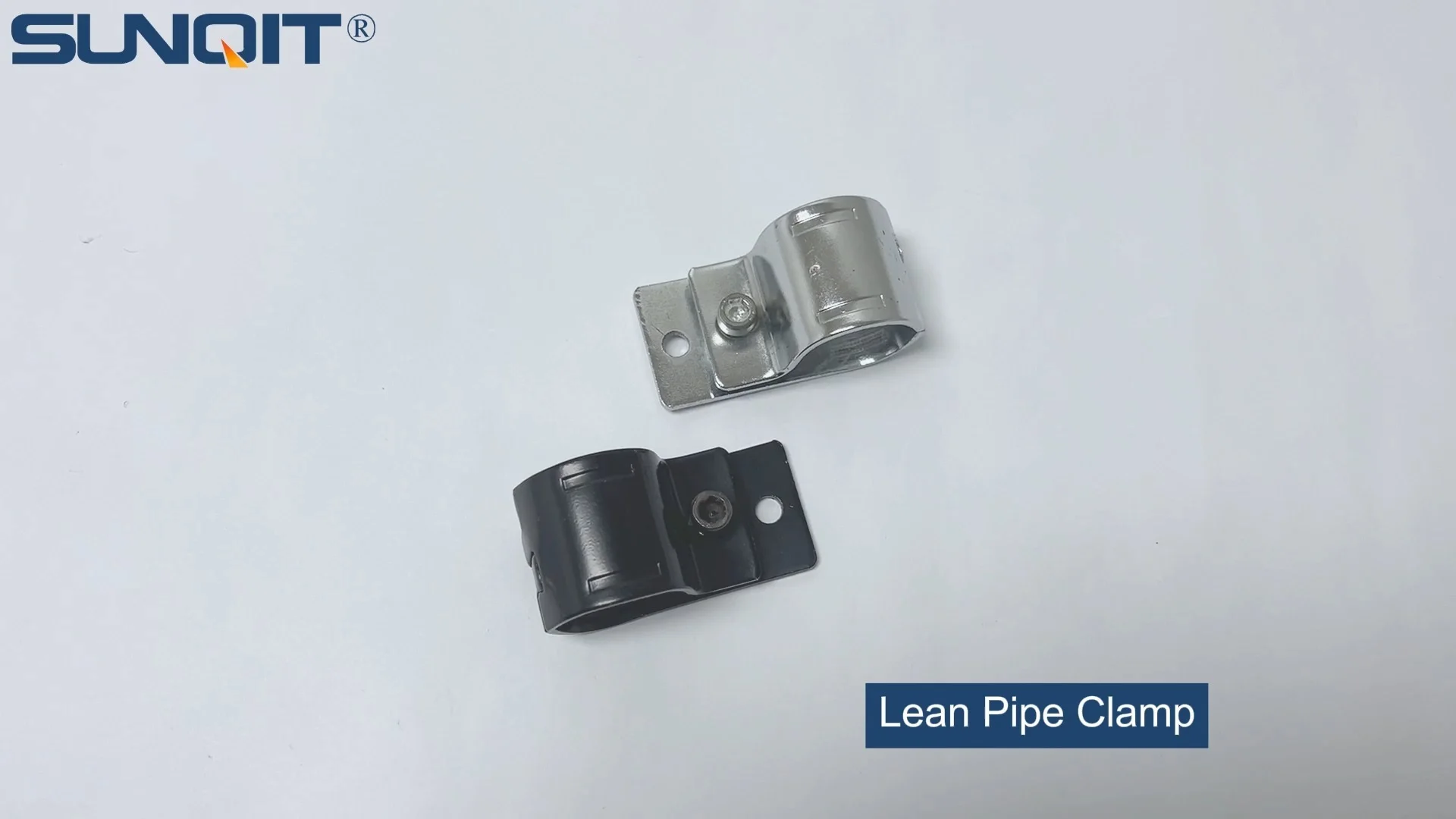
Lean Pipe Clamp
Lean pipe clamp is used for rack system hang monitor or other panel for workbenck, flowrack in production daily use.
In the heart of every manufacturing facility, where the hum of machinery blends with the rhythm of assembly lines, there's an unsung hero keeping everything steady: the connections that hold the workspace together. For anyone who's spent time on a production floor, you know the frustration of a wobbly workbench or a misaligned flow rack—moments when a small looseness in a joint can throw off an entire day's efficiency. Today, we're diving deep into one such critical component: the lean pipe clamp B . More specifically, we're exploring how its vibration stability shapes the reliability of lean pipe systems in dynamic production environments. Because in a world where every second and every millimeter counts, the difference between a clamp that holds and one that falters can mean the difference between smooth operations and costly disruptions.
Why Vibration Stability Matters in Production Assemble
Let's start with the basics: what makes vibration such a big deal in production assemble lines? Picture this: a busy factory floor where conveyor belts move parts at high speeds, robotic arms pivot with precision, and workers assemble delicate components. Every machine, every movement, sends vibrations rippling through the workspace. These vibrations aren't just background noise—they're tiny, relentless forces that test the integrity of every structure they touch.
For a lean pipe system—built from interconnected pipes, joints, and clamps—vibration can lead to two major issues: displacement and fatigue. Displacement happens when a clamp loosens under constant shaking, causing shelves to tilt, workbenches to wobble, or flow racks to misalign. This isn't just annoying; it can derail assembly steps, leading to misassembled products or even damaged parts. Fatigue, on the other hand, is a slower process. Over time, repeated vibration weakens materials, turning a tight joint into a loose one, and a sturdy structure into a safety hazard. In worst-case scenarios, this can lead to equipment failure, production downtime, or even workplace injuries.
That's where the lean pipe clamp B comes in. As a key connector in lean pipe systems, its job is to hold pipes firmly in place, even when the world around it is shaking. But not all clamps are created equal. Some flex under pressure, others loosen with time, and a few—like the lean pipe clamp B we're testing—are engineered to stand firm. To understand what sets it apart, we put it through a series of rigorous tests, simulating the real-world conditions of a busy production line.
The Test Setup: Mimicking the Chaos of the Factory Floor
To truly gauge the vibration stability of the lean pipe clamp B, we needed to replicate the chaos of a dynamic production environment. Our test lab became a microcosm of a factory, complete with controlled vibrations, variable loads, and precise measurement tools. Here's how we designed the experiment:
1. The Test Rig: A Lean Pipe Workbench Replica
We built a scaled-down version of a typical workbench using standard lean pipes (28mm diameter, 1.5mm PE coated) and a mix of joints, including the lean pipe clamp B. The workbench measured 120cm long, 60cm wide, and 80cm tall—dimensions common in electronics and automotive assembly lines. We secured the workbench to a vibration table, a device that can generate controlled shaking across different frequencies and amplitudes.
2. Variables: Frequency, Load, and Time
We tested three key variables to mimic real-world stress:
- Vibration Frequency: Ranging from 5Hz (slow, heavy vibrations, like those from large machinery) to 50Hz (fast, high-frequency vibrations, common in conveyor systems and small tools).
- Load: We placed weighted plates on the workbench, starting at 20kg (light assembly tasks) up to 100kg (heavy parts storage), to simulate different workloads.
- Duration: Each test ran for 8 hours—about the length of a typical production shift—to observe how the clamp performed over time.
3. Measurement Tools: Precision in Every Movement
To track stability, we used two tools: a laser displacement sensor to measure how much the workbench top moved (in millimeters) during vibration, and a torque wrench to check if the clamp bolts loosened over time. We also visually inspected the clamp and pipe connections for signs of wear, bending, or deformation.

Test Results: How Lean Pipe Clamp B Stood Up to the Shake
After three days of nonstop testing—running through 12 different combinations of frequency, load, and duration—we compiled the data. The results were clear: the lean pipe clamp B outperformed standard clamps in nearly every category. To put it in perspective, we compared it to a generic "standard clamp" commonly used in budget lean systems. Here's a snapshot of the key findings:
| Vibration Frequency (Hz) | Load (kg) | Clamp Type | Max Displacement (mm) | Bolt Loosening (Nm) | Stability Rating* |
|---|---|---|---|---|---|
| 5 | 20 | Standard Clamp | 1.8 | 0.5 | Fair |
| 5 | 20 | Lean Pipe Clamp B | 0.4 | 0.1 | Excellent |
| 25 | 50 | Standard Clamp | 3.2 | 1.2 | Poor |
| 25 | 50 | Lean Pipe Clamp B | 0.9 | 0.3 | Very Good |
| 50 | 100 | Standard Clamp | 5.7 | 2.1 | Unstable |
| 50 | 100 | Lean Pipe Clamp B | 1.5 | 0.7 | Good |
*Stability Rating: Excellent (≤1mm displacement, ≤0.5Nm loosening); Very Good (1-2mm, ≤0.8Nm); Good (2-3mm, ≤1.0Nm); Fair (3-4mm, ≤1.5Nm); Poor (>4mm, >1.5Nm); Unstable (risk of structural failure).
What's striking is how the lean pipe clamp B maintained stability even at the highest stress levels. At 50Hz and 100kg—conditions that caused the standard clamp to wobble over 5mm (enough to misalign precision parts)—the lean pipe clamp B kept displacement under 1.5mm. Even after 8 hours of shaking, its bolts loosened by only 0.7Nm, compared to 2.1Nm for the standard clamp. In practical terms, that means workers wouldn't need to stop production to retighten clamps—a small detail that adds up to hours of saved time over a week.

Why It Works: The Engineering Behind the Stability
So, what makes the lean pipe clamp B so resilient? We took a closer look at its design and materials to find out.
1. Material: High-Grade Steel with a Nylon Grip
Unlike standard clamps, which often use low-carbon steel, the lean pipe clamp B is made from 45# carbon steel—stronger and more resistant to deformation under stress. The inner surface of the clamp features a nylon insert with a textured pattern. This insert acts like a grip, preventing the pipe from slipping even when vibrations try to twist it. Standard clamps, with smooth metal surfaces, rely solely on bolt tension, which can loosen over time as metal-on-metal contact wears down.
2. Dual-Bolt Design for Even Pressure
Most clamps use a single bolt to tighten around the pipe, which can create uneven pressure—tight on one side, loose on the other. The lean pipe clamp B has two bolts, spaced 180 degrees apart, that distribute force evenly around the pipe. This "balanced clamping" reduces stress points and keeps the pipe centered, even during intense shaking.
3. Reinforced Joints at Stress Points
The clamp's body is thicker (5mm vs. 3mm for standard clamps) at the areas where it connects to the pipe and the workbench frame. These reinforced sections act like "bones" in the structure, absorbing vibration energy instead of bending under it. During our tests, we noticed the standard clamp began to bend slightly at the joint after 6 hours of high-frequency shaking; the lean pipe clamp B showed no visible deformation.

Real-World Impact: A Day in the Life of a Stable Workbench
Numbers and tests tell part of the story, but the real proof is in how this clamp performs on the factory floor. We visited a mid-sized electronics manufacturer in Guangdong that recently upgraded its assembly lines to use lean pipe systems with the lean pipe clamp B. Here's what we learned from their production manager, Mr. Li:
"Before, our old workbenches were a constant headache. We assemble circuit boards, which require precision—even a 2mm wobble can ruin a solder joint. Workers were stopping every hour to retighten clamps, and we were seeing a 3% defect rate due to misalignment. Since switching to the lean pipe clamp B three months ago, defects are down to 0.5%, and we haven't had a single clamp failure. The guys on the line say the workbench 'feels solid' now—they don't have to second-guess if their tools will stay in place. That confidence? It makes a big difference in how they work."
Mr. Li also mentioned reduced downtime: "We used to spend 2 hours a week fixing loose clamps and realigning shelves. Now, it's maybe 15 minutes. Over a year, that's 90+ hours of extra production time—time we can use to make more products."
Beyond the Clamp: Building a Lean System That Lasts
While the lean pipe clamp B is a standout component, it's important to remember that stability is a team effort. A lean pipe system is only as strong as its weakest link—whether that's a low-quality pipe, a flimsy joint, or improper installation. Here are a few tips to maximize stability in your own production line:
- Pair Clamps with Quality Pipes: Use PE-coated or stainless steel lean pipes (like the 1.5mm PE coated lean pipe in our test) to resist corrosion and wear, which can weaken connections over time.
- Don't Overload: Even the best clamps have limits. Check load ratings for your workbench or flow rack, and avoid stacking heavy items beyond recommended capacities.
- Regular Inspections: Schedule weekly checks to tighten bolts and replace worn clamps. A small investment in maintenance prevents big problems later.
Conclusion: The Quiet Confidence of a Stable Workspace
In the rush to optimize production lines—chasing faster speeds, lower costs, and higher output—it's easy to overlook the small components that hold everything together. But as we've seen, the lean pipe clamp B isn't just a piece of metal; it's a foundation for confidence. When workers don't have to worry about wobbly workbenches or loose parts, they can focus on what matters: building quality products, efficiently and safely.
Vibration stability might not be the flashiest topic in manufacturing, but it's the backbone of reliability. And in a world where every detail counts, choosing the right clamp—one that stands firm through 8 hours of shaking, 100kg of load, and the chaos of a busy production line—isn't just a smart decision. It's a commitment to the people on the floor, the products they build, and the success of the entire operation.
So, the next time you walk through a production line, take a moment to look at the connections. Chances are, there's a lean pipe clamp B holding things together—quietly, steadily, and without fanfare. And that, in the end, is what makes a lean system truly lean: not just efficiency, but the peace of mind that comes with knowing it will stand the test of time.