- Company Articles
- Products and Technology
- Solution
- Warehouse Logistics Optimization with 3060 National Standard Profile A Racks

Warehouse Logistics Optimization with 3060 National Standard Profile A Racks
Related Product
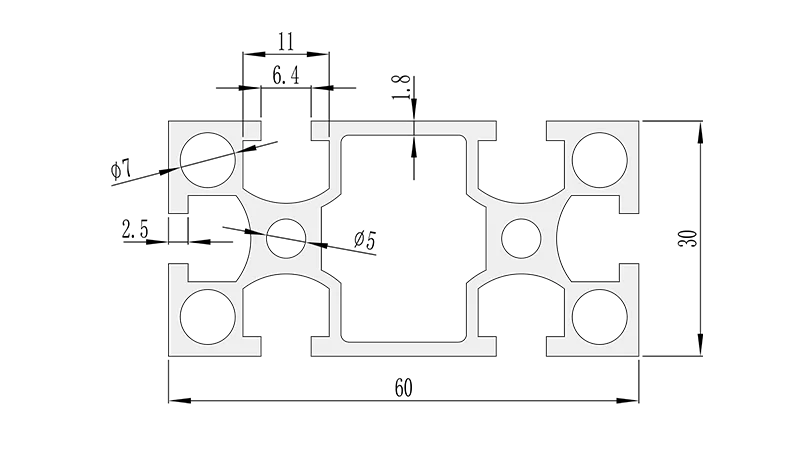
3060 National Standard Profile A
Workbench, production line, logistic rack, warehouse rack Industry: Manufacturer workshop, Automobile, Electronic, Assembling, logistic
Walk into any modern warehouse, and you'll likely be met with a symphony of movement: forklifts gliding down aisles, workers picking orders at lightning speed, and conveyor belts humming as packages make their way to shipping. But beneath this busy surface, many warehouses grapple with silent productivity killers: cluttered storage areas that waste precious square footage, rigid shelving systems that can't adapt to shifting inventory needs, and slow material flow that leaves workers waiting instead of working. These inefficiencies don't just hurt the bottom line—they drain employee morale and make it harder to keep up with customer demands. That's where 3060 National Standard Profile A racks come in. More than just storage solutions, these aluminum extrusion profiles are reshaping how warehouses operate, turning chaos into clarity and inefficiency into streamlined success.
The Problem with "One-Size-Fits-All" Warehouse Systems
Traditional warehouse setups often rely on heavy steel racks or fixed wooden shelving—solutions designed for stability but little else. Steel racks, while strong, are notoriously hard to reconfigure. If your business shifts from storing small electronics to larger appliances, you might need to tear out entire sections and start over, costing time and money. Wooden shelves, on the other hand, warp over time, can't handle heavy loads, and offer zero flexibility. Even worse, these systems rarely integrate well with other logistics tools like flow racks or roller tracks , creating disconnected workflows where materials get stuck in "dead zones" between storage and production.
Then there's the human factor. Workers spend hours navigating narrow aisles, bending to reach low shelves, or stretching for high ones—all while juggling clipboards or scanning devices. These repetitive motions lead to fatigue and errors, and in a worst-case scenario, injuries. Add in the pressure to meet tight shipping deadlines, and it's clear: warehouses need a system that works with their teams, not against them.
3060 National Standard Profile A Racks: A Modern Solution for Modern Challenges
Enter 3060 National Standard Profile A racks. Made from high-quality aluminum extrusion profiles, these systems are built on three core principles: flexibility, durability, and integration. Let's break down what makes them stand out.
Lightweight Strength: The Power of Aluminum Extrusion
Aluminum is the unsung hero here. Unlike steel, it's lightweight—making the profiles easy to carry, lift, and assemble without heavy machinery. But don't let the weight fool you: 3060 National Standard Profile A is engineered to be surprisingly strong. Thanks to the extrusion process, where aluminum is forced through a die to create uniform cross-sections, these profiles boast impressive load-bearing capabilities. Depending on the configuration, a single shelf can hold up to 500kg—plenty for cartons, tools, or even small pallets. And because aluminum resists corrosion, these racks thrive in diverse environments, from dry manufacturing floors to humid cold storage units—no rust, no degradation, just long-lasting performance.
Modular by Design: Build What You Need, When You Need It
The real magic lies in their modularity. 3060 profiles aren't just "shelves"—they're building blocks. With a range of aluminum profile accessories like internal straight aluminum joints, end caps, and pipe sleeves, you can assemble everything from simple storage racks to complex picking stations. No welding, no drilling, no specialized tools—just tighten a few screws, and you're done. Need to add a shelf? Slide in a new profile. Want to widen an aisle? Disassemble a section in minutes. This flexibility means your warehouse can adapt to seasonal spikes, new product lines, or sudden shifts in demand without skipping a beat.
Take, for example, a warehouse gearing up for Black Friday. In August, they need extra storage for holiday inventory; by January, that space should convert back to picking zones. With traditional steel racks, this would require days of downtime and a team of contractors. With 3060 profiles? Their own staff can reconfigure the system over a weekend, using internal straight aluminum joints to quickly adjust shelf heights and add temporary flow racks for fast-moving items. It's logistics on demand.
Seamless Integration: Connecting Storage, Flow, and Work
What truly sets 3060 National Standard Profile A apart is how well it plays with others. These racks don't exist in isolation—they're part of a larger ecosystem that includes flow racks, roller tracks , and even workbenches . Let's see how this integration transforms day-to-day operations.
Flow Racks: Let Gravity Do the Work
Flow racks are a cornerstone of lean logistics, using gravity to move materials from receiving to picking areas. And 3060 profiles are the perfect frame for them. By attaching roller tracks (fitted with 1-inch swivel roller balls or plastic guide rails) to the aluminum profiles, you create a smooth, downward slope where boxes or totes glide forward automatically. This eliminates the need for workers to walk back and forth to restock shelves—instead, they load items at the "upstream" end, and gravity feeds them to the picking side. It's FIFO (first-in, first-out) inventory management made easy, reducing the risk of expired stock and cutting picking time by up to 30%.
For example, a cosmetics warehouse using 3060-based flow racks noticed an immediate difference. Previously, workers spent 20 minutes per hour restocking low shelves; with the new system, restocking happens once a shift, and picking errors dropped by 15%. "It's like having an extra pair of hands," one supervisor noted. "The racks do the heavy lifting, so our team can focus on accuracy."
Workbench Integration: From Storage to Station in Seconds
Picking and packing stations are the heart of any warehouse, and 3060 profiles make them smarter. By combining racks with workbenches (think: flat surfaces built from aluminum honeycomb panels), you create ergonomic hubs where storage and work happen in one place. Need a packing station? Attach a workbench to a flow rack, add a roller track for incoming totes, and position a barcode scanner mount—all using the same 3060 profiles. Workers can pick items from the flow rack, pack them on the bench, and slide them onto a conveyor—no steps wasted.
Ergonomics matter here, too. 3060 profiles let you adjust workbench heights to match your team's needs—no more hunching or straining. Add a few caster wheels , and the entire station can roll to where it's needed most, whether that's near a loading dock or beside a production line. It's logistics tailored to people , not the other way around.
How 3060 Racks Support Lean Systems
At their core, 3060 National Standard Profile A racks are more than storage—they're enablers of lean systems . Lean logistics is all about eliminating waste: wasted time, wasted space, wasted effort. These racks check every box.
- Waste of Space: Modular design means you use only the space you need. No more overbuilt steel racks taking up half the warehouse. Add or remove shelves as inventory fluctuates, and even stack racks vertically to maximize height.
- Waste of Motion: Integrated flow racks and roller tracks cut down on walking and reaching. Materials come to the worker, not the other way around.
- Waste of Time: Fast assembly and reconfiguration mean minimal downtime. Need to pivot from storing bulk goods to small parts? Do it in hours, not days.
- Waste of Inventory: FIFO flow racks reduce expired or obsolete stock, keeping inventory fresh and accurate.
A manufacturing plant in Guangdong put this to the test. They'd long struggled with rigid steel racks that made it hard to implement 5S (a key lean methodology focused on organization). After switching to 3060 profiles, they reorganized their warehouse in a week: "Sort" (removed unused items), "Set in Order" (assigned specific spots using labeled 3060 shelves), "Shine" (easy-to-clean aluminum surfaces), "Standardize" (uniform rack configurations), and "Sustain" (quick to adjust as workflows evolved). The result? A 25% boost in on-time production and a happier, more productive team.
3060 vs. Traditional Racks: A Side-by-Side Comparison
| Feature | Traditional Steel Racks | 3060 National Standard Profile A Racks |
|---|---|---|
| Material | Heavy steel; prone to rust | Lightweight aluminum; corrosion-resistant |
| Assembly Time | Days (requires welding/drilling) | Hours (modular; no special tools) |
| Reconfigurability | Limited (often permanent once installed) | High (easily disassembled and rebuilt) |
| Integration with Flow/Roller Systems | Poor (requires custom adapters) | Seamless (designed for roller tracks and flow racks) |
| Long-Term Cost | Higher (replacement due to rust; downtime for changes) | Lower (durable; minimal downtime; adaptable) |
| Ergonomics | Fixed heights; hard to adjust | Customizable heights; works with ergonomic workbenches |
Real-World Results: Success Stories from the Field
Case Study 1: A Food Distribution Center Streamlines FIFO
A regional food distributor was struggling with expired produce. Their traditional wooden shelves didn't support FIFO, so older items got buried behind new stock. After installing 3060-based flow racks with 1-inch swivel roller balls, they transformed their inventory system. Now, pallets of vegetables roll forward as new ones are added, ensuring the oldest stock is picked first. Expired produce dropped by 40%, and inventory checks became 50% faster—no more digging through stacks.
Case Study 2: A Electronics Manufacturer Cuts Downtime
An electronics plant needed to reconfigure its production line every 3–4 months to accommodate new device models. With steel racks, this meant shutting down for a week, hiring contractors, and losing thousands in revenue. They switched to 3060 profiles and now reconfigure in a single weekend using internal straight aluminum joints and pre-cut profiles. "We used to dread product launches," said the plant manager. "Now, we look forward to them—our racks keep up with our innovation."
Getting Started: What You Need to Know
Ready to optimize your warehouse with 3060 National Standard Profile A racks? Here's a quick checklist to get started:
- Assess Your Needs: Map out your current workflow. Where are the bottlenecks? Do you need more storage, better flow, or ergonomic workbenches?
- Choose Your Accessories: Start with the basics: 3060 profiles, internal straight aluminum joints, end caps, and shelf panels. Add flow rack roller tracks or caster wheels for mobility.
- Plan for Growth: Buy extra profiles and accessories—you'll want to expand or reconfigure later.
- Involve Your Team: Ask workers where they struggle. Their input will help design a system that truly fits their daily tasks.
And remember: 3060 racks are an investment, not an expense. While the upfront cost may be higher than basic steel or wooden systems, the long-term savings in time, labor, and efficiency make them well worth it.
Conclusion: Logistics That Grows with You
Warehouse logistics isn't just about storing goods—it's about creating a system that adapts, empowers, and delivers results. 3060 National Standard Profile A racks do exactly that. With their lightweight strength, modular design, and seamless integration with flow racks , roller tracks , and workbenches , they're more than a storage solution—they're a partner in your warehouse's success. Whether you're a small distributor or a large manufacturer, these racks can transform chaos into clarity, inefficiency into productivity, and stress into success. It's time to build a warehouse that works as hard as your team does.