- Company Articles
- Products and Technology
- Solution
- Warehouse Logistics Optimization with Aluminum Workbench A

Warehouse Logistics Optimization with Aluminum Workbench A
Related Product
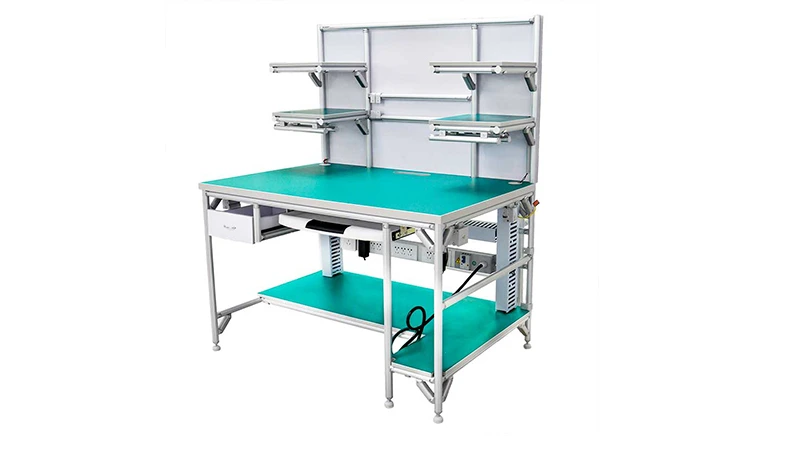
Aluminum Workbench A
Aluminum tube workbench is more flexible and durable, compared with traditional PE/ABS coated steel tube. It is easy to assemble, anti corrosion, rust protection, and recycle use after disassemble.
In the fast-paced world of warehouse logistics, every second counts. From the moment a shipment arrives to the final step of loading orders onto delivery trucks, efficiency isn't just a goal—it's the backbone of profitability. Yet, many warehouses still struggle with a silent productivity killer: inefficient workstations. These are the spots where workers spend hours each day picking, packing, assembling, or inspecting goods. A poorly designed workstation can turn even the most motivated team into a bottleneck, leading to delays, increased errors, and unnecessary physical strain. But what if there was a workstation that didn't just hold tools and materials, but actively streamlined workflows, adapted to changing needs, and integrated seamlessly with other logistics systems? Enter Aluminum Workbench A —a solution that's redefining how warehouses approach productivity.
Meet Aluminum Workbench A: More Than Just a Table
At first glance, Aluminum Workbench A might look like any other workstation. It has a flat surface, sturdy legs, and a clean, industrial design. But look closer, and you'll realize it's engineered with a singular purpose: to make warehouse operations flow better. Unlike traditional workbenches made of wood, steel, or plastic, this isn't a one-size-fits-all piece of furniture. It's a modular, adaptable hub designed to fit into the unique rhythm of your warehouse—whether you're assembling electronics, sorting e-commerce orders, or kitting parts for manufacturing.
Let's start with the basics. Aluminum Workbench A (Single Deck—Without Caster, as specified in its design) is built with a focus on balance: strength without weight, durability without rigidity, simplicity without limitations. Its single-deck surface provides ample space for tasks, while its open-frame design keeps the area underneath free for storage bins, tools, or even additional equipment. But what truly sets it apart is its foundation in aluminum profile —a material that's become a game-changer in modern industrial design.
For warehouse managers who've dealt with heavy steel workbenches that require forklifts to move or wooden ones that warp under moisture, Aluminum Workbench A is a breath of fresh air. It weighs roughly 30% less than a steel bench of the same size, making it easy for two workers to reposition if workflows change. Yet, don't let the lightweight fool you: aluminum's inherent strength means it can support up to 300 kg of evenly distributed weight—more than enough for tools, parts bins, and even small machinery. And unlike wood, it won't splinter, rot, or harbor mold, making it ideal for warehouses with strict hygiene standards, like those in food processing or pharmaceuticals.
The Aluminum Profile Advantage: Why Material Matters in Logistics Workstations
To understand why Aluminum Workbench A outperforms traditional workstations, we need to dive into the star of the show: aluminum profile . These aren't just any aluminum tubes—they're precision-engineered extrusions with a T-slot design that runs along their length. This slot isn't a design quirk; it's a gateway to endless customization. With the right accessories—like brackets, clamps, and panels—workers can attach tool holders, monitor arms, lighting, or even small conveyors directly to the bench, turning it into a personalized command center.
But the benefits of aluminum profile go beyond customization. Let's break them down:
- Corrosion Resistance: Warehouses are tough environments. Humidity, spills, and even chemical cleaners can take a toll on metal surfaces. Aluminum naturally forms a protective oxide layer, so it resists rust and corrosion—no need for frequent painting or treatments. This longevity means fewer replacements and lower maintenance costs over time.
- Thermal Stability: From freezing cold storage units to sweltering shipping docks, aluminum handles temperature extremes better than most materials. It won't expand or contract drastically, ensuring the workbench remains stable and level, even in fluctuating conditions.
- Ease of Assembly: Traditional steel workbenches often require welding or heavy bolts to put together. Aluminum Workbench A, on the other hand, uses simple connectors and T-slot fasteners. A team can assemble a basic unit in under an hour, and reconfiguring it—say, adding a shelf or adjusting the height—takes minutes, not hours. This modularity is a lifesaver for warehouses that frequently update their workflows to meet seasonal demand or new product lines.
To put this in perspective, consider a case study from a mid-sized electronics warehouse in Texas. Before switching to Aluminum Workbench A, they used steel workbenches that took 4 hours to assemble and required a crew of three. When they needed to rearrange their assembly line for a new product launch, moving the steel benches required a forklift and half a day of downtime. After switching to Aluminum Workbench A, their team assembled 10 workstations in a single morning, and reconfiguring them for the new product took just 20 minutes per bench. "It's like building with giant Legos," one warehouse supervisor joked. "We no longer dread workflow changes—now we embrace them."
Another advantage? Aluminum profile is inherently sustainable. It's 100% recyclable, and its lightweight design reduces fuel consumption during shipping. For warehouses aiming to cut their carbon footprint, this is a small change with a big impact.

Seamless Integration with Flow Racks and Roller Tracks: Creating a Fluid Workflow
A workstation is only as good as its ability to connect with the systems around it. In warehouse logistics, materials rarely stay in one place—they flow from storage to workbench, then to packaging, and finally to shipping. If the path between these steps is disjointed, bottlenecks form. Aluminum Workbench A solves this by playing well with two critical components of modern logistics: flow racks and roller tracks .
Let's start with flow racks. These gravity-fed storage systems are a staple in lean warehouses, allowing materials to "flow" forward as items are picked, ensuring first-in, first-out (FIFO) inventory management. The problem? Many workbenches sit separate from flow racks, forcing workers to walk back and forth to retrieve parts. Aluminum Workbench A eliminates this wasted motion by integrating directly with flow rack systems. Thanks to its modular aluminum profile, the bench can be bolted to the end of a flow rack, creating a seamless transition from storage to assembly.
Take a kitting operation, for example. Imagine workers assembling gift boxes for a holiday rush. Instead of walking 10 feet to the flow rack to grab ribbons, boxes, and tissue paper, the flow rack is positioned right next to Aluminum Workbench A. As workers pick items from the front of the flow rack, the next set slides forward automatically. The workbench's surface becomes the assembly point, with tools and tape dispensers mounted to the T-slots within arm's reach. The result? A 30% reduction in time spent walking, according to a case study from a retail distribution center that implemented this setup.
Now, add roller tracks into the mix. These wheeled tracks are designed to move items smoothly across short distances—perfect for transferring finished goods from the workbench to a conveyor or packing station. Aluminum Workbench A's T-slot profile makes attaching roller tracks a breeze. Whether you need a straight track, a 90-degree turn, or a gentle slope, the bench can accommodate it. For instance, in a small-parts assembly line, workers can place completed components on the roller track, which glides them directly to the next workstation—no lifting, no carrying, no delays.
One manufacturing plant in Ohio took this integration a step further by combining Aluminum Workbench A with both flow racks and roller tracks in their quality control area. Incoming parts flow from the rack to the bench for inspection, then pass through a roller track to a reject bin or an approved bin, depending on the result. "Before, inspectors were constantly bending down to pick up parts or walking to move them," the plant manager explained. "Now, everything comes to them, and they send it on its way with a gentle push. We've cut inspection time by 25% and reduced back pain complaints among the team."
| Feature | Traditional Workbench (Steel/Wood) | Aluminum Workbench A |
|---|---|---|
| Integration with Flow Racks | Requires custom brackets or separate stands; often unstable | Direct T-slot mounting; secure and adjustable |
| Roller Track Compatibility | Limited—tracks must be placed on the floor, creating trip hazards | Mounts directly to bench; tracks align with work surface height |
| Workflow Flexibility | Fixed layout; hard to reconfigure without tools | Modular design; tracks/racks can be moved in minutes |
| Ergonomics | Static height; no easy way to adjust for worker comfort | Optional height-adjustable legs; accessories position tools at optimal height |
The table above highlights just how much more connected Aluminum Workbench A is to the rest of your warehouse ecosystem. It doesn't just occupy space—it becomes a node in a network of efficiency.

Lean System Alignment: How Aluminum Workbench A Supports Lean Manufacturing Principles
Lean manufacturing isn't just a buzzword; it's a philosophy centered on eliminating waste—whether that's wasted time, materials, or effort. At its core, lean is about creating more value with fewer resources. Aluminum Workbench A was designed with this philosophy in mind, making it a natural fit for warehouses and factories embracing lean systems .
Let's break down how the bench supports key lean principles:
1. 5S (Sort, Set in Order, Shine, Standardize, Sustain): A cluttered workstation is a breeding ground for waste. Aluminum Workbench A's T-slot system enforces "Set in Order" by giving every tool and material a designated spot. Tool holders snap into the slots, bins hang neatly from brackets, and cables can be routed through built-in channels. This organization makes "Shine" (cleaning) easier—no more digging through piles to wipe the surface. Over time, this becomes standardized, and the bench itself helps sustain the system by making disorganization visible at a glance.
2. Continuous Improvement (Kaizen): Lean isn't a one-and-done project; it's about constant tweaks. Aluminum Workbench A thrives here. If workers notice a tool is always out of reach, they can add a new bracket in 5 minutes. If a new part requires a larger workspace, they can extend the bench with additional aluminum profile sections. This adaptability means the workstation evolves with the team's needs, not against them.
3. Pull Systems: In lean, production is driven by customer demand (pull), not forecasts (push). Aluminum Workbench A integrates with flow racks and roller tracks to support this. For example, in a pick-and-pack station, the bench can be connected to a flow rack holding packaging materials. As workers use boxes from the front of the rack, the next box slides forward—no need to overstock the bench. This prevents overproduction (a key waste) and keeps inventory levels lean.
A case in point: A automotive parts supplier in Michigan used to struggle with overstocked workstations. Workers would hoard extra bolts and washers "just in case," leading to excess inventory and cluttered benches. After switching to Aluminum Workbench A with integrated flow racks, they implemented a kanban system. Each bin on the flow rack held exactly 2 hours of parts, and when a bin was empty, a signal was sent to restock. The workbench's organized layout made it impossible to hoard—there was simply no space for extra parts. Within three months, inventory levels dropped by 20%, and stockouts (which had been a frequent issue) disappeared entirely.
"Lean is about empowering workers to improve their own processes," said the supplier's lean coordinator. "Aluminum Workbench A gives them the tools to do that. If a line worker has an idea to rearrange their station, they don't need to wait for maintenance—they can grab a few brackets and make it happen. That sense of ownership has transformed our culture."
Real-World Impact: Stories from the Warehouse Floor
Numbers and features tell part of the story, but the real test of any logistics tool is how it performs when the pressure is on. Let's look at three warehouses that integrated Aluminum Workbench A and saw tangible results.
Case Study 1: E-Commerce Fulfillment Center (West Coast, USA)
This 500,000-square-foot facility handles over 100,000 orders daily during peak seasons. Their biggest challenge? Packing stations that couldn't keep up with surging demand. Workers were using wooden workbenches with no integrated storage, leading to constant trips to central supply areas for boxes, tape, and packing peanuts.
Solution: They replaced 20 wooden benches with Aluminum Workbench A units, each paired with a flow rack and roller track. Tool holders were mounted to the T-slots for tape guns and label printers, and small conveyor belts (connected via the bench's profile) carried packed boxes to the shipping area.
Results: Packing time per order dropped from 90 seconds to 65 seconds—a 28% improvement. Worker walking distance decreased by 400 miles per day (yes, they tracked it!), and the facility hit its peak season targets with 10 fewer temporary workers than the previous year.
Case Study 2: Medical Device Assembly Plant (Germany)
Precision is critical in medical device manufacturing, and this plant was struggling with inconsistent assembly times due to disorganized workstations. Steel workbenches were heavy and hard to clean, and tools were often misplaced, leading to delays in production.
Solution: Aluminum Workbench A was chosen for its corrosion resistance and modularity. Each bench was customized with ESD (electrostatic discharge) mats (critical for sensitive electronics) and tool holders labeled with color-coded indicators for each step of the assembly process. Flow racks stocked with sterilized parts were attached to the benches, and roller tracks moved partially assembled devices to quality control.
Results: Assembly errors dropped by 15%, and cleaning time between shifts was cut in half. The plant also reported a 35% reduction in tool misplacement, as the labeled holders made it obvious when something was missing.
Case Study 3: Food and Beverage Distribution (Brazil)
This warehouse faced unique challenges: strict hygiene standards, frequent temperature changes (from cold storage to ambient zones), and heavy turnover of temporary workers. Traditional workbenches were either too porous (wood) or too cold to touch (uncoated steel), leading to compliance issues and slow onboarding.
Solution: Aluminum Workbench A's smooth, non-porous surface was easy to sanitize, and its thermal stability meant it didn't get icy cold in chilled areas. The modular design allowed for quick setup of temporary packing stations during peak harvest seasons, and color-coded accessories helped new workers learn workflows faster.
Results: Hygiene audit scores improved from 82% to 98%, and temporary workers reached full productivity 30% faster. The warehouse also avoided $15,000 in fines for non-compliance with food safety regulations.
Beyond the Bench: Long-Term Benefits for Warehouse Managers
For warehouse managers, investing in new equipment is always a balancing act between upfront cost and long-term value. Aluminum Workbench A may have a higher initial price tag than a basic steel or wooden bench, but its total cost of ownership tells a different story. Let's break down the long-term benefits:
Durability = Fewer Replacements: Steel benches rust, wood benches warp, and plastic benches crack. Aluminum Workbench A, with its corrosion resistance and scratch-resistant surface, lasts 3–5 times longer than traditional options. A warehouse that replaces workbenches every 3 years could stretch that to 10–15 years with aluminum—saving thousands in replacement costs.
Reduced Labor Costs: Time is money, and Aluminum Workbench A saves plenty of it. From faster assembly and reconfiguration to less time spent walking and searching for tools, the productivity gains add up. A single bench could save a worker 1–2 hours per day—multiply that by 20 benches, and you're looking at 40+ hours of recovered labor each week.
Worker Retention: In today's tight labor market, keeping skilled workers is more important than ever. Ergonomic, efficient workstations show employees their comfort and productivity matter. Warehouses that upgraded to Aluminum Workbench A report 15–20% lower turnover rates in roles that use the benches—saving on recruitment and training costs.
Scalability: As your business grows, so do your logistics needs. Aluminum Workbench A scales with you. Need to add a new workbench? Just buy another unit and connect it to the existing setup. Want to expand a flow rack or add a new roller track? The T-slot system makes it easy. This scalability means you won't outgrow your investment.
Conclusion: Redefining Warehouse Efficiency, One Workstation at a Time
Warehouse logistics optimization isn't about finding one magic solution—it's about upgrading the small, everyday systems that make or break productivity. Workstations are the heartbeat of these systems, and Aluminum Workbench A proves that even something as "basic" as a bench can transform operations. By combining the strength and flexibility of aluminum profile with seamless integration with flow racks and roller tracks , this workstation doesn't just keep up with the demands of modern logistics—it leads the way.
Whether you're running a small distribution center or a large manufacturing plant, the message is clear: inefficient workstations aren't just a nuisance—they're a drain on your bottom line, your team's morale, and your ability to compete. Aluminum Workbench A offers a better way: a workstation that adapts to your needs, grows with your business, and turns every hour on the warehouse floor into a step toward greater efficiency.
So, the next time you walk through your warehouse, take a closer look at those workstations. Are they holding your team back, or propelling them forward? With Aluminum Workbench A, the answer can be the latter—one bench, one workflow, one success story at a time.