- Company Articles
- Products and Technology
- Product knowledge
- Welded Joints vs. Small Iron Corner Codes: Efficiency in Lean Production Assembly

Welded Joints vs. Small Iron Corner Codes: Efficiency in Lean Production Assembly
Related Product
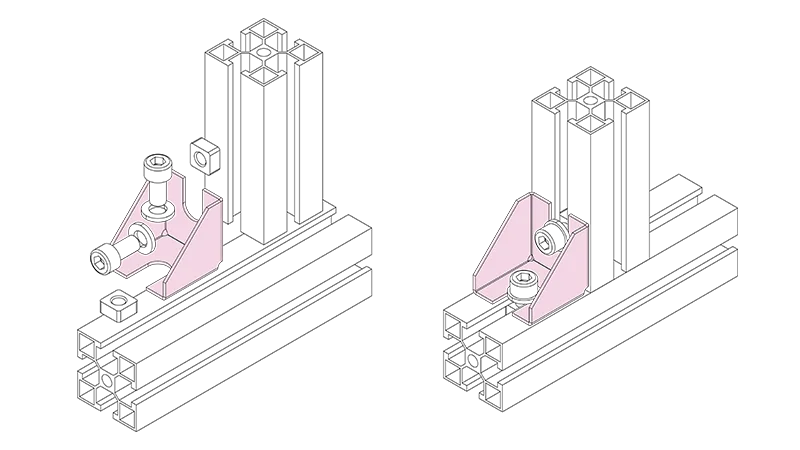
Small Iron Corner Code
Used for 30 series aluminum profile 90° plane connection
The hidden battle shaping the future of flexible manufacturing
Introduction: The Pulse of Lean Production
Walk into any modern manufacturing facility, and you'll feel it immediately—the hum of purpose. Conveyors glide, workbenches buzz with activity, and every square foot of space seems calibrated for one goal: eliminating waste. This is the world of lean production, where efficiency isn't just a buzzword; it's the lifeblood of operations. Yet, for all the talk of high-tech automation and data-driven optimization, some of the most impactful decisions in lean manufacturing come down to the smallest components. Today, we're diving into one such under-the-radar debate: welded joints versus small iron corner codes, and how this choice ripples through every aspect of a lean system.
At first glance, joints might seem trivial. After all, they're just the pieces that hold things together, right? But in reality, they're the unsung heroes (or villains) of assembly line flexibility. Imagine a factory floor where reconfiguring a workbench or adjusting a flow rack takes days instead of hours, or where modifying a production line for a new product means cutting and rewelding metal—wasting time, labor, and materials. That's the difference between a rigid, outdated setup and a dynamic, adaptable one. And at the heart of that difference often lies the choice between traditional welded joints and modern small iron corner codes.
Over the next few thousand words, we'll unpack why this decision matters, how each option stacks up in real-world scenarios, and why forward-thinking manufacturers are rethinking their approach to assembly. Whether you're a plant manager scratching your head over production bottlenecks, a lean coordinator hunting for waste hotspots, or simply curious about the mechanics of efficient manufacturing, this deep dive will show you how the smallest connections can drive the biggest results.
Understanding Welded Joints: The Old Reliable
Let's start with the tried-and-true: welded joints. For decades, welding has been the gold standard for joining metal components in manufacturing. It's simple in concept—melt two pieces of metal, fuse them together, and let them cool into a single, solid bond. In the early days of mass production, this made perfect sense. Factories churned out the same products for years, and assembly lines were built to last decades. A welded joint was like a marriage: permanent, strong, and built to weather the storm.
Walk through a legacy automotive plant, and you'll still see welded joints holding together heavy-duty workbenches, material racks, and conveyor supports. There's a reason for their longevity: when done well, a welded joint is incredibly strong. It can handle heavy loads, resist vibration, and stand up to the daily grind of a busy factory. For applications like supporting large machinery or fixed structures that never need to change, welding remains a solid choice. Welders, too, are skilled craftspeople—their ability to create precise, durable bonds is a cornerstone of traditional manufacturing.
But here's the catch: lean manufacturing isn't about "set it and forget it." It's about continuous improvement, adaptability, and responding quickly to change. And that's where welded joints start to show their age. To weld two pieces together, you need specialized labor, equipment (think welders, grinders, safety gear), and time. Once the joint is set, it's permanent. Need to shorten a workbench? You'll need to cut the weld, which risks damaging the surrounding material. Want to reconfigure a flow rack to accommodate a new product size? Prepare for hours (or days) of cutting, rewelding, and repainting. In a lean system, where every minute of downtime costs money, this rigidity can be a silent productivity killer.
Welded joints also come with hidden costs. The heat from welding can warp metal, leading to misalignments that throw off assembly precision. The process requires a clean, well-ventilated workspace, which isn't always feasible on a busy factory floor. And let's not forget about waste: excess metal from grinding, scrap from failed welds, and the energy consumed by welding equipment all add up. In a world where lean principles demand minimizing waste (muda), these are hard to ignore.

The Rise of Small Iron Corner Codes: Flexibility in a Tiny Package
Enter small iron corner codes: the quiet revolution in assembly line design. If welded joints are the old-school blacksmiths of manufacturing, corner codes are the modular furniture of the industrial world. These small, often L-shaped or T-shaped metal brackets are designed to connect pipes, tubes, and profiles using nothing more than bolts, nuts, and a wrench. No heat, no specialized skills, no permanent bonds—just quick, secure connections that can be taken apart and reassembled in minutes.
So, what exactly are small iron corner codes? They're typically made from durable materials like steel or iron, with pre-drilled holes that align with standard pipes (think lean pipe, aluminum profile, or stainless steel tubing). Some have angled faces for 90-degree connections, others have multiple holes for branching structures, and many are coated to resist rust and corrosion. Their simplicity is their superpower: slide the bracket over the ends of two pipes, tighten the bolts, and you've got a solid joint. Need to adjust? Loosen the bolts, reposition, and retighten. It's that easy.
The rise of corner codes tracks with the evolution of lean manufacturing itself. As factories shifted from mass production to smaller batch sizes and more frequent product changes, the need for flexible assembly tools skyrocketed. Suddenly, being able to reconfigure a workbench in an hour instead of a day wasn't a luxury—it was a competitive advantage. Small iron corner codes answered that call. They're affordable, widely available, and require minimal training to use. A new operator can learn to assemble a basic lean pipe workbench with corner codes in under an hour, whereas welding that same bench would take a skilled welder half a day.
But don't mistake simplicity for weakness. Modern corner codes are engineered to handle significant loads. High-quality iron or steel construction, reinforced edges, and secure bolt tightening mean they can support the weight of tools, materials, and even small machinery. When paired with sturdy materials like aluminum profile or lean pipe, corner code assemblies are more than up to the task of daily factory use. They're also versatile: mix and match different bracket shapes, pipe lengths, and accessories (like casters or roller tracks) to create everything from workbenches and flow racks to turnover trolleys and material carts.
Perhaps the biggest advantage of corner codes is their alignment with lean principles. They eliminate waste in multiple ways: less labor (no welders needed), less energy (no power-hungry welding equipment), less material waste (no scrap from cutting or grinding), and less downtime (quick reconfigurations). They also support the lean goal of "just-in-time" production by allowing lines to be adjusted on the fly. Need to add a shelf to a workbench for a new tool? Grab a corner code, a pipe, and a wrench, and you're done in 10 minutes. Want to repurpose a flow rack for a different product line? Disassemble the old setup and rebuild it—no cutting, no welding, no mess.
Head-to-Head: Welded Joints vs. Small Iron Corner Codes
To truly understand the impact of this choice, let's put welded joints and small iron corner codes side by side. The table below breaks down key factors that matter most in a lean system: installation time, flexibility, cost, durability, and more.
| Criteria | Welded Joints | Small Iron Corner Codes |
|---|---|---|
| Installation Time | Long (1-4 hours per joint, including setup, welding, cooling, and cleanup) | Short (5-15 minutes per joint, using basic hand tools) |
| Labor Skill Required | High (certified welders with specialized training) | Low (basic training for assembly line workers or maintenance staff) |
| Flexibility & Reusability | Very low (permanent bond; disassembly requires cutting/damaging materials) | Very high (easily disassembled, reconfigured, and reused with minimal waste) |
| Initial Cost | High (welding equipment, labor, materials, and workspace setup) | Low (affordable brackets, standard tools, no specialized equipment) |
| Long-Term Cost | High (reconfiguration requires new materials, labor, and downtime) | Low (reusable components, minimal downtime for changes, reduced waste) |
| Durability Under Static Loads | Excellent (permanent bond resists movement and heavy static weight) | Very Good (strong enough for most factory applications when properly tightened) |
| Durability Under Vibration | Good (permanent bond reduces loosening over time) | Good (bolts may loosen slightly; periodic retightening recommended) |
| Waste Generation | High (scrap metal from grinding, excess material, energy waste) | Low (minimal scrap, reusable components, no energy-intensive processes) |
| Compatibility with Lean Principles | Low (rigid, slow to adapt, generates waste) | High (flexible, quick to reconfigure, minimizes waste) |
At a glance, the table tells a clear story: for most lean production environments, small iron corner codes offer significant advantages in flexibility, cost, and waste reduction. But that doesn't mean welded joints are obsolete. For applications where structures are permanent, loads are extremely heavy, or vibration is constant (like supporting industrial presses), welding still has a place. The key is to match the joint type to the application—and in today's fast-paced manufacturing world, that often means prioritizing adaptability.
Real-World Impact: How One Factory Cut Downtime by 60% with Corner Codes
Let's bring this debate to life with a hypothetical (but realistic) scenario. Meet Acme Electronics, a mid-sized manufacturer producing circuit boards for consumer devices. A few years ago, Acme's production line was stuck in a rut. Their workbenches and flow racks were built with welded joints, and every time they needed to adjust for a new product model, the process was painful. For example, when they introduced a smaller circuit board, reconfiguring the flow racks to transport the new size took two full days of welding and grinding. During that time, the line was down, costing the company an estimated $40,000 in lost production.
Acme's lean coordinator, Maria, was tasked with finding a solution. She'd heard about small iron corner codes from a colleague and decided to run a pilot project. The team replaced three welded workbenches with new ones built using lean pipe and small iron corner codes. The results were immediate: assembling each new workbench took just 3 hours (compared to 8 hours for the welded versions). When the next product change came around, instead of shutting down the line, Maria's team disassembled the old flow rack setup, reconfigured the pipes and corner codes, and had the new line running in just 4 hours—down from 2 days. Downtime was cut by 60%, and the company saved over $30,000 on that single change alone.
But the benefits didn't stop there. The new corner code-based workbenches were lighter, making them easier to move (with the addition of casters). The team could quickly add shelves or tool holders as needed, reducing clutter and improving workflow. And because the components were reusable, Acme was able to repurpose old pipes and brackets for new projects, cutting material costs by 15%. "It's like going from building with concrete to building with Lego," Maria noted. "We can adapt on the fly, and that's been a game-changer for our lean system."
Today, Acme has replaced 80% of its welded joints with small iron corner codes, and the impact is clear: faster product launches, lower waste, and a more engaged workforce (since employees can adjust their own workstations without waiting for welders). It's a testament to how even small changes in assembly methods can transform a company's lean journey.
Beyond the Joint: How This Choice Fits into the Larger Lean Picture
The debate between welded joints and small iron corner codes isn't just about holding materials together—it's about aligning with the core principles of lean manufacturing. Let's break down how this choice impacts three key lean pillars: waste reduction, continuous improvement, and respect for people.
Waste Reduction (Muda): Lean philosophy identifies seven types of waste, and welded joints contribute to several. There's overprocessing (the time and energy spent welding), defects (warped metal from heat), unused talent (relying solely on welders instead of empowering line workers), and excess inventory (stockpiling extra materials to account for welding errors). Small iron corner codes, by contrast, minimize these wastes. They require less processing, reduce defects by avoiding heat damage, let line workers handle assembly, and cut inventory needs since components are reusable.
Continuous Improvement (Kaizen): Kaizen thrives on small, frequent changes that make processes better. With welded joints, even small improvements can feel monumental—like trying to turn a battleship with a rowboat oar. Corner codes, however, make kaizen accessible. A line worker noticing that a workbench is too low can loosen a few bolts, adjust the height, and retighten—all in 10 minutes. That kind of immediate action fosters a culture of ownership, where everyone feels empowered to improve their workspace. Over time, these small adjustments add up to significant gains in efficiency and morale.
Respect for People: Lean isn't just about processes; it's about people. Welded joints often create bottlenecks, forcing line workers to wait for welders to make changes. This can lead to frustration and disengagement. Small iron corner codes put control back in the hands of the people using the equipment. When workers can adapt their tools to fit their needs, they feel valued, and that translates to higher productivity and lower turnover. It's a simple shift, but it sends a powerful message: "Your expertise matters, and we trust you to make things better."
Another key consideration is compatibility with modern lean tools and materials. For example, aluminum profile—lightweight, strong, and infinitely customizable—pairs perfectly with small iron corner codes. Aluminum's smooth, pre-drilled surfaces make it easy to attach brackets, and its lightweight nature makes reconfiguration a breeze. Compare that to welding aluminum, which requires specialized equipment and skills (aluminum conducts heat differently than steel, making it trickier to weld). By combining corner codes with aluminum profile, manufacturers create systems that are both strong and agile—ideal for today's fast-changing markets.
Flow racks are another area where corner codes shine. These material handling systems rely on gravity to move products from one workstation to the next, and their efficiency depends on precise alignment. With welded joints, setting up a flow rack requires perfect measurements upfront—any mistake means cutting and rewelding. With corner codes, you can adjust angles, heights, and lengths on the fly, ensuring products glide smoothly without jams. Add in roller track accessories (like plastic guide rails or swivel roller balls), and you've got a system that adapts to different product sizes and weights with minimal hassle.
Making the Right Choice: Factors to Consider
So, does this mean welded joints are obsolete? Not at all. As with any lean decision, the right choice depends on your specific needs. Here are the key factors to consider when choosing between welded joints and small iron corner codes:
1. Product Lifespan and Change Frequency: If you're building a fixed structure that will never need to change (e.g., a support beam for a heavy machine), welding might still be the best option. But if your production lines change monthly, quarterly, or even yearly, corner codes are the clear winner.
2. Load Requirements: For extremely heavy loads (think tons of weight), welded joints may offer better long-term stability. For most factory applications—workbenches, flow racks, trolleys—corner codes paired with strong materials (like steel lean pipe or aluminum profile) are more than sufficient.
3. Labor and Skill Availability: If you have a team of skilled welders on staff and low demand for reconfiguration, welding could work. But if welding resources are limited or you need to empower line workers to make changes, corner codes reduce reliance on specialized labor.
4. Budget and Timeline: Corner codes have lower upfront costs and faster installation times, making them ideal for tight budgets or quick turnaround projects. Welding may have higher initial costs but could be cheaper over decades for permanent structures (though in lean, few structures last that long without changes).
5. Waste Reduction Goals: If minimizing waste is a top priority (and it should be in lean), corner codes are the better choice. They generate less scrap, use less energy, and support reuse—all key to sustainable manufacturing.
For most modern lean systems, the answer is likely a hybrid approach. Use welded joints for the few permanent, heavy-duty structures that never change, and small iron corner codes for everything else. This way, you get the best of both worlds: strength where you need it, flexibility where you don't.
Conclusion: The Future of Lean Assembly is Modular
As we've explored, the choice between welded joints and small iron corner codes is about more than just joining metal—it's about choosing between rigidity and adaptability, between the past and the future of manufacturing. In a world where customer demands change overnight, product lifecycles shrink by the year, and lean principles drive every decision, flexibility isn't optional—it's essential.
Small iron corner codes represent that flexibility. They're a simple, affordable, and effective solution that aligns with the core of lean thinking: eliminate waste, empower people, and continuous improve. They turn assembly lines from static monoliths into dynamic, evolving systems that can keep up with the pace of modern business.
So, the next time you walk through your factory, take a closer look at the joints holding your workbenches, flow racks, and conveyors together. Are they helping you move forward, or holding you back? For most manufacturers, the answer will point toward small iron corner codes—and a future where efficiency, adaptability, and lean success go hand in hand.
After all, in lean production, the strongest systems aren't the ones that never bend—they're the ones that can bend, adapt, and grow stronger with every change. And that's exactly what small iron corner codes deliver.