- Company Articles
- Products and Technology
- Product knowledge
- What Aluminum Alloy Grade is Used in 3030 National Standard Profile A?

What Aluminum Alloy Grade is Used in 3030 National Standard Profile A?
Related Product
3030 National Standard Profile A
Workbench, production line, logistic rack, warehouse rack Industry: Manufacturer workshop, Automobile, Electronic, Assembling, logistic
Walk into any modern factory, workshop, or logistics center, and you'll likely spot a silent workhorse holding everything together: aluminum profiles. These unassuming metal structures form the backbone of workbenches, material racks, conveyor systems, and even modular production lines. They're the reason your local warehouse can efficiently sort packages, why a car manufacturing plant's assembly line runs smoothly, and why your office's ergonomic desk stays sturdy day in and day out. Among the countless types of aluminum profiles available, one stands out for its versatility and reliability: the 3030 National Standard Profile A. But what makes this profile so essential? And more importantly, what aluminum alloy grade gives it the strength, flexibility, and durability to support so many industrial applications?
In this article, we'll dive deep into the world of aluminum profiles, focusing on the 3030 National Standard Profile A. We'll explore its design, its role in lean system setups, and most critically, the specific aluminum alloy grade that makes it a staple in workshops worldwide. Whether you're a factory manager looking to optimize your production line, a procurement specialist sourcing materials, or simply curious about the engineering behind everyday industrial tools, this guide will demystify the alloy that powers one of the most widely used profiles in the industry.
Understanding the 3030 National Standard Profile A: Basics First
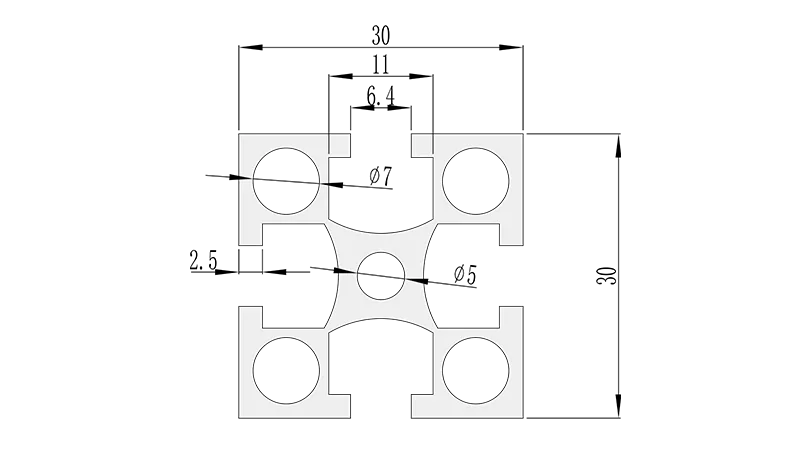
Before we get to the alloy grade, let's break down what the "3030 National Standard Profile A" actually is. The name itself gives us key clues. The "3030" refers to its cross-sectional dimensions: 30 millimeters in width and 30 millimeters in height, forming a square or rectangular tube (depending on design) that's easy to integrate into modular structures. The "National Standard" part means it complies with strict quality and dimensional regulations set by national authorities—think of it as a guarantee that the profile meets uniform standards for thickness, straightness, and performance, no matter which supplier you buy it from. And "Profile A" likely denotes a specific design variant, perhaps with standardized T-slot configurations (the grooves along the profile) that make it compatible with a wide range of aluminum profile accessories, from connectors to end caps.
Why does this matter? In industrial settings, consistency is king. When you're building a workbench or a material rack, you need to know that the profiles you're using will fit together seamlessly, support the intended load, and last through years of heavy use. The 3030 National Standard Profile A checks all these boxes, which is why it's a go-to choice for everything from simple shelving units to complex lean system setups. But none of this would be possible without the right aluminum alloy at its core.
Why the Alloy Grade Matters: More Than Just Metal
Aluminum is never used in its pure form for structural profiles—it's always alloyed with other metals to enhance specific properties. The choice of alloy determines how strong the profile is, how resistant it is to corrosion, how easy it is to shape (extrude), and even how it looks after surface treatment. For example, an alloy with high copper content might be stronger but more prone to corrosion, while one with magnesium and silicon could offer better formability and a smoother finish. When it comes to aluminum extrusion profiles like the 3030 National Standard Profile A, the alloy grade is the hidden factor that makes or breaks its performance.
Let's consider a real-world scenario: A manufacturer needs to build a material rack B (3 row and 3 floor) to hold heavy components. If they choose a low-grade alloy, the rack might warp under the weight, leading to safety risks and frequent replacements. On the flip side, a high-grade alloy with unnecessary strength could drive up costs without adding value. The 3030 National Standard Profile A is designed to strike a balance—offering enough strength for most industrial tasks without being overengineered. To do that, it relies on a tried-and-true alloy that's been a staple in the extrusion industry for decades: 6063 aluminum alloy.
The Star of the Show: 6063 Aluminum Alloy
If you ask any aluminum extrusion expert which alloy is most commonly used for profiles like the 3030 National Standard Profile A, the answer will almost always be 6063. Sometimes called "architectural alloy," 6063 is prized for its excellent extrudability, which means it can be easily shaped into complex cross-sections (like the T-slots in 3030 profiles) with tight tolerances. But that's just the start. Let's break down why 6063 is the perfect match for this profile:
- Formability: 6063 has a lower melting point and better flow characteristics than many other alloys, making it ideal for extrusion. This allows manufacturers to create precise, consistent profiles—critical for ensuring that 3030 National Standard Profile A pieces from different batches (or even different suppliers) fit together perfectly.
- Surface Finish: After extrusion, 6063 takes anodization (a common surface treatment) exceptionally well. Anodizing creates a hard, corrosion-resistant layer on the aluminum, giving the profile a smooth, professional look that holds up in dusty, humid, or oily workshop environments. For profiles that might be visible (like those in office workstations or retail displays), this is a huge plus.
- Strength-to-Weight Ratio: While 6063 isn't the strongest aluminum alloy (that title might go to 7075, used in aerospace), it offers more than enough strength for most industrial applications. A 3030 profile made from 6063 can easily support the weight of tools, components, or even small machinery, all while remaining lightweight enough to be moved or reconfigured as needed—key for lean system flexibility.
- Cost-Effectiveness: 6063 uses relatively common alloying elements (magnesium and silicon), making it more affordable than specialized alloys. This keeps the 3030 National Standard Profile A budget-friendly, which is a big deal for businesses looking to scale up their operations without breaking the bank.
To put it simply, 6063 is the sweet spot for aluminum extrusion profiles. It's not the fanciest alloy, but it's reliable, versatile, and perfectly suited to the demands of 3030 National Standard Profile A applications.
Diving Deeper: The Composition of 6063 Aluminum Alloy
Curious about what exactly goes into 6063? Let's look at its chemical composition (by weight, as per industry standards):
- Silicon (Si): 0.20–0.60% – Improves flow during extrusion and enhances strength when combined with magnesium.
- Magnesium (Mg): 0.45–0.90% – Works with silicon to form magnesium silicide (Mg2Si), the compound that gives 6063 its strength after heat treatment.
- Iron (Fe): ≤0.35% – A trace element; too much can weaken the alloy and cause surface defects.
- Copper (Cu): ≤0.10% – Kept low to avoid reducing corrosion resistance.
- Manganese (Mn): ≤0.10% – Minimized to prevent brittleness.
- Zinc (Zn): ≤0.10% – Low levels to maintain formability.
- Chromium (Cr): ≤0.10% – Helps with grain structure control during heat treatment.
- Titanium (Ti): ≤0.10% – Refines the grain size, improving strength and surface finish.
- Aluminum (Al): Remainder – The base metal, providing lightweight properties.
This precise blend is what gives 6063 its unique properties. When heated to the right temperature (around 530°C for extrusion), the alloy becomes malleable enough to be pushed through a die, taking on the 30mm x 30mm shape of the 3030 National Standard Profile A. After extrusion, it undergoes a heat treatment process (usually T5 or T6 temper) to strengthen the magnesium silicide particles, locking in the profile's mechanical properties.
How 6063 Performs in Real-World Applications
Let's move beyond the lab and into the workshop. How does a 3030 National Standard Profile A made from 6063 hold up in actual use? Let's take a few common scenarios:
Workbench E (Single Deck – Without Caster): A typical workshop workbench might use 3030 profiles for the frame. With 6063 alloy, the legs and crossbars can support a load of 200–300 kg (depending on design) without bending. Even if a heavy tool is dropped on the bench, the profile's toughness (thanks to 6063's ductility) prevents it from cracking.
Material Rack B (3 Row and 3 Floor): This rack, used to store boxes or components, relies on 3030 profiles for uprights and horizontal supports. 6063's corrosion resistance ensures the rack won't rust, even in humid warehouses, while its strength keeps the shelves from sagging under the weight of stacked materials.
Lean System Setups: In lean manufacturing, flexibility is key. 3030 profiles are often used to build modular production lines or kanban systems, where components need to be moved quickly. 6063's lightweight nature makes it easy to reconfigure the setup, while its strength ensures the system remains stable during operation.
In all these cases, 6063's properties align perfectly with the needs of the application. It's why you'll rarely find a 3030 National Standard Profile A made from anything else—6063 is simply too well-suited to the task.
Comparing 3030 with Other Profiles: Why 6063 Still Shines
To really appreciate 6063's role in 3030 National Standard Profile A, let's compare it to other common aluminum profiles and their alloys. Below is a table showing how 3030 (with 6063) stacks up against 2020 and 4040 profiles, two other popular sizes:
| Profile Type | Dimensions (mm) | Common Alloy | Key Properties | Typical Applications | Load Capacity (Approx.) |
|---|---|---|---|---|---|
| 3030 National Standard Profile A | 30x30 | 6063 | Balanced strength, excellent extrudability, good corrosion resistance | Workbenches, material racks, lean system frames, small conveyor supports | 200–400 kg (per linear meter, vertical) |
| 2020 National Standard Profile | 20x20 | 6063 (sometimes 6061) | Lightweight, highly flexible, lower load capacity | Small shelving, electronic enclosures, hobby projects | 50–150 kg (per linear meter, vertical) |
| 4040 National Standard Profile | 40x40 | 6061 or 6063 | Higher strength, heavier, more rigid | Heavy-duty racks, machinery frames, large conveyor systems | 400–800 kg (per linear meter, vertical) |
As you can see, 3030 with 6063 hits the middle ground—stronger than 2020 (which is better for light tasks) but more lightweight and affordable than 4040 (which is overkill for many applications). This versatility is why it's such a popular choice. And while 4040 profiles sometimes use 6061 (a slightly stronger alloy), 6063 remains the top pick for 3030 due to its superior extrudability and surface finish—critical for the precise T-slots that make 3030 compatible with so many aluminum profile accessories.
The Role of Aluminum Profile Accessories: Making 3030 Even More Versatile
A profile is only as good as the accessories that connect it. The 3030 National Standard Profile A's T-slots are designed to work with a wide range of aluminum profile accessories, from 90° aluminum profile connectors to 3030 aluminum profile end caps. And because the profile is made from 6063, these accessories fit snugly and securely, ensuring the entire structure stays stable.
For example, a 90° aluminum profile connector (used to join two profiles at a right angle) relies on the profile's T-slot to grip tightly. If the profile were made from a softer alloy, the connector might loosen over time, weakening the structure. But 6063's moderate hardness ensures a firm hold, even with repeated assembly and disassembly. Similarly, end caps—used to cover the ends of profiles for safety and aesthetics—fit perfectly because 6063's extrusion process creates consistent dimensions, so there's no gap between the cap and the profile.
In short, 6063's properties don't just make the 3030 profile strong—they make it compatible with the ecosystem of accessories that turn a simple metal tube into a fully functional industrial tool.
How to Ensure You're Getting Genuine 6063 Alloy
Now that you know 6063 is the alloy of choice for 3030 National Standard Profile A, how can you be sure the profile you're buying is actually made from it? Unfortunately, not all suppliers are created equal. Some might cut corners by using lower-grade alloys (like 1050, a pure aluminum alloy that's weaker and less durable) to save costs. Here are a few tips to verify the alloy grade:
- Ask for Certifications: Reputable suppliers will provide material certificates (like mill test reports) that confirm the alloy composition. Look for mentions of "6063" or compliance with standards like GB/T 6892 (China's national standard for aluminum extruded profiles).
- Check the Surface Finish: 6063 takes anodization very well, resulting in a smooth, uniform surface. If the profile has a rough or uneven finish, it might be a lower-grade alloy.
- Test the Weight: While not foolproof, 6063 has a consistent density. If a 3030 profile feels significantly lighter than others of the same length and wall thickness, it could be made from a less dense (weaker) alloy.
- Buy from Trusted Suppliers: Stick to suppliers with a track record of providing quality aluminum extrusion profiles. Many lean system suppliers or aluminum profile specialists will have strict quality control processes to ensure their 3030 National Standard Profile A uses genuine 6063.
Investing a little time in verifying the alloy grade can save you from costly replacements or safety issues down the line.
Conclusion: 6063 – The Backbone of 3030 National Standard Profile A
At the end of the day, the 3030 National Standard Profile A's success boils down to its alloy: 6063 aluminum. This unassuming blend of aluminum, magnesium, and silicon gives the profile the strength, flexibility, and reliability needed to excel in industrial applications. Whether it's supporting a workbench in a small workshop or forming the frame of a large material rack in a warehouse, 6063 ensures the profile can handle the job.
So the next time you walk past a 3030 profile in a factory or workshop, take a moment to appreciate the engineering behind it. It's not just a piece of metal—it's a carefully crafted alloy that makes modern manufacturing, logistics, and lean system setups possible. And for anyone looking to build or buy a 3030 National Standard Profile A, remember: the alloy grade isn't just a detail—it's the foundation of everything the profile can do.