- Company Articles
- Products and Technology
- Product knowledge
- What is a Four Way Straight Lean Pipe Joint Chrome? Definition & Core Functions

What is a Four Way Straight Lean Pipe Joint Chrome? Definition & Core Functions
Related Product
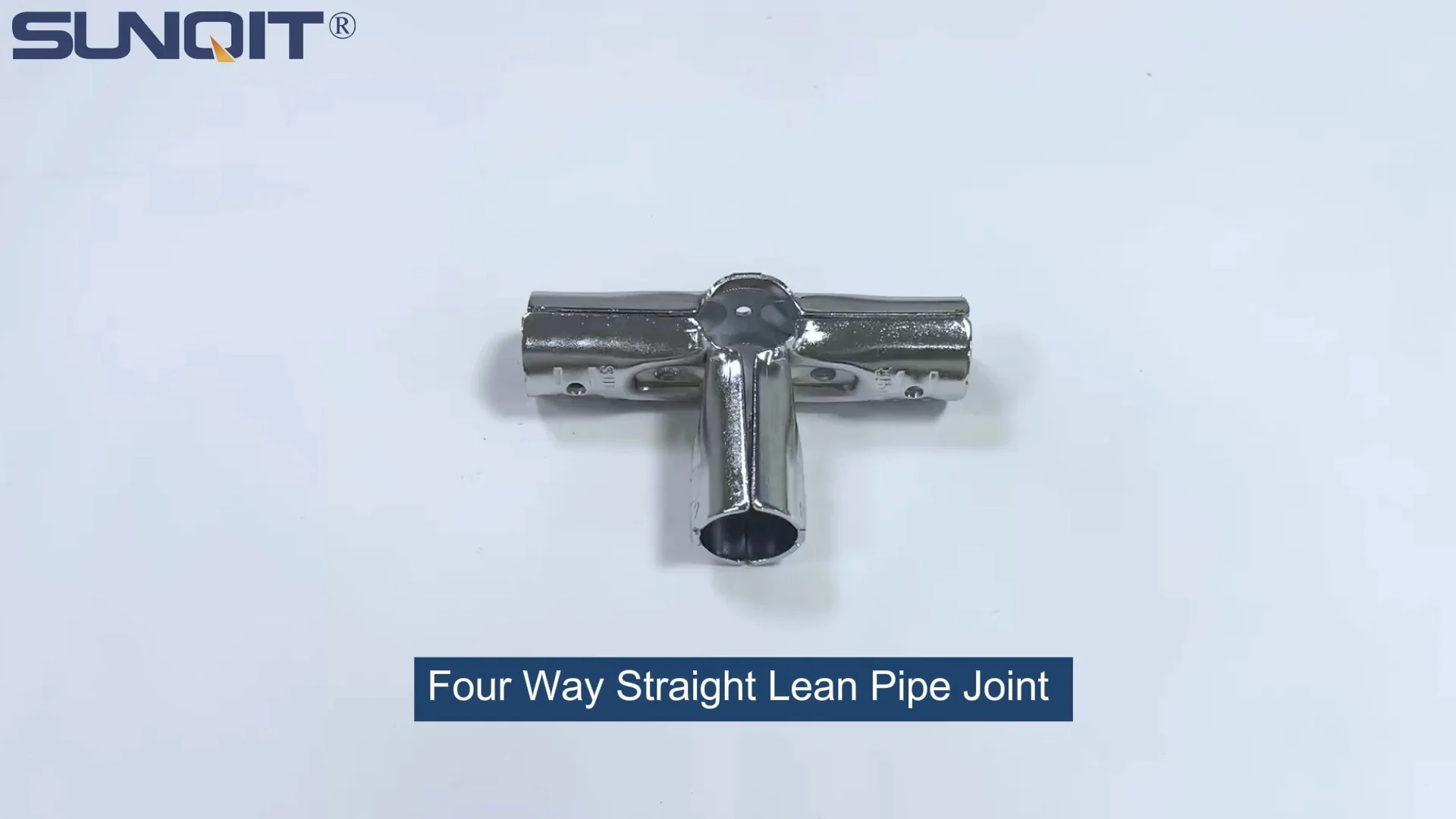
Four Way Straight Lean Pipe Joint Chrome
Four way lean pipe joint for 4 pcs 28MM lean pipe connection in straight angle, which used widely in workbench, flow rack, hand trolley frame connection.
Introduction: The Backbone of Lean Manufacturing
In the fast-paced world of manufacturing and warehousing, efficiency isn't just a buzzword—it's the lifeblood of staying competitive. Every second wasted, every unnecessary movement, and every rigid setup that can't adapt to change eats into profits and slows down progress. This is where lean system solutions come into play, designed to streamline workflows, reduce waste, and keep operations agile. At the heart of these systems lie yet powerful components: lean pipe joints. Today, we're zeroing in on one that's a workhorse in modular setups: the Four Way Straight Lean Pipe Joint Chrome.
Imagine walking into a busy production floor. Rows of workbenches hum with activity, materials glide smoothly along flow racks, and turnover trolleys move seamlessly between stations. What you might not notice is the hidden hero holding it all together: a small, unassuming joint that connects metal pipes at precise angles, allowing for endless configurations. That's the Four Way Straight Lean Pipe Joint Chrome. It's not flashy, but without it, the flexibility and adaptability that make lean manufacturing so effective would be nearly impossible.
Whether you're a small workshop owner looking to optimize your assembly line or a warehouse manager tasked with scaling operations, understanding this joint's role can transform how you approach workspace design. Let's dive into what it is, how it works, and why it's become a staple for anyone serious about lean principles.
Defining the Four Way Straight Lean Pipe Joint Chrome
Let's start with the basics. A lean pipe joint is a connector used to join lengths of lean pipe (also called "lean tube"), the modular metal pipes that form the skeleton of lean workstations, racks, and material handling systems. These joints are the "building blocks" that turn simple pipes into complex, functional structures—think of them as the Lego pieces of industrial design.
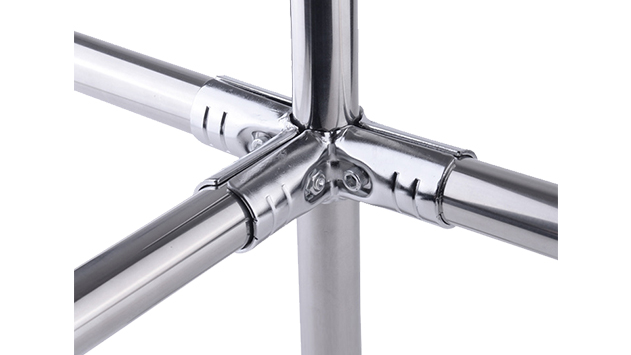
The Four Way Straight Lean Pipe Joint Chrome, as the name suggests, is a specialized type of joint designed to connect four lean pipes in a straight, linear configuration. Unlike two-way joints (which connect two pipes end-to-end) or three-way joints (which split into three directions), this joint allows for four pipes to extend from a single central point, all aligned along the same horizontal or vertical axis. Picture a cross, but with all arms pointing straight in the same plane—no angles, no bends, just clean, straight lines.
But what sets the "chrome" variant apart? Chrome plating isn't just for looks (though it does add a sleek, professional finish). Chrome is highly resistant to corrosion, scratches, and wear, making these joints ideal for environments where durability matters—like factories with frequent cleaning, warehouses with humidity, or workshops where tools and materials might bump against the structure. The chrome layer acts as a protective barrier, ensuring the joint stays strong and functional even after years of heavy use.
Materials matter too. Most Four Way Straight Lean Pipe Joints Chrome are made from high-quality steel (often carbon steel) before being chrome-plated. This combination gives them the strength to support heavy loads—think stacks of inventory on a flow rack or the weight of tools and equipment on a workbench—without bending or warping. Some manufacturers also offer aluminum versions for lighter-duty applications, but the chrome-plated steel models remain the go-to for robustness.
Core Functions: What Makes This Joint Indispensable?
Now that we know what it is, let's break down what it does . The Four Way Straight Lean Pipe Joint Chrome isn't just a connector—it's a problem-solver. Here are its core functions, and why each matters in real-world operations:
1. Multi-Directional Connectivity: Building Out, Not Just Up
Traditional two-way joints limit you to straight lines; three-way joints add a perpendicular direction, but the four-way straight joint takes it a step further by letting you extend in four straight directions from one point. This is game-changing for creating wide, stable structures. For example, a workbench frame using four-way joints can have pipes extending left, right, front, and back, allowing you to add shelves on both sides, tool hooks in front, and a material bin holder in the back—all without needing extra joints or complicated modifications.
In a warehouse setting, this means flow racks can be built with multiple levels and crossbars, maximizing vertical and horizontal space. A single four-way joint at the corner of a rack can support two horizontal pipes (for the shelf) and two vertical pipes (for the frame), eliminating the need for overlapping joints and reducing material waste.
2. Stability Without Compromise: Rigidity Meets Flexibility
Lean systems need to be both flexible (easy to reconfigure) and stable (safe to use). The Four Way Straight Lean Pipe Joint Chrome nails this balance. Its design features internal threads or clamping mechanisms that grip the lean pipe tightly when tightened, preventing wobbling or shifting. The chrome-plated steel construction adds rigidity, so even when supporting heavy loads—like a stack of car parts on a turnover trolley—the joint holds firm.
Consider a small electronics manufacturer that assembles circuit boards. Their workbench, built with four-way joints, needs to support a soldering iron, a bin of components, and a monitor. The joints ensure the bench doesn't sway when an operator leans on it, and the shelves stay level, so tiny screws and chips don't roll off. That stability isn't just about safety; it's about maintaining precision in every task.
3. Tool-Free Assembly (Mostly): Saving Time and Labor
One of the biggest advantages of lean pipe systems is how quickly they can be put together—and taken apart. The Four Way Straight Lean Pipe Joint Chrome is designed with this in mind. Most models use a simple bolt-and-nut system or a cam lever that tightens by hand. No welding, no drilling, no specialized tools. A single worker can assemble a basic flow rack in under an hour, and if production needs change next month, they can disassemble it just as fast and reconfigure the pipes into a new setup.
For a startup that's growing rapidly, this is a lifesaver. When they first launched, they might have used a small workbench with a few shelves. Six months later, demand spikes, and they need to add two more workstations and a larger flow rack. With four-way joints, they don't have to buy new equipment—they just reorder a few extra pipes and joints, and repurpose what they already have. Time saved, money saved, and minimal disruption to operations.
4. Compatibility: Playing Well With Others
A good joint shouldn't limit your choices, and the Four Way Straight Lean Pipe Joint Chrome plays nice with almost all standard lean pipes. Whether you're using 28mm diameter steel lean pipes, aluminum lean pipes, or even stainless steel variants, this joint is designed to fit snugly. It also works with other accessories: casters for mobile trolleys, roller tracks for flow racks, and even brackets for attaching shelves or bins.
Let's say you're setting up a material rack. You start with vertical lean pipes connected by four-way joints at the top and bottom. Then you add horizontal roller tracks (using roller track connectors) to create levels for boxes. Want to add a caster wheel to make it mobile? Just attach a caster bracket to the bottom joint. Need a side shelf for tools? Screw a shelf bracket into the joint's threaded holes. This compatibility turns a simple joint into a hub for endless possibilities.

How It Compares: Four Way vs. Other Lean Pipe Joints
To really appreciate the Four Way Straight Lean Pipe Joint Chrome, it helps to see how it stacks up against other common joints. Let's compare it to two of the most popular options: the Two Way Straight Joint and the Three Way T-Joint. Here's a quick breakdown:
| Joint Type | Number of Pipe Connections | Best For | Key Advantage | Limitations |
|---|---|---|---|---|
| Two Way Straight Joint | 2 (straight line) | Extending pipes in a single direction (e.g., long workbench legs) | Simple, low cost, minimal space | No branching; limited to linear structures |
| Three Way T-Joint | 3 (one straight, one perpendicular) | Adding a perpendicular branch (e.g., a shelf on a workbench) | Basic branching; ideal for L-shapes | Only one perpendicular direction; can't extend in four directions |
| Four Way Straight Joint Chrome | 4 (two straight, two perpendicular, all in one plane) | Wide, stable structures with multiple branches (e.g., flow racks, multi-shelf workbenches) | Maximizes space; supports complex, balanced setups | Slightly bulkier than two-way joints; overkill for simple structures |
The takeaway? The Four Way Straight Lean Pipe Joint Chrome isn't meant to replace other joints—it complements them. For simple, linear setups, a two-way joint is all you need. For basic L-shapes, a three-way T-joint works great. But when you need to build something that's both wide and deep—like a material rack with three rows and three floors (sound familiar?)—the four-way joint becomes irreplaceable. It distributes weight evenly across four directions, reducing stress on individual pipes and making the entire structure more stable.
Think of it like building with blocks: two-way joints are like straight connectors, three-way are like T-junctions, but four-way are like cross-shaped connectors that let you build out in all directions. When you're aiming for a structure that's not just tall but also broad and functional, you need that cross-shaped versatility.
Real-World Applications: Where You'll Find It in Action
Enough theory—let's look at how this joint shines in real workplaces. Here are three common scenarios where the Four Way Straight Lean Pipe Joint Chrome proves its worth:
1. Workbench Assembly: Customizing for Every Task
A workbench is the heart of any production or repair station, and no two workbenches are the same. A mechanic might need a bench with tool hooks on one side, a parts bin on the other, and a shelf above. An electronics assembler might want a flat surface with anti-static mats, plus side racks for circuit boards. The Four Way Straight Lean Pipe Joint Chrome makes these customizations possible.
Take the "Workbench E (Single Deck-without Caster)" from many lean pipe suppliers. Its frame is built using vertical pipes connected by four-way joints at the top and bottom. The top joints connect the front, back, left, and right horizontal pipes, creating a sturdy rectangular frame for the work surface. Need to add a side shelf? Just attach a pipe to one of the four-way joints on the side. Want to hang a tool organizer? Screw a bracket into the front joint. It's like having a modular desk that adapts to your needs, not the other way around.
2. Flow Racks: Keeping Materials Moving
Flow racks are all about efficiency—materials should slide easily from the back to the front, so workers always have what they need at arm's reach. To make this work, flow racks need multiple levels, each with roller tracks, and they need to be stable enough to hold heavy boxes without sagging. Enter the Four Way Straight Lean Pipe Joint Chrome.
Consider a "Material Rack B (3 Row and 3 Floor)" setup. Each vertical support column uses four-way joints at every floor level. These joints connect the vertical pipe to the horizontal pipes that form the rack's sides, plus the crossbars that support the roller tracks. With four-way joints, you can add crossbars on both the left and right sides of each vertical column, creating a wider, more stable base for the roller tracks. This means you can load more boxes onto each level without worrying about the rack bending or collapsing.
And when your inventory mix changes? No problem. Loosen the bolts on the four-way joints, reposition the horizontal pipes, and adjust the roller tracks to fit new box sizes. It's a level of adaptability that fixed wooden or metal racks just can't match.
3. Turnover Trolleys: Mobility with Stability
Turnover trolleys are the workhorses of warehouses, shuttling materials from storage to production lines and back. They need to be lightweight enough to push around but strong enough to carry heavy loads—often 200kg or more. The Four Way Straight Lean Pipe Joint Chrome is key here, providing the structural integrity to handle the weight while keeping the trolley easy to assemble.
A typical trolley frame uses four vertical pipes (one at each corner), connected by four-way joints at the top and bottom. The bottom joints connect to horizontal pipes that form the base, where caster wheels are attached. The top joints connect to crossbars that prevent the trolley from wobbling when loaded. Because the four-way joints distribute weight evenly across all four vertical pipes, the trolley remains stable even when loaded unevenly—say, with a heavy box on one side and lighter materials on the other.
One warehouse manager I spoke to put it this way: "Before we switched to lean pipe trolleys with four-way joints, we were always replacing wooden trolleys that cracked under heavy loads. Now, we just tighten a bolt if a joint feels loose, and the trolleys last for years. It's saved us so much time and money."
Why Chrome? The Hidden Benefits of Chrome Plating
We've mentioned the chrome plating a few times, but it's worth diving deeper into why this feature matters. Chrome isn't just for aesthetics—though the shiny, silver finish does make workspaces look more professional. Here are the practical benefits:
- Corrosion Resistance: Factories and warehouses are tough environments. Spills, humidity, and even cleaning chemicals can eat away at uncoated steel joints. Chrome plating acts as a barrier, preventing rust and corrosion from taking hold. This is especially critical for facilities that use water-based cleaning solutions or are located in humid climates.
- Scratch and Wear Resistance: Pipes rub against joints during assembly, tools bump into them during use, and trolleys scrape against walls. Chrome is hard and durable, so it resists scratches and dents that would weaken a plain steel joint over time. This means less maintenance and longer-lasting structures.
- Easy to Clean: Chrome's smooth surface doesn't trap dirt or grime, making it easy to wipe down. In food processing or pharmaceutical facilities, where cleanliness is non-negotiable, this is a must. A quick wipe with a damp cloth is all it takes to keep the joints sanitized.
- Professional Appearance: Let's not underestimate the psychological impact. A workspace with shiny, well-maintained equipment feels more organized and cared for, which can boost employee morale. When clients or auditors visit, it sends a message that you take quality seriously—right down to the smallest components.
For these reasons, even though chrome-plated joints cost a bit more than uncoated ones, many businesses see them as a smart investment. The longer lifespan and reduced maintenance costs more than make up for the initial price difference.
Choosing the Right Supplier: What to Look For
Not all Four Way Straight Lean Pipe Joint Chrome products are created equal. To ensure you're getting a joint that will stand the test of time, it's important to choose a reputable lean pipe supplier . Here are a few key factors to consider:
Material Quality: Ask what grade of steel the joint is made from. Look for suppliers who use high-carbon steel (e.g., Q235) for strength. Avoid joints that feel lightweight or flimsy—they're likely made from low-quality metal that will bend under stress.
Chrome Plating Thickness: Thicker plating means better durability. A good rule of thumb is to look for plating that's at least 0.01mm thick. You can check this by asking for a certificate of analysis or testing a sample joint with a magnet (chrome is non-magnetic, so a thick layer will reduce magnetism).
Thread Quality: The threads inside the joint (for bolts) should be clean and precise. If they're rough or stripped, the joint won't grip the pipe tightly, leading to wobbly structures. Ask for a sample and try screwing in a bolt—if it's hard to turn or feels loose, keep looking.
Customer Support: A good supplier won't just sell you a joint—they'll help you choose the right components for your project. Look for suppliers who offer technical advice, sample kits, or even custom solutions if you need something specific.
Remember, the cheapest option isn't always the best. Saving a few cents on a joint might cost you hundreds later when a workbench collapses or a flow rack fails. Invest in quality, and you'll reap the rewards in reliability and longevity.
Conclusion: Small Joint, Big Impact
The Four Way Straight Lean Pipe Joint Chrome is a testament to the power of small, well-designed components. It's not glamorous, but it's essential—a quiet enabler of the flexibility, efficiency, and adaptability that define modern lean system solutions. From workbenches that adapt to changing tasks to flow racks that keep materials moving and turnover trolleys that stand up to daily use, this joint is the backbone of modular workspace design.
As manufacturing and warehousing continue to evolve, with smaller batches, faster turnaround times, and ever-changing customer demands, the need for agile systems will only grow. The Four Way Straight Lean Pipe Joint Chrome isn't just a part of that future—it's helping build it, one joint at a time.
So the next time you walk through a well-organized production floor or a warehouse, take a closer look at the structures around you. Chances are, you'll spot the Four Way Straight Lean Pipe Joint Chrome holding it all together, quietly doing its job so the rest of the operation can thrive. And now that you know its story, you'll appreciate just how much of a difference it makes.