- Company Articles
- Products and Technology
- Product knowledge
- What is the Load Capacity of Swivel Stem Caster Wheels? A Complete Guide

What is the Load Capacity of Swivel Stem Caster Wheels? A Complete Guide
Related Product
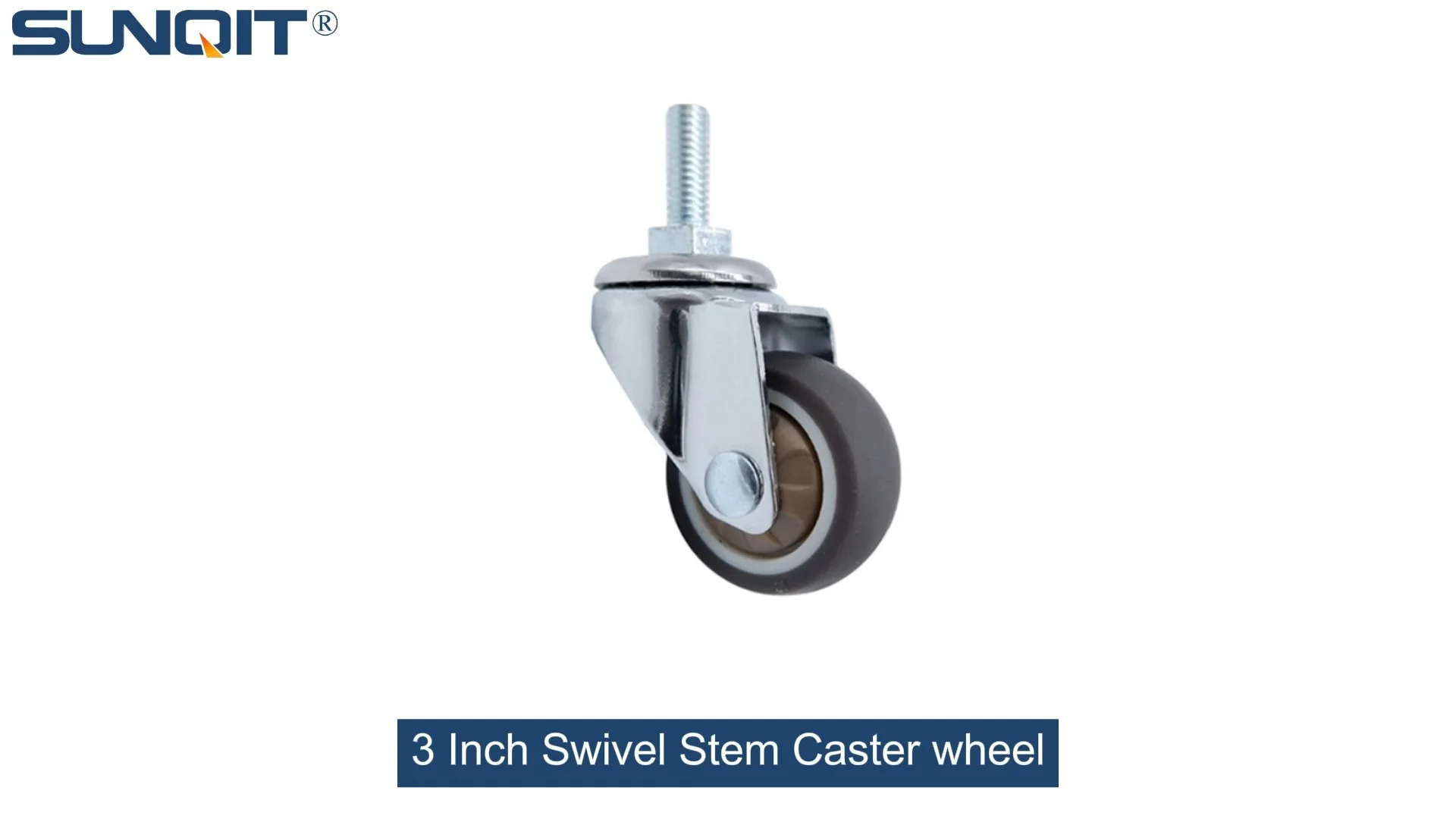
Swivel Stem Caster wheel
360 Degree Swivel Stem Caster. Threaded-post mount design, castors diameter 3 inch.Each swivel caster wheels loading 70KGS. Heavy enough and widely suit for carts, chairs, cabinet, flow rack, workbench, turnover rolley.
Walk into any warehouse, factory, or even a busy office, and you'll likely spot them: the unsung heroes of mobility, quietly supporting everything from heavy machinery to office chairs. We're talking about caster wheels—and among the most versatile of them all are swivel stem caster wheels. These small but mighty components play a critical role in keeping operations moving, quite literally. But here's the thing: not all caster wheels are created equal, and one of the most important factors that separates a reliable caster from a disaster waiting to happen is its load capacity. Whether you're setting up a lean system on the factory floor, equipping a workbench for a busy workshop, or choosing casters for a material trolley, understanding load capacity isn't just a technical detail—it's the key to safety, efficiency, and avoiding costly downtime. In this guide, we'll break down everything you need to know about swivel stem caster wheel load capacity, from what it means to how to choose the right one for your needs.
What Are Swivel Stem Caster Wheels, Anyway?
Before we dive into load capacity, let's make sure we're all on the same page about what swivel stem caster wheels are. At their core, a caster wheel is a wheel mounted on a bracket (called a yoke or fork), which allows the wheel to rotate 360 degrees. This swiveling action is what makes them so maneuverable—unlike fixed casters, which only roll forward and backward, swivel casters let you turn and pivot with ease. Now, the "stem" part refers to how the caster attaches to the object it's moving. A stem caster has a rod (the stem) that inserts into a hole or socket on the equipment, making installation straightforward and secure. This design is popular in everything from medical carts to industrial workbenches because it's compact and can handle a wide range of weights.
But not all swivel stem casters are identical. Some come with brakes to lock the wheel in place (we'll talk more about the swivel stem caster wheel with brake later), while others are designed for specific environments, like wet floors or rough terrain. And of course, their load capacity—the maximum weight they can safely support—varies widely. To understand load capacity, we first need to look at the basic components of a swivel stem caster, as each part plays a role in how much weight it can handle.
The Building Blocks: Components of a Swivel Stem Caster Wheel
Every swivel stem caster wheel is made up of a few key parts, and each contributes to its overall load capacity:
- The Wheel: The part that touches the ground. Made from materials like rubber, polyurethane, steel, or nylon, its size (diameter and width), material, and tread design all affect weight distribution and load capacity.
- The Swivel Head: The mechanism that allows the wheel to rotate 360 degrees. It includes bearings (ball bearings, roller bearings, or plain bearings) that reduce friction and ensure smooth movement. A sturdy swivel head is critical for handling heavy loads without seizing up.
- The Stem: The metal rod that attaches the caster to the equipment. Stems can be threaded (screwed into place), grip-ring (pressed into a hole), or expanding (expanding to fit snugly in a socket). The stem's material and diameter determine how well it can transfer weight from the equipment to the caster.
- The Brake (Optional): For casters like the swivel stem caster wheel with brake , a brake mechanism (usually a foot pedal or lever) locks the wheel or swivel head to prevent movement when needed. While brakes don't directly affect load capacity, a well-designed brake adds stability, which is important for safety under heavy loads.
Demystifying Load Capacity: What Does "Load Capacity" Actually Mean?
At its simplest, load capacity is the maximum weight a single caster wheel can support without failing. But here's where it gets a bit nuanced: load capacity isn't just a single number. Most manufacturers specify two types of load capacity for swivel stem casters: static load capacity and dynamic load capacity .
Static vs. Dynamic Load Capacity
Static Load Capacity: This is the maximum weight the caster can support when it's not moving . Think of a loaded workbench parked in one spot for hours—the casters are under static load. Static load capacity is usually higher than dynamic because the weight is evenly distributed and there's no additional stress from movement.
Dynamic Load Capacity: This is the maximum weight the caster can support when it's moving . When equipment is rolling, the caster experiences additional forces: vibrations, shocks from uneven floors, and friction in the swivel head. Dynamic load capacity is lower than static because these forces put extra strain on the wheel, bearings, and stem. For most applications—like a turnover trolley moving across a factory floor—dynamic load capacity is the more important number to consider.
It's also worth noting that load capacity is tested under ideal conditions: smooth floors, proper installation, and even weight distribution. In real-world scenarios, factors like uneven floors, frequent starts/stops, or exposure to chemicals can reduce the effective load capacity. That's why experts recommend never exceeding 80% of the rated dynamic load capacity in everyday use—it's a safety buffer to account for these variables.

Key Factors That Influence Swivel Stem Caster Wheel Load Capacity
Now that we know what load capacity is, let's explore the factors that determine how much weight a swivel stem caster can handle. Understanding these will help you choose the right caster for your needs.
1. Wheel Material: The Foundation of Weight Support
The wheel is the first point of contact with the ground, so its material plays a huge role in load capacity. Here's how common materials stack up:
- Steel Wheels: The heavyweights of the caster world. Steel wheels are incredibly strong and can handle loads up to 10,000 lbs or more per caster. They're ideal for industrial settings with rough floors but can damage delicate surfaces like hardwood or tile.
- Polyurethane Wheels: A popular middle ground. Polyurethane is a synthetic material that combines the durability of plastic with the grip of rubber. It's non-marking (great for finished floors), absorbs shocks, and can handle loads from 200 lbs to 5,000 lbs per caster, depending on size.
- Rubber Wheels: Best for light to medium loads (100 lbs to 1,500 lbs). Rubber provides excellent traction and is gentle on floors, but it can wear down quickly under heavy loads or high temperatures.
- Nylon Wheels: Stiff and resistant to chemicals, oil, and moisture. Nylon wheels handle medium loads (500 lbs to 3,000 lbs) and are a good choice for wet or corrosive environments, though they're noisier than rubber or polyurethane.
2. Wheel Size: Bigger Isn't Always Better—But It Often Helps
Wheel diameter (the distance across the wheel) and width (the distance from one side of the tread to the other) both affect load capacity. Larger diameter wheels distribute weight over a larger area, reducing the pressure on the floor and the wheel itself. For example, a 6-inch diameter wheel will typically handle more weight than a 3-inch wheel of the same material. Similarly, wider wheels spread the load further, which is why heavy-duty casters often have wider treads.
But size isn't everything. A larger wheel may be harder to maneuver in tight spaces, so there's a balance between load capacity and practicality. For example, a lean system workstation in a cramped factory might need smaller casters for maneuverability, even if it means sacrificing some load capacity—though in lean manufacturing, efficiency often relies on both mobility and strength.
3. Swivel Head and Bearings: The Unsung Heroes of Load Handling
Even the strongest wheel won't help if the swivel head can't handle the weight. The swivel head's bearings are especially critical: ball bearings (small metal balls) reduce friction and allow smooth rotation under heavy loads, while roller bearings are better for shock absorption. Casters with high load capacities almost always use precision ball bearings or tapered roller bearings, which are designed to handle radial (sideways) and axial (vertical) loads.
The swivel head's housing (the metal casing that holds the bearings) also matters. Heavy-duty casters have thicker, reinforced housing to prevent bending or cracking under pressure. A poorly made swivel head might work fine for light loads but will seize or break when asked to support hundreds of pounds, putting workers and equipment at risk.
4. Stem Type and Installation: How Well Is the Caster Attached?
The stem is the bridge between the equipment and the caster, so it must be strong enough to transfer the load without bending or pulling out. Threaded stems (common in industrial equipment) are screwed into the equipment, providing a secure connection for heavy loads. Grip-ring stems, which are pressed into a hole, are easier to install but better suited for light to medium loads, as they can loosen over time under heavy weight.
Installation is just as important as the stem itself. A stem that's not properly tightened or seated in the equipment can fail prematurely, even if the caster's rated load capacity is high enough. Always follow the manufacturer's guidelines for stem size and installation torque to ensure maximum load capacity.
5. Environment: When the Floor Fights Back
The environment in which the caster operates can reduce its effective load capacity. For example:
- Uneven Floors: If the floor is bumpy or sloped, the load isn't evenly distributed across all casters, meaning some casters will bear more weight than others. This can push individual casters beyond their rated capacity.
- High Temperatures: Heat can soften materials like rubber or polyurethane, reducing their load-bearing ability. Steel wheels are better for hot environments, like foundries.
- Moisture or Chemicals: Water, oil, or chemicals can corrode metal parts (like stems or swivel heads) or degrade wheel materials, weakening the caster over time.

Types of Swivel Stem Caster Wheels: Matching Load Capacity to Your Needs
Swivel stem casters come in a range of load capacities, from tiny casters for office chairs (50 lbs per caster) to industrial giants for heavy machinery (10,000 lbs+ per caster). To make it easier, they're often categorized by load capacity:
Light-Duty Swivel Stem Casters (Up to 500 lbs per caster)
These are the casters you'll find on office chairs, small carts, or home appliances. They typically have rubber or small polyurethane wheels, grip-ring stems, and basic ball bearings. While they're not built for heavy lifting, they're affordable and easy to install. A light-duty swivel stem caster wheel with brake might be used on a utility cart in a retail store, where mobility and occasional locking are needed but heavy loads aren't a concern.
Medium-Duty Swivel Stem Casters (500 lbs to 2,000 lbs per caster)
The workhorses of warehouses and workshops. Medium-duty casters are common on workbench setups, tool carts, and small lean system trolleys. They often have polyurethane or nylon wheels, threaded stems, and precision ball bearings. A medium-duty swivel stem caster wheel with brake is ideal for a workbench that needs to be moved occasionally but locked in place during use—think of a mobile assembly station on a factory floor, where workers need to reposition their tools quickly.
Heavy-Duty Swivel Stem Casters (2,000 lbs to 10,000+ lbs per caster)
Built for industrial environments, these casters feature steel or large polyurethane wheels, thick steel stems, and roller bearings. They're used on heavy machinery, shipping containers, and large material racks. In lean system manufacturing, where efficiency and durability are key, heavy-duty casters ensure that even loaded pallets or large assemblies can be moved without slowing down production.

How to Calculate Load Capacity for Your Application
Choosing the right caster isn't just about picking a load capacity out of thin air—it requires a bit of math. Here's a simple formula to calculate how much load each caster will need to support:
Total Load ÷ Number of Casters = Load per Caster
But wait—there's a catch. You should always add a safety margin to account for uneven loading, dynamic forces (like pushing or pulling the cart), and wear and tear. Most experts recommend a safety factor of 1.5 to 2.0, meaning you multiply the calculated load per caster by 1.5 or 2.0 to get the minimum load capacity each caster should have.
Example 1: A Mobile Workbench in a Lean System
Let's say you're building a mobile workbench for a lean system production line. The workbench itself weighs 200 lbs, and you expect workers to load it with tools, parts, and assemblies totaling 500 lbs. So the total load is 200 lbs + 500 lbs = 700 lbs. The workbench has 4 casters.
Step 1: Calculate load per caster without safety factor: 700 lbs ÷ 4 casters = 175 lbs per caster.
Step 2: Add a safety factor of 1.5: 175 lbs × 1.5 = 262.5 lbs.
So each caster should have a dynamic load capacity of at least 263 lbs. A medium-duty polyurethane caster with a 3-inch wheel would easily handle this, and adding a swivel stem caster wheel with brake would let workers lock the workbench in place during use.
Example 2: A Heavy-Duty Turnover Trolley
Now, imagine a turnover trolley in a warehouse that carries 2,000 lbs of metal parts. The trolley itself weighs 300 lbs, so total load is 2,300 lbs. It has 6 casters (more casters mean less load per caster).
Step 1: Load per caster without safety factor: 2,300 lbs ÷ 6 casters ≈ 383 lbs per caster.
Step 2: Safety factor of 2.0 (since it's a heavy load): 383 lbs × 2.0 = 766 lbs.
Here, you'd need casters with a dynamic load capacity of at least 766 lbs each. A heavy-duty polyurethane or steel wheel caster with a threaded stem would be the way to go.
Caster Accessories: Small Parts That Make a Big Difference
While the caster wheel and stem get most of the attention, caster accessories play a crucial role in maximizing load capacity and safety. These small parts can enhance performance, extend lifespan, and even boost load capacity in some cases. Let's take a look at the most useful caster accessories :
Bearings: The Key to Smooth Movement Under Load
Bearings reduce friction between the swivel head and the caster yoke, allowing the wheel to rotate freely even under heavy loads. Upgrading to precision ball bearings or sealed roller bearings can significantly improve a caster's ability to handle weight without seizing. For example, a caster with plain bearings might struggle with 500 lbs, but the same caster with ball bearings could handle 800 lbs.
Brake Upgrades: Stability for Heavy Loads
For the swivel stem caster wheel with brake , upgrading to a heavy-duty brake (like a dual-locking brake that locks both the wheel and swivel head) adds stability when the caster is stationary. This is especially important for tall equipment or uneven loads, where a single-wheel brake might not be enough to prevent tipping.
Stem Extensions and Adapters: Customizing for Your Equipment
If your equipment's mounting hole is too deep or the stem is too short, stem extensions or adapters can bridge the gap. These caster accessories ensure a secure connection, which is critical for load capacity—an adapter that's too weak can snap under heavy weight, even if the caster itself is rated for the load.
Wheel Guards and Covers: Protecting Against Debris
In dirty environments (like construction sites or factories with metal shavings), wheel guards prevent debris from getting stuck in the wheel or swivel head. A clogged wheel can cause uneven wear, reducing load capacity over time. Guards are simple caster accessories that extend the life of your casters.
Real-World Applications: Where Swivel Stem Casters Shine
Swivel stem caster wheels are everywhere, but their load capacity makes them indispensable in specific industries. Let's look at a few key applications where choosing the right load capacity is critical:
Lean System Manufacturing: Efficiency Meets Durability
Lean system manufacturing focuses on minimizing waste and maximizing efficiency, and mobility is a big part of that. In lean environments, workstations, material racks, and assembly lines need to be reconfigured quickly to adapt to changing production needs. Swivel stem casters with the right load capacity ensure that even heavy workbenches or material carts can be moved without disrupting workflow. For example, a lean system might use medium-duty swivel stem casters with 1,000 lbs load capacity on a mobile assembly line, allowing workers to shift the line layout in minutes rather than hours.
Workbenches: Mobility for Productivity
A workbench isn't just a table—it's a hub of activity, holding tools, parts, and sometimes heavy machinery. Adding swivel stem casters to a workbench turns it into a mobile workstation, perfect for shared spaces or dynamic production lines. For a woodworking workbench loaded with power tools (500 lbs total), medium-duty casters with 200 lbs load capacity (plus safety factor) would work. For a metalworking bench with a vice and heavy stock (1,500 lbs total), heavy-duty casters with 500 lbs load capacity each are a must.
Healthcare: Safety Under Pressure
In hospitals, swivel stem casters are used on medical carts, beds, and equipment. Here, load capacity is a matter of patient safety. A hospital bed with a 300-lb patient, plus bedding and monitors, might weigh 800 lbs total. With 4 casters, each caster needs a load capacity of at least 300 lbs (with safety factor), and a swivel stem caster wheel with brake ensures the bed stays put during procedures.
Maintenance Tips: Keeping Your Casters Rolling Strong
Even the best swivel stem caster wheels will underperform if not maintained. Regular maintenance not only extends their lifespan but also ensures they continue to handle their rated load capacity. Here are some tips:
- Inspect Regularly: Check for signs of wear, like cracked wheels, bent stems, or loose bearings. A wheel with a flat spot or a stem that wobbles should be replaced immediately—it's a sign the caster is no longer safe for its rated load.
- Clean Often: Remove dirt, debris, and oil from the wheels and swivel head. A stiff brush or compressed air works well. For sticky substances (like grease), use a mild detergent and water.
- Lubricate Bearings: Apply a high-quality lubricant (like lithium grease) to the swivel head bearings every 6 months (or more often in dirty environments). This reduces friction and prevents seizing, which is critical for maintaining load capacity.
- Tighten Loose Parts: Check stem nuts, brake levers, and wheel axles for tightness. Loose parts can cause uneven loading, reducing effective load capacity.
- replace Worn Accessories: If a brake pad wears out or a bearing starts to grind, replace those caster accessories promptly. Waiting can lead to bigger problems (like a seized swivel head) that compromise load capacity.
Frequently Asked Questions About Swivel Stem Caster Wheel Load Capacity
Q: Can I exceed the load capacity if I'm only moving the caster a short distance?
A: No. Load capacity is a safety limit, and exceeding it—even for a short time—can cause the caster to fail, leading to equipment damage or injury. The dynamic forces of moving (like starting, stopping, or turning) actually increase the stress on the caster, so short distances don't reduce the risk.
Q: How does floor type affect load capacity?
A: Soft floors (like carpet) or uneven floors cause the wheel to sink or tilt, increasing the pressure on the wheel and swivel head. This can reduce effective load capacity by 10-30%. For example, a caster rated for 1,000 lbs on concrete might only handle 700 lbs on thick carpet.
Q: Are swivel stem casters with brakes less durable than non-brake casters?
A: Not necessarily. A well-designed
swivel stem caster wheel with brake
is built to the same load capacity standards as non-brake casters. The brake mechanism is separate from the load-bearing components, so as long as the brake is maintained (e.g., replacing worn pads), it won't affect durability.
Q: How many casters should I use for my equipment?
A: At least 4 casters for stability (two swivel, two fixed is common), but more casters reduce the load per caster. For very heavy loads, 6 or 8 casters distribute the weight better. The formula (Total Load ÷ Number of Casters) helps determine how many you need—just remember to add the safety factor.
Q: Can I mix casters with different load capacities on the same equipment?
A: It's not recommended. Casters with lower load capacities will bear more weight than they're rated for, leading to premature failure. Stick to casters with the same load capacity (or higher) to ensure even weight distribution.
Conclusion: Investing in the Right Caster for Long-Term Success
Swivel stem caster wheels might seem like small components, but their load capacity has a big impact on safety, efficiency, and productivity. Whether you're outfitting a lean system workstation, a mobile workbench , or a heavy-duty industrial cart, taking the time to calculate load capacity, choose the right materials, and maintain your casters will pay off in the long run. Remember: the cheapest caster isn't always the best—opting for a high-quality caster with the correct load capacity (and the right caster accessories ) will save you from costly downtime, repairs, and accidents.
So the next time you're shopping for swivel stem casters, ask yourself: What's my total load? How many casters do I need? What environment will they be in? And don't forget to consider extras like the swivel stem caster wheel with brake for added safety. With the right knowledge, you'll find casters that keep your operations moving smoothly—today, tomorrow, and for years to come.