- Company Articles
- Products and Technology
- Product knowledge
- What is the Maximum Length of 4040A EU Standard Aluminum Profile Available?

What is the Maximum Length of 4040A EU Standard Aluminum Profile Available?
Related Product
4040A EU Standard Aluminum Profile
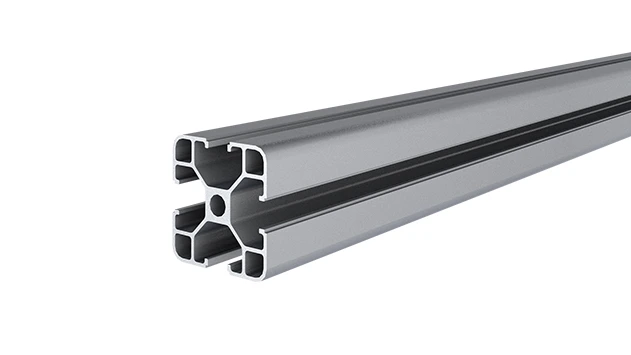
4040A is a 4.00x4.00 CM fractional 40 series square extrusion T-slot profile with four open T-slots, each side with 4.00cm face.
If you've ever walked through a manufacturing plant, a warehouse, or even a modern workshop, you've probably seen them—those sleek, silver structures holding up workbenches, guiding conveyor belts, or forming the frames of material racks. They're aluminum profiles, and they're the unsung heroes of efficient, adaptable spaces. Among the countless types available, one stands out for its versatility and reliability: the 4040A EU Standard Aluminum Profile. But if you're planning a project that relies on these profiles, there's one question that's likely top of mind: What's the maximum length I can get? Let's dive in and explore not just the numbers, but the "why" behind them, and how it impacts everything from your workbench design to your supply chain.
First Things First: What Even Is a 4040A EU Standard Aluminum Profile?
Before we talk lengths, let's make sure we're all on the same page about what a 4040A EU Standard Aluminum Profile actually is. At its core, it's a structural component made from aluminum, shaped through a process called aluminum extrusion profile —think of squeezing toothpaste through a tube, but with molten aluminum and a precision die. The "4040" in the name tells you its cross-section: 40mm wide by 40mm tall, making it a square profile. The "A" denotes a specific variant, often related to the design of its T-slots (those grooves running along the sides) or wall thickness, which affects strength and weight. And "EU Standard" means it adheres to strict European norms for dimensions, tolerances, and material quality—so you know you're getting a consistent, reliable product, whether you buy it in Berlin, Barcelona, or beyond.
These profiles are beloved for a reason. Their T-slots let you slide in accessories like brackets, connectors, or panels without welding, making them infinitely customizable. Need a workbench? Bolt a tabletop to 4040A profiles. A conveyor system? Attach roller tracks to their sides. A material rack? Stack them with shelves. They're lightweight yet strong, resistant to corrosion, and reusable—perfect for lean manufacturing setups where adaptability is key.
What Limits the Length of an Aluminum Profile?
To understand maximum length, we need to peek behind the scenes at how these profiles are made and moved. It's not as simple as "make it as long as possible"—there are practical constraints at every step.
1. The Extrusion Process Itself
Aluminum profiles start as billets—cylindrical blocks of aluminum alloy. These billets are heated, then pushed through a die (a metal mold) under extreme pressure to form the profile's shape. The length of the extruded profile depends on two things: the size of the billet and the power of the extrusion press. A typical billet might be 1-2 meters long, but when stretched through the die, it can produce a profile many times that length. However, there's a limit: too long, and the profile can warp or lose dimensional accuracy as it cools. Extruders balance speed, temperature, and billet size to ensure the final product stays straight and meets EU standards. For 4040A profiles, which have a sturdy 40x40mm cross-section, the extrusion process can handle longer lengths than thinner or more complex profiles, but it's not unlimited.
2. Transportation Headaches
Even if an extruder could make a 20-meter 4040A profile, how would you get it to your workshop? Trucks, trains, and shipping containers have maximum length limits. In most EU countries, standard trucks can carry loads up to 13.6 meters, but that's including the trailer. For long items like aluminum profiles, "oversized load" permits are required for anything over 6-7 meters, which adds costs, paperwork, and logistical delays. Most suppliers stick to lengths that fit in standard transport to keep prices reasonable and delivery reliable. That's why 6 meters is a common sweet spot—it fits in a standard truck bed without extra hassle.
3. Handling and Installation
Imagine trying to maneuver a 10-meter aluminum profile through a factory doorway or up a loading dock. It's heavy (a 6-meter 4040A profile with 2mm wall thickness weighs around 15-20kg), awkward, and risky—one wrong move could bend the profile or cause injury. Shorter lengths are easier to carry, cut, and assemble. Even if your project needs a continuous 8-meter structure, joining two 4-meter profiles with a connector is often more practical than wrestling with a single 8-meter piece. Plus, shorter lengths reduce waste: if you only need 5.5 meters for a workbench, buying a 6-meter profile and cutting off 0.5 meters is better than paying for a custom 5.5-meter length (though many suppliers do offer cut-to-length services for a fee).
4. Structural Integrity
Aluminum is strong, but it's not indestructible. A very long profile, unsupported, will sag under its own weight over time. For example, a 10-meter 4040A profile spanning between two supports might bow in the middle, which is a problem if you're using it for a workbench or conveyor that needs to stay level. To avoid this, you'd need extra supports, which adds complexity and cost. In most cases, using standard lengths (and adding supports or connectors where needed) is more efficient than chasing maximum length.

So, What's the Maximum Length You Can Actually Get?
Now, the moment of truth: for 4040A EU Standard Aluminum Profiles, the standard maximum length offered by most suppliers is 6 meters . This isn't arbitrary—it's the length that balances extrusion feasibility, transportation ease, and practical use. You'll find 6-meter 4040A profiles in stock at most distributors, ready to ship without custom lead times.
But what if 6 meters isn't enough? Maybe you're building a 7-meter-long conveyor track and want to minimize joints. In that case, some suppliers offer custom lengths up to 8-10 meters, but there are caveats. First, it'll cost more—custom extrusion runs or cutting from longer billets take extra time and resources. Second, delivery will be slower, as it may require a special production slot. Third, you'll need to arrange oversized transport, which can add weeks and hundreds of euros to your project. For most businesses, the trade-off isn't worth it—better to use 6-meter profiles and connect them with a 90° aluminum profile connector or a straight joint.
To put this in perspective, let's compare 4040A with other common profiles. Here's a quick table of standard lengths for popular EU standard aluminum profiles:
| Profile Type | Cross-Section (mm) | Standard Length (m) | Max Custom Length (m) | Typical Use Case |
|---|---|---|---|---|
| 4040A EU Standard | 40x40 | 6 | 8-10 | Workbenches, material racks, machine frames |
| 2020 EU Standard | 20x20 | 3-6 | 6-8 | Light-duty frames, shelving, small workstations |
| 4080A EU Standard | 40x80 | 6 | 8 | Heavy-duty conveyor systems, industrial workbenches |
| 3030R EU Standard (Rounded) | 30x30 | 6 | 7 | Retail displays, ergonomic workstations |
As you can see, 4040A holds its own, with a maximum custom length of 8-10 meters—more than enough for most projects, especially when paired with aluminum profile accessories to connect shorter sections.
How Does Length Impact Your Project?
Let's say you're designing a workbench for your assembly line. You need it to be 5 meters long. If you use 6-meter 4040A profiles, you can cut them down to 5 meters, leaving 1 meter of scrap (which you can save for smaller projects). Alternatively, you could buy two 3-meter profiles and join them in the middle with a connector. Which is better? It depends on your priorities: a single 5-meter piece has no joint in the middle, which might be better for stability, but cutting it yourself requires tools and time. Two 3-meter pieces are easier to transport and install, and the connector (like an internal straight aluminum joint) adds minimal bulk. Most manufacturers opt for the latter—using standard lengths and accessories—to keep projects flexible and costs low.
For larger structures, like a 12-meter material rack, you'd likely use four 3-meter profiles or two 6-meter profiles per upright, connected with brackets. The key is that 4040A's T-slots and compatible accessories (end caps, hinges, clamps) make it easy to build big without needing extra-long profiles. In fact, using shorter lengths can be an advantage: if one section gets damaged, you only need to replace a 3-meter piece, not a 10-meter one.
Choosing the Right Supplier: More Than Just Length
When sourcing 4040A profiles, the maximum length is just one factor. You also need a supplier who understands your project's needs—someone who can advise on lengths, offer cut-to-size services, and provide the aluminum profile accessories you'll need to put it all together. A good lean pipe supplier , for example, often stocks 4040A profiles alongside lean pipe systems, since they're both used in lean manufacturing setups. They'll know that a 6-meter profile is standard, but can also arrange custom lengths if your project truly demands it.
What should you ask a supplier? Start with: "What's your standard length for 4040A EU profiles?" If they say 6 meters, that's a good sign—they're aligned with industry norms. Then: "Do you offer cut-to-length services?" Most do, for a small fee, which can save you time and reduce waste. Finally: "What accessories do you recommend for joining lengths?" They should be able to suggest connectors, brackets, or end caps that work seamlessly with their profiles, ensuring your structure is strong and meets safety standards.
Wrapping Up: It's About Balance
So, to answer the question: The maximum length of a 4040A EU Standard Aluminum Profile is typically 6 meters for standard orders, with custom lengths up to 8-10 meters available (though less common and more costly). This sweet spot balances extrusion capabilities, transportation practicality, and ease of use. And honestly? For most projects, 6 meters is more than enough. With the right aluminum profile accessories —connectors, brackets, and T-slot hardware—you can build just about anything, from a small workbench to a large conveyor system, using standard lengths. It's why 4040A profiles remain a staple in factories, workshops, and warehouses across Europe: they're reliable, adaptable, and designed to work within the realities of how we make, move, and build things.
So next time you're planning your project, don't get fixated on chasing the longest profile possible. Focus on how to make standard lengths work for you—with a little creativity and the right accessories, 6 meters can go a very long way.