- Company Articles
- Products and Technology
- Product knowledge
- What is the Weight of 4040A EU Standard Aluminum Profile per Meter?

What is the Weight of 4040A EU Standard Aluminum Profile per Meter?
Related Product
4040A EU Standard Aluminum Profile
4040A is a 4.00x4.00 CM fractional 40 series square extrusion T-slot profile with four open T-slots, each side with 4.00cm face.
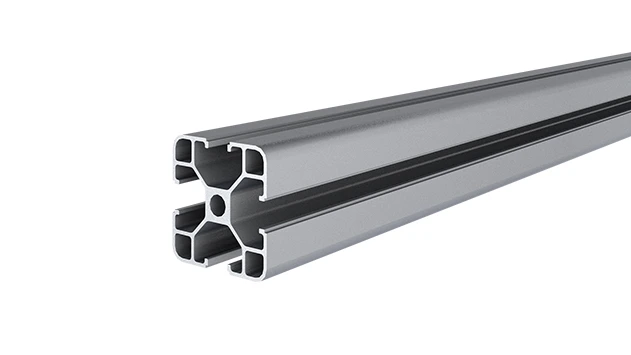
If you've ever walked through a manufacturing plant, visited a workshop, or even peeked behind the scenes of a retail store's stockroom, you've probably seen them—sleek, silver structures holding up workbenches, organizing tools, or guiding products along assembly lines. Those unsung heroes are aluminum extrusion profiles, and among them, the 4040A EU Standard Aluminum Profile stands out as a workhorse in countless industries. But if you're designing a workspace, building a custom (rack), or simply curious about the specs that make these profiles so versatile, one question often rises to the top: How much does a 4040A EU Standard Aluminum Profile weigh per meter? Let's dive into this topic, unpacking not just the numbers, but why they matter, how they're calculated, and how this profile fits into the bigger picture of modern manufacturing.
1. The Rise of Aluminum Extrusion Profiles: Why They're Everywhere
Before we zoom in on the 4040A, let's take a step back and appreciate why aluminum extrusion profiles have become so indispensable. Aluminum itself is a wonder material—lightweight yet surprisingly strong, resistant to corrosion, and infinitely recyclable. When you add extrusion to the mix, you get profiles that can be shaped into almost any cross-section, from simple squares to complex, custom designs. This flexibility is why they're used in everything from car frames to window frames, and yes, the workbenches and lean system setups that keep factories running smoothly.
Extrusion works by forcing heated aluminum billets through a die (a metal mold) to create long, uniform shapes. The result? Profiles with precise dimensions, consistent strength, and T-slots (those grooves you see along the edges) that make it easy to attach accessories like brackets, panels, or connectors. For manufacturers, this means less time spent on cutting and welding, and more time innovating. For small businesses or DIY enthusiasts, it means building sturdy, modular structures without needing specialized tools. And for the planet? Aluminum's high recyclability (over 95% of the energy used to produce it can be saved by recycling) aligns with the growing demand for sustainable manufacturing practices.
2. EU Standards: The Backbone of Quality and Consistency
Now, not all aluminum profiles are created equal. That's where standards come in. The EU has strict guidelines for aluminum extrusion profiles, outlined in EN 755 (a set of European standards covering aluminum and aluminum alloy extruded profiles). These standards ensure that profiles meet specific criteria for dimensions, mechanical properties (like tensile strength), and surface quality. Why does this matter? Imagine ordering a profile from one supplier and a connector from another—if they don't follow the same standards, they might not fit together. EU standards eliminate that headache, making profiles and accessories interoperable across brands and countries.
For the 4040A, "EU Standard" isn't just a label; it's a promise. It means the profile's dimensions, wall thickness, and material composition are consistent, whether you buy it in Germany, France, or Poland. This consistency is especially crucial for lean system setups, where even a millimeter of variation can throw off the alignment of a conveyor or the stability of a workbench. So when we talk about the 4040A, we're talking about a profile built to meet these rigorous standards—something you can trust to perform reliably, no matter the application.

3. Decoding the 4040A: What the Name Tells Us
Let's start with the basics: What does "4040A" actually mean? The first two numbers, "40," refer to the profile's cross-sectional dimensions. In this case, it's 40mm by 40mm—so a square profile, 4 centimeters on each side. The "A" at the end is a bit trickier; it denotes a specific variant within the 40x40mm family. Different manufacturers might use "A," "B," or "C" to indicate slight differences in design, like the number of T-slots, the depth of the slots, or the wall thickness. For the 4040A, the "A" typically signals a standard design with two or four T-slots (depending on the manufacturer) and a wall thickness that balances strength and weight—key for applications where both durability and maneuverability matter.
To visualize this, picture a 40x40mm square tube. The outer edges are straight, and along each side, there's a T-shaped slot running the length of the profile. These slots are what make the 4040A so versatile: you can slide in bolts, nuts, or specialized aluminum profile accessories like end caps or angle brackets to build just about anything. But the star of the show here is the wall thickness—the thin layer of aluminum that gives the profile its strength. This thickness is the primary factor in determining the profile's weight per meter, so let's focus on that next.
4. Calculating the Weight of 4040A: The Formula That Matters
Weight might seem like a simple measurement, but for aluminum profiles, it's a balancing act. Too heavy, and the profile becomes hard to transport or install; too light, and it might not support the load you need. So how do manufacturers determine the weight of a 4040A per meter? It all comes down to two things: volume and density .
The formula is straightforward: Weight = Volume × Density . Let's break it down. First, volume: for a linear profile, volume per meter is calculated by multiplying the cross-sectional area (in square meters) by the length (1 meter). Then, multiply that volume by the density of the aluminum alloy used (typically around 2.7 grams per cubic centimeter for 6063 aluminum, the most common alloy for profiles). But to get the cross-sectional area, we need to account for the profile's hollow design—after all, it's a tube, not a solid block of aluminum.
Let's use a common example for 4040A: a wall thickness of 1.5mm. The outer dimensions are 40mm x 40mm, so the outer area is 40mm × 40mm = 1600 mm². The inner dimensions (the hollow part) would be outer dimensions minus twice the wall thickness (since the wall is on both sides): (40mm - 2×1.5mm) × (40mm - 2×1.5mm) = 37mm × 37mm = 1369 mm². The cross-sectional area of the aluminum itself is then outer area minus inner area: 1600 mm² - 1369 mm² = 231 mm². To convert this to cubic meters (for volume per meter), we multiply by 1 meter (1000mm) and convert units: 231 mm² × 1000 mm = 231,000 mm³ = 231 cm³ (since 1 cm³ = 1000 mm³). Finally, multiply by density: 231 cm³ × 2.7 g/cm³ = 623.7 grams, or approximately 0.62 kilograms per meter.
But wait—wall thickness can vary. Some 4040A profiles might have a 2.0mm wall for heavier loads, while others could be as thin as 1.2mm for lighter applications. Let's see how that changes the weight:
| 4040A Variant | Outer Dimensions (mm) | Wall Thickness (mm) | Inner Dimensions (mm) | Cross-Sectional Area (mm²) | Weight per Meter (kg) |
|---|---|---|---|---|---|
| Standard (1.5mm wall) | 40x40 | 1.5 | 37x37 | 231 | ~0.62 |
| Heavy-Duty (2.0mm wall) | 40x40 | 2.0 | 36x36 | 304 | ~0.82 |
| Lightweight (1.2mm wall) | 40x40 | 1.2 | 37.6x37.6 | 183 | ~0.49 |
These numbers are estimates, as slight variations in wall thickness (due to manufacturing tolerances) can affect the final weight by a few grams. Always check with your supplier for exact specs, but this gives you a good baseline.
5. How 4040A Compares to Other Common Profiles
To truly understand the 4040A's weight, it helps to compare it to similar profiles. Let's look at a few popular options:
4040A vs. 4040B: The "B" variant often has a thicker wall (say, 2.5mm) for extra strength. A 4040B with a 2.5mm wall would have an inner dimension of 35x35mm, a cross-sectional area of 375 mm², and a weight of ~1.01 kg/m—significantly heavier than the standard 4040A. It's ideal for heavy machinery or high-load racks but overkill for simple workbenches.
4040A vs. 3030A: The 3030A is a smaller profile (30x30mm). With a 1.5mm wall, its cross-sectional area is around 171 mm², weighing ~0.46 kg/m. It's lighter and more compact, great for small shelves or lightweight workstations, but can't match the 4040A's load capacity.
4040A vs. 2020A: Even smaller (20x20mm), the 2020A with a 1.2mm wall weighs just ~0.2 kg/m. It's perfect for delicate setups like 3D printer frames or small electronics workbenches but would buckle under the weight of, say, a tool chest full of equipment.
The 4040A sits in the sweet spot—light enough to be maneuverable, strong enough for most industrial and commercial applications, and compatible with a wide range of aluminum profile accessories.
6. Real-World Uses: Where 4040A Shines
Numbers are one thing, but seeing the 4040A in action brings its weight into perspective. Let's look at a few common applications:
Workbenches: The Foundation of Productivity
Walk into any workshop, and you'll likely find workbenches built with 4040A profiles. A typical workbench frame might use four vertical 4040A legs (each 1.5 meters tall) and horizontal crossbars. With a weight of ~0.62 kg/m, a 1.5m leg weighs ~0.93 kg—light enough for two people to carry, but strong enough to support a wooden or metal top, tools, and whatever project you're working on. Add aluminum profile accessories like end caps (to cover sharp edges) and gussets (to reinforce corners), and you've got a sturdy, customizable workspace that won't sag under pressure.
Lean System Setups: Streamlining Manufacturing
Lean manufacturing is all about efficiency—eliminating waste, reducing downtime, and keeping workflows smooth. 4040A profiles are a cornerstone of lean systems, used to build flow racks (for organizing parts), conveyor supports, and material handling trolleys. For example, a flow rack might use 4040A uprights and crossbars to hold inclined roller tracks, allowing parts to slide down to the assembly line. The profile's weight ensures the rack stays stable, even when fully loaded, while its T-slots make it easy to adjust the height or add new shelves as needs change.
Retail Displays: Combining Form and Function
It's not just factories that love the 4040A. Retailers use it to build custom display racks, pop-up stands, or mobile product carts. Its sleek, silver finish looks professional, and its lightweight design makes it easy to rearrange store layouts. A display rack with 4040A frames can hold stacks of clothing, electronics, or groceries without looking bulky, and since it's corrosion-resistant, it holds up well in high-traffic areas.
7. Aluminum Profile Accessories: Making 4040A Even More Versatile
A profile is only as good as the accessories that go with it, and the 4040A plays well with others. Here are a few must-have accessories that enhance its functionality:
Connectors: 90° aluminum profile connectors, 45° connectors, and 3-way connectors let you join profiles at any angle. They slide into the T-slots and tighten with bolts, creating strong, rigid joints without welding.
End Caps: These plastic or aluminum caps snap onto the ends of the profile, covering sharp edges and giving a clean, finished look. They're especially important for workbenches where hands might brush against the ends.
Panels and Plates: Attach plywood, acrylic, or aluminum honeycomb panels to the T-slots to create work surfaces, shelves, or machine guards. The 4040A's weight ensures the panels stay flat and stable.
Casters: Add casters to the bottom of a 4040A frame, and you've got a mobile workstation or trolley. The profile's moderate weight means the casters won't struggle to roll, even when loaded.
8. Common Questions About 4040A Weight
Q: Does surface treatment (like anodizing) affect the weight?
A: Anodizing is a thin layer (usually 5-20 microns) that adds corrosion resistance and color. It adds negligible weight—maybe a gram or two per meter. Not enough to impact your design.
Q: Can I get a custom wall thickness for 4040A?
A: Yes! Many suppliers offer custom extrusions. A thicker wall (e.g., 3.0mm) would increase the weight (up to ~1.2 kg/m for 4040A), but it's worth it for extreme loads. Just be prepared for longer lead times and higher costs.
Q: How does aluminum's weight compare to steel?
A: Steel is much denser (~7.85 g/cm³ vs. aluminum's 2.7 g/cm³). A steel profile with the same dimensions as 4040A would weigh ~2.5x more—great for structural beams but terrible for anything that needs to be moved regularly.
9. Conclusion: Why 4040A's Weight Makes It a Winner
At the end of the day, the weight of a 4040A EU Standard Aluminum Profile per meter (roughly 0.5-1.0 kg/m, depending on wall thickness) is more than just a number. It's a testament to aluminum's unique properties—strength without the bulk—and a key reason why this profile is the backbone of so many industries. Whether you're building a workbench, setting up a lean system, or designing a retail display, the 4040A offers the perfect balance of weight, strength, and versatility. And with a little knowledge of how that weight is calculated, you can make informed decisions that ensure your project is safe, efficient, and built to last.
So the next time you see a sleek aluminum structure holding up the tools, products, or projects that matter, take a moment to appreciate the engineering behind it—starting with the weight of that 4040A profile, quietly doing its job, one meter at a time.