- Company Articles
- Products and Technology
- Product knowledge
- What Load Capacity Do You Need? Swivel Stem Caster Wheel with Brake Selection

What Load Capacity Do You Need? Swivel Stem Caster Wheel with Brake Selection
Related Product
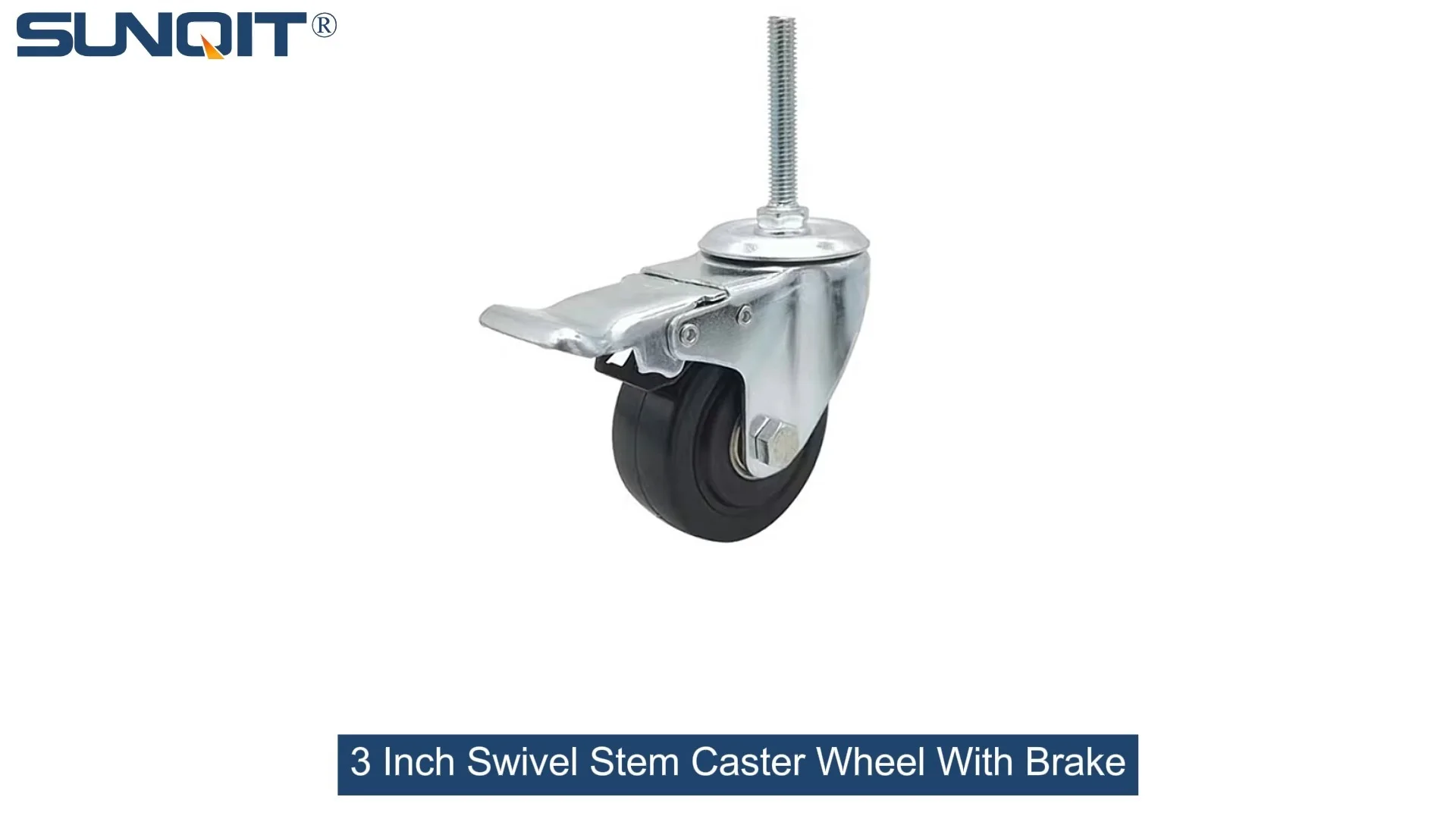
Swivel Stem Caster Wheel with Brake
360 Degree Swivel Stem Caster with brake. Threaded-post mount design, castors diameter 3 inch.Each swivel caster wheels loading 70KGS. Heavy enough and widely suit for carts, chairs, cabinet, flow rack, workbench, turnover rolley.
In the bustling world of workshops, warehouses, hospitals, and even offices, there's a humble component that keeps operations moving—quite literally: caster wheels. These small but mighty tools attach to everything from tool cabinets and medical carts to heavy-duty workbenches and material racks, turning static furniture into mobile assets. But not all caster wheels are created equal. When it comes to selecting the right one, especially a swivel stem caster wheel with brake , one factor stands above the rest: load capacity. Choose a caster that's too weak, and you risk accidents, equipment damage, or frustratingly immobile carts. Choose one that's overkill, and you're wasting money on unnecessary bulk. So, how do you determine the load capacity you truly need? Let's dive in.
Understanding Swivel Stem Caster Wheels with Brakes
Before we get into load capacity, let's clarify what a swivel stem caster wheel with brake actually is. At its core, it's a caster wheel designed to rotate 360 degrees (swivel), mounted on a stem that screws or bolts into the bottom of equipment (stem mount), and equipped with a brake mechanism to lock the wheel in place. This combination of mobility and control makes it a staple in environments where equipment needs to be both maneuverable and stationary on demand—think assembly lines, hospital corridors, or warehouse picking stations.
The "stem" is the metal rod that connects the caster to the equipment. Stem mounts are popular because they're easy to install, secure, and work well with hollow or thin surfaces (like the legs of a workbench ). The "swivel" feature lets the wheel rotate freely, allowing the equipment to turn in any direction without dragging. And the "brake"? That's the safety net. Brakes can lock the wheel (preventing rotation) or the swivel (preventing turning), or both—critical for keeping heavy loads stable when loading/unloading or when precision positioning is needed.
Why Load Capacity Isn't Just a Number—It's a Safety Imperative
Load capacity refers to the maximum weight a single caster wheel can support without failing. Seems straightforward, right? But here's the catch: it's not just about the weight of the equipment itself. It's about the total weight of the equipment plus whatever it's carrying—tools, materials, products, or even people. Underestimating this total is where most problems start.
Imagine a workbench in a manufacturing plant. The bench itself might weigh 200 pounds, but when loaded with power tools, metal parts, and a day's worth of supplies, that weight could jump to 500 pounds or more. If the casters under that bench are rated for only 300 pounds total, each caster (assuming four casters) is carrying 125 pounds—way over its individual limit. Over time, the wheels might crack, the stem could bend, or the brake could fail. Worse, during movement, an overloaded caster might seize, causing the bench to tip or the operator to strain their back. In a warehouse, a cart with underrated casters could collapse under a pallet of goods, leading to damaged inventory or workplace injuries.
On the flip side, overrating load capacity isn't ideal either. A caster built for 1,000 pounds will be bulkier, heavier, and more expensive than one rated for 500 pounds. It might also be harder to maneuver, defeating the purpose of having a mobile workbench or cart in the first place. So, finding that sweet spot—enough capacity to handle the load safely, but not so much that it hinders usability—is key.

Breaking Down Load Capacity Ratings: Static vs. Dynamic
When shopping for swivel stem caster wheel with brake options, you'll notice two load ratings: static and dynamic. Understanding the difference is critical.
Static Load Capacity
Static load is the weight a caster can support when the equipment is stationary . This is the "parked" weight—when the brake is engaged, and the wheel isn't moving. Static load ratings are usually higher than dynamic ratings because there's no added stress from rolling, friction, or sudden stops.
Dynamic Load Capacity
Dynamic load is the weight a caster can support when the equipment is moving . This includes not just the weight of the load but also forces like acceleration, deceleration, bumps in the floor, and turns. When a caster rolls over a crack or a threshold, for example, the dynamic load spikes temporarily. That's why dynamic ratings are lower than static ones—manufacturers account for these extra stresses.
So, which one matters more? Both. But if your equipment spends most of its time moving (like a warehouse cart), dynamic load is your primary concern. If it's mostly stationary but occasionally moved (like a workbench that stays in one spot until a project finishes), you still need to ensure dynamic capacity is sufficient for those movement moments.

Calculating Your Total Load: A Step-by-Step Guide
The first rule of caster selection: always calculate the total load first . Here's how to do it right:
Step 1: Weigh the Equipment (Empty)
Start with the basics: the weight of the equipment itself. If you don't have the manual, use a scale. For example, a metal workbench might weigh 250 pounds empty.
Step 2: Estimate the Maximum Load It Will Carry
What will you put on the equipment? Tools, boxes, parts, etc. Be generous here—don't just calculate for average use; think about worst-case scenarios. If the workbench holds tools (50 lbs), raw materials (150 lbs), and a laptop (10 lbs), that's 210 pounds of load. Add that to the empty weight: 250 + 210 = 460 pounds total.
Step 3: Account for Uneven Weight Distribution
.,,., 33%( 25%,)..
Step 4: Divide by the Number of Casters (and Add a Safety Factor)
. 33% , 460 x 0.33 ≈ 152 .—— 50% .?(,). 152 x 1.5 = 228 . 228 capacity.
Example: Workbench Caster Calculation
Empty workbench weight:
250 lbs
Maximum load:
210 lbs
Total weight:
460 lbs
Number of casters:
4
Worst-case distribution (33%):
460 x 0.33 ≈ 152 lbs per caster
Safety factor (50%):
152 x 1.5 = 228 lbs per caster
Required dynamic load capacity per caster:
≥ 228 lbs

Wheel Material Matters: How It Affects Load Capacity
,.,——.:
Rubber Wheels
,,,,., 100-300 .,.
Polyurethane Wheels
.,,(),—— 300-800 . ,,.
Nylon/Plastic Wheels
,,,., 500-1,200 .?,.
Steel Wheels
. 1,000 ,().,,,.
Wheels
,(1,500 ),.,.
,( 4 ):
| Wheel Material | Typical Dynamic Load Capacity (per wheel, 4" diameter) | Best For |
|---|---|---|
| Rubber | 100-300 lbs | Smooth indoor floors, light loads, quiet environments |
| Polyurethane (on steel core) | 300-800 lbs | General use, workbenches , carts, moderate loads |
| Nylon | 500-1,200 lbs | Industrial settings, chemical resistance, heavy tools |
| Steel | 1,000-2,500 lbs | Extreme loads, rough surfaces, outdoor/warehouse use |
Beyond Load Capacity: Other Features to Consider
, :
Brake Type
."",——."",——.,.
Wheel Size
,,(). 5 3 ,.
Stem Length and Diameter
.,.,..
Caster Accessories
for Added Durability
Caster accessories can boost performance and extend lifespan. For example, a reinforced stem (to prevent bending), a double-wheel configuration (to distribute load), or a floor protector (to reduce friction and wear). In high-load applications, consider accessories like shock-absorbing springs or precision bearings to reduce stress on the wheel and swivel mechanism.
Real-World Scenarios: Choosing Casters for Common Equipment
Let's put this all together with a few examples of how load capacity calculations play out in everyday settings:
Scenario 1: Warehouse Picking Cart
Empty cart weight:
150 lbs
Maximum load (boxes of products):
400 lbs
Total weight:
550 lbs
Number of casters:
4
Worst-case distribution (33%):
550 x 0.33 ≈ 182 lbs
Safety factor (50%):
182 x 1.5 = 273 lbs per caster
Recommendation:
Polyurethane wheels (4" diameter) rated for 300+ lbs, with total-lock brakes for stability on warehouse floors.
Scenario 2: Hospital Medical Cart
Empty cart weight:
100 lbs
Maximum load (medications, equipment, supplies):
250 lbs
Total weight:
350 lbs
Number of casters:
4
Worst-case distribution (33%):
350 x 0.33 ≈ 116 lbs
Safety factor (50%):
116 x 1.5 = 174 lbs per caster
Recommendation:
Rubber wheels (3" diameter) rated for 200+ lbs, with quiet swivel and easy-to-use brakes (critical for patient areas).
Scenario 3: Industrial
Workbench
Empty bench weight:
300 lbs
Maximum load (tools, metal parts, machinery):
600 lbs
Total weight:
900 lbs
Number of casters:
4
Worst-case distribution (33%):
900 x 0.33 ≈ 297 lbs
Safety factor (50%):
297 x 1.5 = 446 lbs per caster
Recommendation:
Steel-core polyurethane wheels (5" diameter) rated for 500+ lbs, with heavy-duty stems and dual-locking brakes.
Common Mistakes to Avoid
Even with careful calculations, it's easy to slip up. Here are the most common mistakes to watch for:
Mistake 1: Using the "Average" Load Instead of "Maximum"
——. 100 , 400 , 400 .
Mistake 2: Ignoring Floor Conditions
,.,().
Mistake 3: Overlooking Brake Quality
..(),.
Mistake 4: Forgetting About
Caster Accessories
Caster accessories like stem extenders, lock washers, or bearing upgrades can solve common problems. For example, if the stem is too short, a stem extender can add length without compromising strength.
Maintenance: Keeping Casters Performing at Peak Capacity
,:
- : ,.
- : ,.
- : ,,.
- : ,——.
Final Thoughts: Investing in the Right Casters Saves Time, Money, and Headaches
——,.,,,,,,.
:——,,.:"?",.