- Company Articles
- Products and Technology
- Product knowledge
- What Makes a High-Quality Aluminum Profile 3 Way Connector?

What Makes a High-Quality Aluminum Profile 3 Way Connector?
Related Product
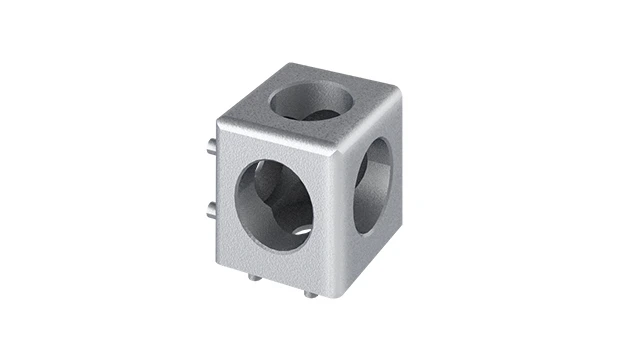
Aluminum Profile 3 Way Connector
The 3 way - squared corner connector is an external fastening method that is typically used to create a corner connection between three profiles. It is a heavy-duty connection that is simple to use and provides a polished look.
Walk into any modern manufacturing facility, and you'll witness a symphony of precision: assembly lines where products take shape, workbenches cluttered with tools yet oddly organized, and material racks that seem to defy gravity as they hold heavy components. Behind this orchestration lies a hidden framework—aluminum extrusion profiles, the backbone of modular industrial design. But what transforms these sleek, silver beams into functional structures? The answer is simple yet critical: connectors. And among the most versatile of these connectors is the aluminum profile 3 way connector. It's the unsung hero that lets you build corners, branches, and intersections, turning linear profiles into three-dimensional systems. But here's the catch: not all 3 way connectors are created equal. A cheap, poorly made connector can turn a sturdy workbench into a wobbly liability, while a high-quality one becomes the silent guarantee of safety, efficiency, and longevity. So, what separates the best from the rest? Let's unpack the qualities that define a superior aluminum profile 3 way connector.
1. The Foundation: Premium Aluminum Alloy
At the heart of any high-quality connector is the material it's made from. Aluminum profile 3 way connectors are typically crafted from aluminum alloys, but not just any alloy will do. The best manufacturers opt for 6063-T5 aluminum alloy —a material renowned for its balanced blend of strength, corrosion resistance, and workability. Why 6063-T5? Let's break it down.
First, 6063 aluminum is an extrusion-grade alloy, meaning it flows smoothly through dies during manufacturing—a critical trait for creating complex connector shapes with precise dimensions. Unlike cheaper alloys, it resists cracking or warping under the pressure of extrusion, ensuring consistent wall thickness and structural integrity. Second, the "T5" designation refers to its heat treatment: solution heat-treated and then artificially aged. This process (strengthens) the alloy, boosting its tensile strength to around 180 MPa and yield strength to 110 MPa—numbers that translate to a connector that can handle heavy loads without bending or deforming.
Contrast this with low-quality connectors, often made from recycled aluminum or soft alloys like 1100 (99% pure aluminum). These materials may be cheaper, but they lack the structural rigidity needed for industrial use. A recycled aluminum connector might contain impurities like iron or copper, which create weak points prone to brittleness. Imagine tightening a bolt into such a connector—instead of the threads gripping firmly, they strip, leaving you with a loose joint that compromises the entire structure. Worse, soft alloys deform under sustained load; a material rack supported by these connectors might start sagging after just a few months of use.
High-quality connectors also avoid "fillers" or hollow sections where strength matters. Some manufacturers cut corners by thinning walls or adding hollow cores to reduce material costs, but this is a false economy. A 3 way connector with uniform wall thickness (typically 2-3mm for standard sizes) distributes stress evenly across its structure, preventing cracks from forming at stress points. When you hold a premium connector, you'll notice its heft—substantial but not excessive, a telltale sign of dense, high-purity aluminum.
2. Precision Engineering: Tolerances That Make a Difference
If material is the foundation, precision is the blueprint. A 3 way connector's job is to join three aluminum profiles at specific angles (often 90°, 135°, or custom angles), and even the smallest misalignment can throw the entire structure off. That's why high-quality connectors are engineered with microscopic attention to detail.
Let's start with dimensional tolerances . The holes where bolts pass through to secure the connector to the profile must align perfectly with the T-slots on the aluminum profile. The best manufacturers hold tolerances as tight as ±0.05mm for these critical holes. To put that in perspective, a human hair is about 0.08mm thick—so we're talking about precision finer than a strand of hair. Why does this matter? If a hole is even 0.1mm off-center, the bolt may bind when tightened, stripping the threads or warping the connector. Over time, this misalignment creates uneven stress, turning a tight joint into a loose one that wobbles with vibration.
Angular accuracy is another non-negotiable. A 3 way connector designed for 90° joints must maintain that angle within ±0.5°. Imagine building a square workbench with connectors that are off by just 1°—the top would (skew), tools would slide off, and the structure would rock. High-quality connectors achieve this precision through CNC machining, where computer-controlled mills carve the angles with mathematical exactness. Low-quality connectors, by contrast, are often cast in molds with poor tolerances, resulting in angles that vary by 2-3°—enough to make assembly a frustrating guessing game.
Surface finish plays a role too. The best connectors have smooth, burr-free edges, both for safety and functionality. A burr might seem minor, but when you slide a profile into the connector, a rough edge can scratch the profile's anodized coating, exposing it to corrosion. Worse, burrs can prevent the profile from seating fully, leaving gaps that weaken the joint. High-quality manufacturers use deburring tools and tumbling processes to ensure every edge is smooth to the touch.
| Feature | High-Quality Connector | Low-Quality Connector |
|---|---|---|
| Hole Alignment Tolerance | ±0.05mm | ±0.2mm or more |
| Angular Accuracy (90° joint) | ±0.5° | ±2-3° |
| Surface Finish | Smooth, burr-free, anodized | Rough edges, visible burrs, uneven paint |
| Wall Thickness | Uniform (2-3mm) | Inconsistent, thinned in non-visible areas |

3. Structural Design: More Than Just a "T" Shape
A 3 way connector's job isn't just to "connect"—it's to distribute force . When you attach three aluminum profiles to a connector, every load (whether from a heavy tool on a workbench or a stack of boxes on a material rack) travels through the connector. A well-designed connector spreads this force evenly, while a poorly designed one concentrates it, creating weak points that fail over time.
Take the ribbing (internal reinforcing) of the connector, for example. High-quality 3 way connectors often have internal ribs—thin, raised structures that add rigidity without adding excessive weight. These ribs act like the beams in a bridge, preventing the connector from flexing when pressure is applied. For instance, a connector without ribs might bend slightly when you tighten a bolt, loosening the joint over time. With ribs, the connector stays rigid, keeping the bolt tight and the joint secure.
The contact area between the connector and the profile is another key design element. The best connectors have deep, wide grooves where the profile fits, maximizing the surface area in contact. This isn't just about stability—it's about load distribution. A larger contact area means the weight of the structure is spread across more of the profile's surface, reducing stress on any single point. Low-quality connectors, by contrast, have shallow, narrow grooves, so only a small portion of the profile actually touches the connector. This can cause the profile to indent or even crack under heavy loads.
Then there's the threaded inserts (if the connector uses them). Some 3 way connectors come with pre-threaded holes for bolts, eliminating the need for T-nuts. In high-quality models, these threads are cut into steel inserts that are press-fit into the aluminum. Steel is stronger than aluminum, so the threads resist stripping even when bolts are tightened repeatedly. Cheap connectors skip the steel inserts, threading directly into the aluminum. Over time, the soft aluminum threads wear down, turning a tight bolt into a loose one with a simple twist.
Even the shape of the connector matters. Look closely at a premium 3 way connector, and you'll notice its edges are rounded, not sharp. This isn't just for safety (though it does prevent cuts during assembly); rounded edges reduce stress concentration. Sharp corners act like tiny fault lines, where cracks can start and spread under vibration or load. Rounded edges distribute stress more evenly, making the connector more durable in high-vibration environments like assembly lines.

4. Compatibility: Playing Well With Others
A 3 way connector is only as good as its ability to work with other components—and in the world of aluminum profiles, that means compatibility with aluminum profile accessories , T-slots, and standard profile sizes. The best connectors are designed to fit the most common profile series, like 2020, 3030, 4040, and 4080 (named for their width and height in millimeters). But compatibility goes beyond just "fitting"—it's about seamless integration.
Let's start with T-slot alignment. Aluminum profiles have T-shaped slots along their length, where bolts, nuts, and accessories attach. A high-quality 3 way connector's holes align perfectly with these slots, regardless of the profile size. For example, a 4040 profile has T-slots 8mm wide; the connector's bolt holes should be spaced to match the slot positions, so a T-nut can slide in easily and the bolt can tighten without binding. Low-quality connectors often have generic hole spacing, forcing users to drill new holes or use shims to make them fit—compromising both safety and efficiency.
Compatibility with other connectors is also critical. In complex structures, a 3 way connector might need to work alongside a 90° aluminum profile connector or a 135° aluminum profile connector to create angles and branches. High-quality connectors from reputable brands follow industry standards, ensuring that all their accessories work together seamlessly. Imagine building a material rack where a 3 way connector on the bottom shelf doesn't align with a 90° connector on the top—suddenly, the entire structure is lopsided. Reputable manufacturers test their connectors as a system, not in isolation, to avoid these headaches.
Even the finish matters for compatibility. Most aluminum profiles are anodized (a process that adds a protective oxide layer), and high-quality connectors are anodized to the same thickness (typically 10-15 microns). This ensures that when the connector and profile are joined, there's no galvanic corrosion—a chemical reaction that occurs when two dissimilar metals (or metals with different finishes) touch in a humid environment. Low-quality connectors might skip anodization or use a thinner coating, leading to unsightly rust spots at the joints over time.
5. Durability: Built to Outlast the Structure
Industrial equipment isn't meant to be temporary. A well-built workbench or material rack should last for years, even decades. That means its connectors must be durable enough to outlast the structure itself. High-quality aluminum profile 3 way connectors achieve this through a combination of corrosion resistance, wear resistance, and fatigue strength.
Corrosion resistance starts with the anodization process. As mentioned earlier, high-quality connectors undergo anodizing—a process where the aluminum surface is converted into a hard, porous oxide layer that's then sealed. This layer acts as a barrier against moisture, chemicals, and salt (critical for factories near coastal areas). The best connectors can withstand 500+ hours of salt spray testing (per ASTM B117 standards) without showing signs of corrosion. By contrast, cheap connectors might be painted or powder-coated, which chips easily, exposing the aluminum to rust. Imagine a food processing plant where moisture is constant—within months, a painted connector would start flaking, leaving the joint vulnerable.
Wear resistance is equally important, especially for connectors that are assembled and disassembled regularly (a common practice in modular design). The threads, grooves, and contact points must resist wear from repeated use. High-quality connectors use hardened steel inserts for threads, as mentioned earlier, and their contact surfaces are smooth but not slippery—ensuring a tight grip that doesn't loosen over time. Low-quality connectors wear quickly; after a few assemblies, the grooves might become misshapen, and the threads might strip, making the connector useless.
Fatigue strength is the connector's ability to withstand repeated stress without failing. In a factory setting, structures vibrate—from machinery, foot traffic, or even the movement of products on conveyors. Over time, this vibration can cause metal fatigue, leading to cracks. High-quality connectors are tested for fatigue, often undergoing thousands of stress cycles to ensure they don't weaken. For example, a connector might be subjected to 10,000 cycles of loading and unloading at 70% of its maximum capacity—if it survives without cracking, it's deemed fatigue-resistant. Cheap connectors skip this testing, and it shows: they might work fine initially but develop cracks after a few months of vibration.
6. Manufacturing Excellence: The Process Behind the Product
Great connectors don't just happen—they're the result of meticulous manufacturing processes. From raw material selection to final inspection, every step matters. Let's walk through the journey of a high-quality aluminum profile 3 way connector.
It starts with material testing . Reputable manufacturers test every batch of aluminum alloy for purity and composition, rejecting any that fall below their standards. This might involve spectrographic analysis to check for impurities or tensile testing to verify strength. Low-quality manufacturers often skip this step, using whatever aluminum is cheapest that day—leading to inconsistent quality.
Next comes extrusion or forging. Most 3 way connectors are either extruded (pushed through a die) or forged (hammered or pressed into shape). Extrusion is ideal for complex shapes, while forging creates denser, stronger metal. High-quality manufacturers use cold forging for critical components, as it work-hardens the aluminum, boosting its strength. The extruded or forged blank is then machined using CNC (computer numerical control) mills, which carve the precise angles, holes, and grooves. CNC machining ensures that every connector is identical, with tolerances as tight as ±0.05mm. Low-quality manufacturers might use manual mills or casting, leading to variations between connectors.
After machining comes surface treatment. The connector is cleaned to remove oils and debris, then anodized. Anodization involves submerging the connector in an acid bath and passing an electric current through it, creating a thick oxide layer. The best manufacturers control the bath temperature, current, and duration to ensure a uniform finish. After anodizing, the connector is sealed to close the pores in the oxide layer, making it more corrosion-resistant. Some low-quality manufacturers skip sealing, leaving the oxide layer porous and prone to staining.
Finally, there's inspection. High-quality manufacturers perform 100% inspection on their connectors, checking dimensions, angles, surface finish, and thread quality. This might involve using coordinate measuring machines (CMMs) to verify tolerances or visual checks for burrs and defects. Any connector that fails inspection is rejected. Low-quality manufacturers often use spot checks (inspecting only a small percentage of connectors), letting defects slip through.
7. Real-World Performance: The Proof in the Factory
At the end of the day, a connector's quality is measured by how it performs in real-world conditions. Let's look at two scenarios to see the difference:
Scenario 1: The Flimsy Connector A small electronics manufacturer buys cheap 3 way connectors to build workbenches for their assembly line. At first, everything seems fine—the workbenches are sturdy, and the connectors fit the 3030 profiles. But after six months, problems start. The connectors loosen, making the workbenches wobble. Workers complain that tools slide off the tables, and once, a heavy soldering iron fell, narrowly missing a worker's foot. When the maintenance team inspects the connectors, they find stripped threads and cracks at the corners. The manufacturer has to replace all connectors, halting production for two days—a cost far higher than buying quality connectors upfront.
Scenario 2: The High-Quality Connector A automotive parts supplier invests in high-quality 3 way connectors for their material racks. The racks hold heavy metal components, and the factory floor vibrates constantly from nearby machinery. Five years later, the racks are still standing strong. The connectors show no signs of corrosion, even though the factory is near the coast. When the supplier expands and needs to reconfigure the racks, the connectors disassemble easily—threads are still tight, and the aluminum hasn't fatigued. The only maintenance needed? A quick wipe-down to remove dust.
The difference? The high-quality connectors were designed to handle vibration, corrosion, and repeated use—factors the cheap connectors ignored. In industrial settings, downtime costs money, and accidents cost even more. A high-quality 3 way connector isn't an expense; it's an investment in reliability.
8. How to Spot a Low-Quality Connector (Before It's Too Late)
Now that you know what makes a high-quality connector, how do you avoid the low-quality ones? Here are red flags to watch for:
- Weight: High-quality aluminum is dense. If a connector feels surprisingly light for its size, it might be hollow or made of a soft alloy.
- Surface finish: Rough edges, uneven coloring, or visible tool marks are signs of poor manufacturing.
- Thread quality: Run a bolt through the threads—if it's too loose or too tight, the threads are poorly cut.
- Branding: Reputable manufacturers stamp their logo or part number on the connector. No branding often means no quality control.
- Price: If it's significantly cheaper than competitors, ask why. Quality aluminum and machining cost money—there's no such thing as a "premium connector" at rock-bottom prices.
Conclusion: The Connector That Connects It All
Aluminum profile 3 way connectors might seem like small components, but they're the linchpin of modular industrial design. A high-quality connector is defined by its material (6063-T5 aluminum), precision engineering (tight tolerances, angular accuracy), thoughtful design (ribbing, contact area, rounded edges), compatibility with aluminum profile accessories and other connectors, durability (anodization, wear resistance), and rigorous manufacturing processes. It's the difference between a structure that lasts decades and one that fails in months. So, the next time you're building a workbench, material rack, or assembly line, remember: the connector you choose isn't just a part—it's the foundation of everything that comes after. Choose wisely.