- Company Articles
- Products and Technology
- Product knowledge
- What Makes Chrome Four Way Straight Lean Pipe Joints Ideal for Modular Systems?

What Makes Chrome Four Way Straight Lean Pipe Joints Ideal for Modular Systems?
Related Product
Four Way Straight Lean Pipe Joint
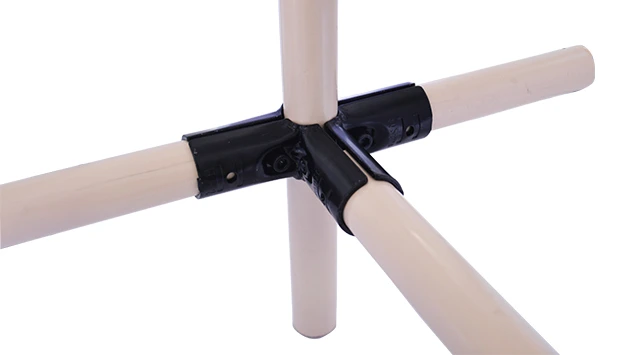
Four way lean pipe joint for 4 pcs 28MM lean pipe connection in straight angle, which used widely in workbench, flow rack, hand trolley frame connection.
Walk into any modern manufacturing facility, warehouse, or assembly plant, and you'll likely notice a common theme: flexibility. Gone are the days of, fixed workstations that take weeks to reconfigure and cost a fortune to replace. Today's operations thrive on adaptability—on systems that can evolve as production needs shift, as new products roll off the line, and as teams strive to do more with less. This is where modular systems shine, and at the heart of these systems lies a small but mighty component: the lean pipe joint. Specifically, the chrome four way straight lean pipe joint has emerged as a unsung hero, quietly enabling the kind of agility that keeps businesses competitive in fast-paced industries.
Imagine a scenario: A production supervisor at a consumer electronics plant needs to retool a section of the assembly line to accommodate a new smartphone model. The old setup, with welded steel frames and bolted shelves, would require days of downtime and a team of contractors. But with modular lean pipe systems? They grab a handful of lean pipes , a box of joints, and within hours, the workbench is reconfigured, flow racks are adjusted, and materials are moving seamlessly again. That's the power of modularity—and it all starts with the right joints.
In this article, we'll dive deep into why chrome four way straight lean pipe joints have become the go-to choice for modular systems. We'll explore their design, their benefits, and how they transform the way teams build, adapt, and optimize workspaces. Whether you're a plant manager looking to streamline operations, a small business owner setting up a workshop, or simply curious about the mechanics behind efficient modular setups, this guide will show you why these unassuming joints are the backbone of modern lean manufacturing.
Understanding Modular Systems: Why Flexibility Matters
Before we zoom in on the joints themselves, let's take a step back to understand what modular systems are and why they've become indispensable in today's industrial and commercial spaces. At their core, modular systems are built from interchangeable components—think pipes, panels, shelves, and connectors—that can be easily assembled, disassembled, and reconfigured to suit changing needs. Unlike traditional fixed structures, which are designed for a single purpose and hard to modify, modular systems are like building blocks for grown-ups: versatile, reusable, and infinitely adaptable.
The rise of modular systems is closely tied to the principles of lean manufacturing, a philosophy centered on eliminating waste, improving efficiency, and maximizing value. In lean environments, every square foot of space, every minute of labor, and every dollar spent must contribute to productivity. Rigid workstations that can't keep up with shifting production demands? That's waste. Storage racks that sit half-empty because they're too tall or too narrow? That's waste. Modular systems combat this by letting teams "right-size" their setups in real time—no more overbuilding, no more underutilizing resources.
But here's the thing: A modular system is only as strong as its weakest link. And in most cases, that link is the joint. Joints are the connectors that hold the system together, determining how securely components attach, how easily they can be adjusted, and how well the entire structure holds up under daily use. A poorly designed joint might loosen over time, limit the number of connections, or corrode in harsh environments—all of which undermine the system's flexibility and longevity. This is why choosing the right joint isn't just a matter of convenience; it's a decision that impacts everything from safety to bottom-line costs.
Anatomy of a Chrome Four Way Straight Lean Pipe Joint: Design That Delivers
So, what exactly is a chrome four way straight lean pipe joint ? Let's break it down. At first glance, it might look like a simple metal piece with holes, but its design is surprisingly thoughtful—engineered to balance strength, versatility, and ease of use. Let's start with the basics:
Materials: Chrome Plating for Durability
Most lean pipe joints are made from steel, but the "chrome" in the name refers to the plating—a thin layer of chromium applied to the surface. This isn't just for shine (though it does give the joint a sleek, professional look). Chrome plating adds a hard, corrosion-resistant barrier that protects the underlying steel from rust, scratches, and wear. In manufacturing environments where spills, humidity, or chemicals are common, this is a game-changer. A chrome-plated joint can withstand daily bumps, cleaning, and exposure to elements that would quickly degrade a plain steel or plastic joint.
Four-Way Connectivity: More Than Just a "T" Joint
The "four way straight" designation is key here. Unlike two-way joints (which connect two pipes in a straight line) or three-way joints (which add a perpendicular branch), four-way straight joints allow for connections in four directions—typically, two along a central axis (straight line) and two perpendicular to that axis (side branches). Picture a cross shape, where the joint sits at the center, and pipes extend outward in four directions. This design unlocks a level of flexibility that's hard to match with simpler joints.
For example, with a four-way joint, you can build a workbench with a main frame, then add side shelves, tool holders, and material bins—all connected at the same joint point. Or, in a flow rack, you can create multi-tiered storage by branching pipes upward and outward, maximizing vertical space without sacrificing stability.
Grip and Stability: How They Hold Pipes Securely
A joint is only useful if it holds pipes tightly. Chrome four way straight lean pipe joints achieve this through a combination of friction and mechanical design. Most feature internal ribs or serrations that bite into the outer surface of the lean pipe when tightened, creating a secure grip. Some also include set screws or bolts that can be tightened with a hex key, further locking the pipe in place. This dual-action design—friction plus mechanical fastening—ensures that even under heavy loads (like a fully stocked flow rack or a workbench with power tools), the joint won't slip or loosen.
Importantly, this grip is adjustable. Need to reposition a pipe? Simply loosen the set screw, slide the pipe to the desired position, and retighten. No welding, no drilling, no permanent modifications. This adjustability is what makes modular systems truly "lean"—you're not stuck with a mistake; you're just one twist of a wrench away from a better setup.

5 Key Benefits That Make Chrome Four Way Straight Lean Pipe Joints Ideal
Now that we understand their design, let's explore why these joints stand out in the world of modular systems. From versatility to durability, they offer a unique combination of benefits that address the most common pain points in workspace design.
1. Unmatched Versatility: Build More with Fewer Components
One of the biggest advantages of four-way joints is their ability to reduce the number of components needed to build complex structures. With a two-way or three-way joint, creating a multi-branched system often requires combining multiple joint types, which can complicate assembly and increase costs. But with a four-way joint, you can connect pipes in four directions from a single point, eliminating the need for extra connectors.
Take a lean pipe workbench as an example. A basic workbench might have a rectangular frame: two long pipes (front and back) connected by shorter pipes (sides). To add a shelf above the work surface, you'd need vertical pipes at each corner, connected by horizontal pipes for the shelf. With three-way joints, each vertical pipe would require a joint to connect the lower frame, the upper shelf, and possibly a side brace. With four-way joints? The vertical pipe can connect to the lower frame (two directions), the upper shelf (third direction), and a side brace (fourth direction)—all in one joint. Fewer parts mean faster assembly, fewer inventory items to track, and a cleaner, less cluttered structure.
This versatility also extends to non-traditional setups. Need a custom material handling trolley with tool hooks on one side and a bin holder on the other? A four-way joint makes it easy to branch out in multiple directions without overcomplicating the frame. It's like having a Swiss Army knife in your modular toolkit—one tool, endless possibilities.
2. Durability That Stands Up to Industrial Use
Manufacturing floors, warehouses, and workshops are tough environments. Pipes get bumped by forklifts, tools get dropped on frames, and daily cleaning routines expose components to water, detergents, and chemicals. A joint that can't handle this abuse will fail quickly, leading to wobbly structures, safety hazards, and costly replacements.
Chrome four way straight lean pipe joints are built to endure. The chrome plating isn't just for looks—it's a hard, wear-resistant layer that resists scratches, dents, and corrosion. Unlike painted joints, which can chip and expose the underlying metal to rust, chrome plating bonds tightly to the steel, creating a barrier that holds up over time. Even in humid environments or areas with frequent moisture (like food processing plants or car washes), chrome joints maintain their integrity, ensuring the system stays stable for years.
But durability isn't just about the plating. The steel core of these joints is often made from high-grade carbon steel, chosen for its strength and rigidity. When combined with the serrated grip design, this means the joint can handle significant weight without bending or deforming. A typical chrome four-way joint can support hundreds of pounds of static load (like a fully stocked flow rack) and dynamic load (like materials sliding down roller tracks), making it suitable for even heavy-duty applications.
3. Tool-Free Assembly (or Close to It) for Lightning-Fast Setup
Time is money, especially in production environments. The longer it takes to assemble or reconfigure a workstation, the more downtime your team faces, and the more productivity suffers. This is where the user-friendly design of chrome four way straight lean pipe joints really shines: they're designed for quick, tool-free (or minimal-tool) assembly.
Most models feature a simple clamping mechanism: slide the pipe into the joint, align it with the desired direction, and tighten a set screw with a hex key (or even just a screwdriver, in some cases). No welding, no drilling, no cutting—just a few twists, and the joint grips the pipe securely. This means a small team can assemble a basic workbench in under an hour, or reconfigure a flow rack in 30 minutes flat.
Compare this to traditional welded structures, which require skilled labor, heavy equipment, and hours (or days) of work. Or even bolt-together systems, which often need wrenches, sockets, and precise alignment to avoid stripping threads. With chrome four-way joints, the barrier to entry is low—any team member can learn to assemble and adjust the system with minimal training, reducing reliance on specialized technicians.
4. Compatibility with a Wide Range of Lean Pipe Accessories
A modular system is only as useful as the accessories you can add to it. Shelves, bins, tool hooks, monitor mounts, ESD mats—these are the extras that turn a basic frame into a fully functional workspace. Chrome four way straight lean pipe joints play well with almost all standard lean pipe accessories, making it easy to customize your setup without compatibility headaches.
Most lean pipe accessories are designed to attach to standard 28mm or 30mm lean pipes (the most common sizes), and since four-way joints connect these pipes, they serve as anchor points for accessories. Need to add a bin rail to your flow rack? Simply attach it to the horizontal pipe connected by a four-way joint. Want to mount a power strip under your workbench? Use a pipe clamp (another common accessory) to secure it to the vertical pipe, connected via a four-way joint.
This compatibility also extends to other joint types. If you need a three-way connection in one part of your system, you can mix four-way and three-way joints without issue—they all connect to the same pipes, using the same fastening methods. This flexibility means you're not locked into a single brand or system; you can mix and match components from different suppliers to get exactly what you need.
5. Cost-Efficiency: Save Money Now and Later
At first glance, modular systems might seem more expensive than traditional fixed structures. After all, buying pipes, joints, and accessories upfront requires an initial investment. But when you factor in the long-term costs—reconfiguration, replacement, and downtime—modular systems with chrome four way straight lean pipe joints often come out ahead.
First, there's the cost of reconfiguration. With fixed structures, changing a workbench or rack means hiring contractors, buying new materials, and losing productivity during the process. With modular systems, reconfiguration is a do-it-yourself job: loosen the joints, move the pipes, retighten, and you're done. No labor costs, no new materials (unless you need to add a few pipes), and minimal downtime. Over time, these savings add up—especially for businesses that frequently launch new products or adjust production lines.
Second, there's durability. Chrome joints last longer than cheaper alternatives (like plastic or unplated steel), reducing the need for replacements. A well-maintained chrome joint can last 5-10 years or more, whereas a plastic joint might crack after a year of heavy use, and unplated steel could rust through in a humid environment. Fewer replacements mean lower long-term costs and less hassle.
Finally, there's the value of adaptability. A modular system with four-way joints can be repurposed as needs change. That workbench you built for assembling small parts? When the product line shifts, disassemble it and build a flow rack for larger components instead. The joints and pipes are reusable, so you're not throwing away money on obsolete equipment. In a world where business needs change fast, this kind of flexibility is priceless.

Real-World Applications: Where Chrome Four Way Straight Joints Shine
To truly appreciate the value of chrome four way straight lean pipe joints, let's look at how they're used in real-world settings. From manufacturing plants to small workshops, these joints are transforming spaces and making teams more efficient.
Lean Pipe Workbenches: Customizable Workstations for Every Task
Workbenches are the heartbeat of any assembly or production area, and no two teams need the same setup. A electronics assembler might need a (ESD) surface, tool hooks, and a monitor mount. A mechanic might need a heavy-duty surface, parts bins, and a vice. With chrome four way straight lean pipe joints, building a workbench that fits these needs is simple.
Consider a workbench built for a small appliance manufacturer. The base frame uses four-way joints to connect the front, back, and side pipes, with vertical pipes at each corner. Halfway up the vertical pipes, four-way joints add horizontal pipes for a lower shelf (for storing tools) and diagonal braces (for stability). Near the top, another set of four-way joints supports an upper shelf for materials and a lighting bar. On one side, a branch from a four-way joint holds a bin rail for small parts; on the other side, a tool board hangs from pipes connected via four-way joints. The result? A workstation that's tailored to the team's exact workflow, with everything within arm's reach—and if the workflow changes next month, it's easy to reposition shelves, add new accessories, or even adjust the height of the work surface.
Flow Racks: Streamlining Material Handling
Flow racks are designed to keep materials moving—literally. They use gravity to feed parts from the back (where they're stocked) to the front (where they're used), reducing the need for workers to bend, reach, or walk to retrieve items. Chrome four way straight lean pipe joints are ideal for building flow racks because they allow for multi-tiered, multi-directional designs that maximize storage density.
A typical flow rack might have a frame with vertical pipes at the corners, connected by horizontal pipes at the top and bottom. Between the vertical pipes, inclined roller tracks (another modular component) carry materials from back to front. To add a second tier of tracks, four-way joints connect the vertical pipes to horizontal pipes that support the upper roller tracks. Need a third tier? Add another set of four-way joints and horizontal pipes. On the sides, four-way joints can support label holders, so teams can quickly identify what's on each track. The result is a compact, efficient storage system that keeps materials organized and accessible—all thanks to the joint's ability to branch out in multiple directions.
Turnover Trolleys: Mobile Solutions for Material Transport
Turnover trolleys (also called material carts) are essential for moving parts, tools, and finished products around a facility. They need to be sturdy enough to carry heavy loads, nimble enough to navigate tight spaces, and adaptable enough to hold different types of items. Chrome four way straight lean pipe joints make building custom trolleys a breeze.
A trolley frame might start with a rectangular base, with four-way joints at the corners connecting the side pipes and caster mounts (for wheels). Vertical pipes at the corners rise from the base, with four-way joints midway up to support horizontal pipes for shelves or bin rails. On one end, a push handle (made from lean pipe) connects to the vertical pipes via four-way joints, making the trolley easy to maneuver. Need to carry large, bulky items? Remove the shelves by loosening the joints. Need to separate small parts? Add dividers using pipes connected to the four-way joints. The possibilities are endless, and because the joints are so strong, the trolley can carry hundreds of pounds without wobbling or tipping.
How Chrome Four Way Straight Joints Compare to Other Options
To fully appreciate the value of chrome four way straight lean pipe joints, it helps to compare them to other common joint types. Let's take a look at how they stack up against two popular alternatives: three-way non-chrome joints and plastic four-way joints.
| Feature | Chrome Four Way Straight Lean Pipe Joint | Three-Way Non-Chrome Steel Joint | Plastic Four-Way Joint |
|---|---|---|---|
| Connections | 4 directions (2 straight, 2 perpendicular) | 3 directions (1 straight, 2 perpendicular) | 4 directions (similar to chrome) |
| Durability | High (chrome plating resists corrosion/wear) | Medium (unplated steel prone to rust) | Low (prone to cracking under heavy loads) |
| Weight Capacity | High (supports heavy loads without bending) | Medium (good but limited by 3-way design) | Low (not suitable for industrial use) |
| Assembly Time | Fast (tool-free with hex key) | Fast (similar to chrome) | Fast (snap-on, but less secure) |
| Cost (Per Unit) | Moderate (higher upfront, lower long-term) | Low (cheaper upfront, higher replacement cost) | Lowest (cheapest upfront, highest replacement cost) |
As the table shows, chrome four way straight joints offer the best balance of versatility, durability, and long-term value. Three-way joints are cheaper but limit design flexibility, while plastic joints are the cheapest but lack the strength and longevity needed for industrial use. For businesses that rely on modular systems to stay agile, the investment in chrome four-way joints pays off in reduced downtime, fewer replacements, and endless customization options.
Tips for Getting the Most Out of Your Chrome Four Way Straight Lean Pipe Joints
To maximize the performance and lifespan of your chrome four way straight lean pipe joints, follow these simple tips:
1. Tighten Joints Properly (But Don't Overdo It)
Most chrome four-way joints use set screws to lock pipes in place. Tighten them firmly with a hex key—enough to secure the pipe, but not so tight that you strip the screw or damage the pipe's surface. A good rule of thumb: tighten until you feel resistance, then give it a quarter-turn more. This ensures a secure grip without over-tightening.
2. Clean and Inspect Regularly
Chrome plating is durable, but it still benefits from occasional cleaning. Wipe joints with a damp cloth to remove dust, dirt, and grease buildup. Inspect for signs of wear, like loose screws, bent serrations, or damage to the chrome plating. Catching issues early (like a loose set screw) prevents bigger problems later (like a collapsing shelf).
3. Plan Your Design Before Assembly
While modular systems are easy to reconfigure, taking time to plan your design upfront saves frustration. Sketch out your workspace (workbench, flow rack, etc.) and mark where joints will go. This helps you determine how many four-way joints you need and where to place them for optimal strength and flexibility.
4. Mix and Match with Other Joint Types
Four-way joints are versatile, but they're not the only tool in your toolkit. For straight runs, use two-way joints to save cost. For corners, use three-way or 90-degree joints. Mixing joint types lets you optimize for both function and budget.
Conclusion: The Joint That Powers Modern Modular Systems
In the world of modular systems, the chrome four way straight lean pipe joint is more than just a connector—it's the key to unlocking the flexibility, durability, and efficiency that modern businesses demand. Its ability to connect pipes in four directions from a single point reduces complexity, its chrome plating ensures longevity in tough environments, and its tool-free assembly makes reconfiguration a breeze. Whether you're building a lean pipe workbench, a flow rack, or a custom material trolley, these joints provide the foundation for systems that adapt as quickly as your business does.
As manufacturing and warehousing continue to evolve—with shorter product cycles, smaller batch sizes, and a focus on lean principles—the need for adaptable workspaces will only grow. Chrome four way straight lean pipe joints aren't just keeping up with this evolution; they're driving it, enabling teams to build, rebuild, and optimize without limits. So the next time you walk through a smoothly running factory or a well-organized workshop, take a closer look at the structures around you. Chances are, the unsung hero holding it all together is a small, shiny joint with four ways to connect—and infinite ways to innovate.