- Company Articles
- Products and Technology
- Application Cases
- Why 3C Manufacturers Rely on Aluminum Workbench D for High-Precision Assembly

Why 3C Manufacturers Rely on Aluminum Workbench D for High-Precision Assembly
Related Product
Aluminum Workbench D
Aluminum tube workbench is more flexible and durable, compared with traditional PE/ABS coated steel tube. It is easy to assemble, anti corrosion, rust protection, and recycle use after disassemble.
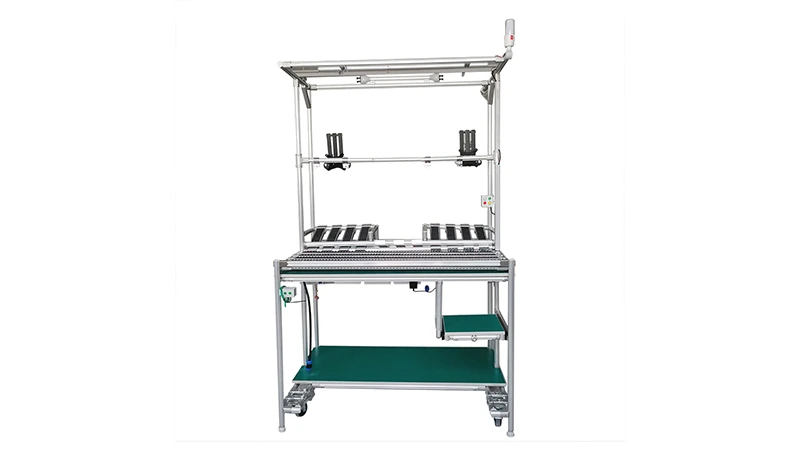
Walk into any 3C manufacturing plant—where smartphones, laptops, and smartwatches come to life—and you'll notice a silent hero amid the buzz of machinery and the focus of workers: the workbench. It's not just a flat surface; it's the stage where precision meets productivity, where tiny microchips are soldered onto PCBs, and where a single misalignment can turn a $500 component into scrap. In this high-stakes environment, 3C manufacturers don't just need workbenches—they need Aluminum Workbench D . Designed specifically for single-deck, caster-free operations, this workbench has become the backbone of modern 3C assembly lines. Let's dive into why it's more than just a table, and how it's redefining what it means to build electronics with accuracy, safety, and efficiency.
The 3C Manufacturing Challenge: Precision, Speed, and Static—Oh My
First, let's talk about what makes 3C manufacturing so unique (and tough). We're talking about products that pack more computing power into a device the size of your palm than early supercomputers. A typical smartphone, for example, has over 1,000 components, many smaller than a grain of rice. Assembling these requires not just steady hands but a workspace that minimizes variables. Add to that the threat of electrostatic discharge (ESD)—a silent killer that can fry a microchip with a charge as small as 100 volts (and yes, you can't even feel a charge until it hits 3,000 volts)—and suddenly, the "simple" workbench becomes a critical line of defense.
Then there's the pressure to scale. 3C manufacturers churn out millions of units annually, and any delay or defect eats into profits. Traditional workbenches—often made of steel, wood, or generic plastic—fall short here. Steel is heavy and hard to reconfigure when production lines switch from assembling tablets to smartwatches. Wood absorbs moisture, warps over time, and offers zero ESD protection. Plastic is lightweight but flimsy, unable to support heavy tools or withstand the wear of daily use. Enter Aluminum Workbench D: built with aluminum extrusion profile and engineered for the unique demands of 3C assembly. It's not just a tool; it's a solution to these very challenges.
Aluminum Workbench D: A Closer Look at the Design That Wins
At first glance, Aluminum Workbench D might seem unassuming. It's a single-deck setup without casters—no frills, right? But that simplicity is by design. Let's break down its core features and why each matters for 3C precision:
1. The Material: Aluminum Extrusion Profile—Strength Meets Flexibility
The workbench's frame is built from
aluminum extrusion profile
—a material that's revolutionized manufacturing workspaces. Here's why that matters: Aluminum is lightweight (about 1/3 the weight of steel) but surprisingly strong, with a tensile strength that can handle the weight of heavy tools, component bins, and even semi-assembled products without bending. But the real magic is in the "extrusion" part. During manufacturing, aluminum is heated to a malleable state and pushed through a die, creating custom profiles with built-in T-slots. These T-slots are like the workbench's "universal adapter"—they let you attach accessories (tool holders, LED lights, power strips) anywhere along the frame, no drilling or welding required. For 3C manufacturers, this means a workbench that can evolve with changing production needs. Today, it's set up for PCB assembly; tomorrow, add a parts bin holder and a magnifying lamp, and it's ready for camera module installation.
2. Single Deck, No Casters: Stability Over Mobility
You might wonder: Why no casters? Isn't mobility important in a busy factory? For some tasks, yes—but not for high-precision assembly. Casters, even locked ones, introduce tiny amounts of wobble. When you're soldering a 0.1mm wire to a PCB, that wobble can mean the difference between a perfect connection and a failed component. Aluminum Workbench D's fixed, caster-free design eliminates that variable. It sits solidly on the floor, anchored by adjustable feet that level it even on uneven surfaces. The single-deck surface (no lower shelves to clutter) keeps the workspace focused—no reaching under or around to grab tools, reducing motion waste (a key
lean system
principle we'll circle back to later).
3. ESD-Ready: Protecting What Can't Be Seen
Remember that ESD threat we mentioned? Aluminum Workbench D doesn't just ignore it—it fights back. The work surface is treated with a specialized coating that dissipates static electricity, channeling it safely to the ground instead of letting it build up and zap components. Many models also come with integrated grounding points, so workers can connect anti-static wristbands directly to the bench, creating a closed loop of protection. For 3C manufacturers, this isn't just a nice-to-have; it's a compliance requirement. Industry standards like ANSI/ESD S20.20 mandate ESD protection in electronics manufacturing, and failing an audit can shut down production. Aluminum Workbench D doesn't just meet these standards—it makes compliance easy.

Aluminum Extrusion Profile: The Unsung Hero of Customization
Let's zoom in on that aluminum extrusion profile because it's the secret sauce here. Traditional workbenches are often "one and done"—what you see is what you get. If you need to add a tool rack six months later, you're drilling holes or zip-tying it on (and we all know how that looks). With extruded aluminum, the T-slots change everything. Think of them as a grid of built-in attachment points running along every inch of the frame. Want to mount a magnetic tool strip above the work surface? Slide a bracket into the T-slot, tighten a screw, and you're done. Need a bin for tiny screws? Snap in a plastic bin holder. Even better, these accessories are modular—mix, match, and reconfigure as production needs change.
But it's not just about accessories. The extrusion process itself ensures consistency. Every aluminum profile is identical, so when you order 100 Aluminum Workbench D units, they're all the same height, same width, same strength. That uniformity is crucial for 3C manufacturers, where standardizing workflows across shifts and lines reduces training time and errors. Steel workbenches, by contrast, can warp or rust over time, leading to uneven surfaces. Wood? It swells in humidity, shrinks in dry conditions—hardly ideal for a workspace where "level" is non-negotiable.
And let's not forget weight. Aluminum's lightness makes installation a breeze. A team of two can set up a Workbench D in under 30 minutes, compared to steel workbenches that often require forklifts and four people. In a factory where floor plans change quarterly (hello, new product launches), that flexibility is gold. You're not stuck with a permanent fixture—you're investing in a workspace that grows with you.

Lean System Integration: Making Every Move Count
3C manufacturers live and die by lean system principles—eliminating waste, optimizing flow, and keeping production moving like a well-oiled machine. Aluminum Workbench D isn't just compatible with lean; it's built for it. Let's take "motion waste" as an example. In traditional setups, workers might reach 12 inches to grab a tool, then 18 inches to place a component, then 10 inches to pick up a soldering iron. Over an 8-hour shift, that adds up to miles of unnecessary movement. Aluminum Workbench D solves this by putting everything within a 16-inch "golden zone"—the area where workers can reach without stretching or twisting.
How? Thanks to those T-slots and aluminum profile accessories . A typical setup might include: a tool rail mounted 6 inches above the work surface, holding soldering irons and tweezers; a parts bin holder angled at 45 degrees for easy access to resistors and capacitors; and a cable management tray under the back edge to keep power cords from tangling. One electronics manufacturer we worked with reported a 22% reduction in assembly time per unit after reconfiguring their lines with Workbench D—all because workers weren't wasting time hunting for tools or stretching to reach components.
Another lean principle: "pull" production, where components arrive just in time for assembly. Aluminum Workbench D pairs seamlessly with flow racks and conveyors (common in 3C lines) to create a smooth material flow. Since the workbench is fixed, it becomes a stable endpoint for these systems—components roll in on a conveyor, workers assemble, and finished subassemblies move out, with no risk of the workbench shifting mid-process. It's not just about speed; it's about predictability. And in 3C manufacturing, predictability equals profitability.
ESD Workstation: More Than a Bench—A Shield Against Disaster
Let's get real about ESD damage. The Electronics Industry Association estimates that static electricity costs U.S. manufacturers over $5 billion annually in damaged components, rework, and lost production. In 3C, where a single PCB can cost $200 to replace, that's not a risk worth taking. Aluminum Workbench D, when paired with ESD mats, wristbands, and grounded tools, transforms into a full ESD workstation —a controlled environment where static can't build up.
Here's how it works: The workbench's aluminum frame is conductive, so any static charge on the surface travels through the frame to the ground (via a grounding cable connected to the facility's ESD system). The surface coating, often a blend of conductive particles and resin, ensures the charge dissipates slowly (not instantly—sudden discharge can be just as bad as buildup). Even the paint used on the frame is ESD-safe, so you don't have to worry about scratches exposing non-conductive materials. Compare that to a wooden workbench, which acts like a sponge for static, or a plastic bench that insulates charges, turning the surface into a ticking time bomb.
We visited a laptop manufacturer last year that had switched to Aluminum Workbench D after a costly ESD incident. A batch of 500 motherboards failed testing because of hidden static damage—costing the company $100,000 in parts and two days of downtime. Six months after installing Workbench D, their ESD-related defects dropped to zero. "It's not just about the bench," their production manager told us. "It's about peace of mind. When you're building something as complex as a laptop, you can't afford to wonder if the table is the reason things are failing."
Aluminum Workbench D vs. The Rest: A Head-to-Head Comparison
Curious how Aluminum Workbench D stacks up against traditional options? Let's break it down. The table below compares key features that matter most to 3C manufacturers:
| Feature | Aluminum Workbench D | Steel Workbench | Wooden Workbench | Plastic Workbench |
|---|---|---|---|---|
| Material | Aluminum extrusion profile (lightweight, corrosion-resistant) | Carbon steel (heavy, prone to rust) | Hardwood (absorbs moisture, warps) | Polypropylene (flimsy, low heat resistance) |
| ESD Protection | Built-in (conductive coating, grounding options; compliant with ANSI/ESD S20.20) | Requires add-on mats (inconsistent performance) | None (insulates static; high risk) | Limited (only if specially treated; wears off over time) |
| Customization | High (T-slots for easy accessory mounting; reconfigurable in minutes) | Low (requires drilling/welding; permanent changes) | Very low (nailing/screwing damages surface) | Low (few attachment points; accessories often don't fit) |
| Stability (No Casters) | Excellent (fixed design, adjustable leveling feet; no wobble) | Good (heavy, but casters add instability even when locked) | Poor (legs loosen over time; uneven surfaces) | Poor (lightweight; shifts with heavy tool use) |
| Longevity (5-Year Cost) | High (no rust, minimal wear; $0 maintenance) | Medium (rust treatment needed; $500+/year in upkeep) | Low (warping, scratches; replacement every 2-3 years) | Very low (cracks under heavy use; replacement every 1-2 years) |
The takeaway? Aluminum Workbench D isn't just better—it's smarter. It's an investment that pays off in fewer defects, faster assembly times, and less downtime. Steel and wood might cost less upfront, but when you factor in maintenance, replacements, and ESD-related losses, they're far more expensive in the long run.
Beyond the Bench: Accessories That Turn Good into Great
What really makes Aluminum Workbench D shine is how it plays well with others—specifically, aluminum profile accessories that turn a basic workbench into a fully equipped assembly station. Let's highlight a few must-haves for 3C lines:
Tool Racks & Holders: Magnetic strips for screwdrivers, spring-loaded clips for tweezers, and adjustable arms for soldering irons—all mountable via T-slots. No more fumbling through drawers; tools hang right where you need them.
LED Task Lighting: Slim, dimmable LED strips that attach to the back of the workbench, illuminating the surface without casting shadows (critical for inspecting tiny components).
Anti-Fatigue Mats: Thick, cushioned mats that lock into the base of the workbench, reducing foot and leg strain during long shifts. Some even come with ESD properties to double down on static protection.
Material Racks: Like material rack b (3 row and 3 floor) , which can be mounted to the side of the workbench to hold bulk components. This keeps parts organized and within arm's reach, cutting down on trips to the stockroom.
One of our clients, a smartwatch manufacturer, added a pivoting monitor arm to their Workbench D stations. The monitor displays step-by-step assembly guides, eliminating the need for paper manuals (which get dirty, torn, or outdated). Workers simply glance up to check the next step, keeping their hands free to work. It's a small change, but it reduced errors by 15% in the first month alone.
Why Suppliers Matter: Not All Aluminum Workbenches Are Created Equal
Okay, so you're sold on Aluminum Workbench D—now what? Choosing the right supplier is just as important as choosing the workbench itself. Not all aluminum extrusion profiles are made to the same standards. A cheap knockoff might use thinner aluminum (1mm instead of the recommended 2mm), or skip the ESD coating, leaving you with a pretty table that fails when it counts.
Look for suppliers who specialize in lean system and ESD solutions. They should be able to provide certification for the aluminum profile (check for ISO 9001 quality standards) and ESD testing reports (verify compliance with ANSI/ESD S20.20). Avoid suppliers who can't answer detailed questions about the extrusion process or the conductivity of their coatings—if they don't know, they're probably cutting corners.
Also, ask about customization. A good supplier will let you tweak the workbench's dimensions (within reason) to fit your specific line layout. Need a 6-foot bench instead of the standard 5-foot? They should accommodate that. Want the surface color to match your factory's branding? (Hey, why not?) A supplier who treats you like a partner, not just a customer, will go the extra mile to make sure the workbench fits your needs—not the other way around.
The Verdict: Aluminum Workbench D Isn't Just a Workbench—It's a Competitive Edge
At the end of the day, 3C manufacturing is a race to build better products faster, cheaper, and safer than the competition. Aluminum Workbench D might not be the flashiest piece of equipment on the line, but it's the one that makes everything else possible. It's the stability that ensures precision, the ESD protection that safeguards components, the flexibility that adapts to new products, and the lean-friendly design that cuts waste. It's not just about building electronics—it's about building confidence in every unit that rolls off the line.
So the next time you pick up your smartphone or laptop, take a second to appreciate the workbench that helped build it. Chances are, it was an Aluminum Workbench D—quietly doing its job, so the technology you rely on can do yours.