- Company Articles
- Products and Technology
- Product knowledge
- Why Aluminum Profile 3 Way Connectors Are Essential for Flexible Workstations

Why Aluminum Profile 3 Way Connectors Are Essential for Flexible Workstations
Related Product
Aluminum Profile 3 Way Connector
The 3 way - squared corner connector is an external fastening method that is typically used to create a corner connection between three profiles. It is a heavy-duty connection that is simple to use and provides a polished look.
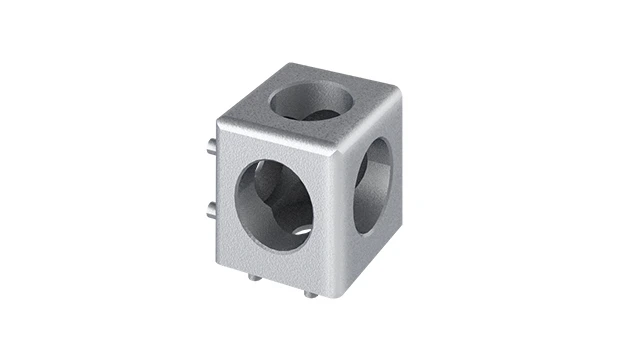
In today's fast-paced manufacturing, warehousing, and logistics environments, the ability to adapt quickly isn't just a luxury—it's a necessity. Production lines shift, product demands fluctuate, and workflows evolve overnight. The workstations that once served a single purpose now need to morph, expand, or shrink at a moment's notice. This is where flexibility becomes the backbone of efficiency, and at the heart of that flexibility lies a humble yet powerful component: the aluminum profile 3 way connector. Far more than just a piece of hardware, these connectors are the unsung heroes that turn rigid structures into dynamic, customizable workspaces. Let's dive into why they've become indispensable in modern workplaces, and how they're redefining what it means to build a workstation that grows with your needs.
The Rise of Flexible Workstations: Why One-Size-Fits-All No Longer Cuts It
Gone are the days when a factory floor or warehouse was filled with permanent, bolted-down workbenches and fixed material racks. Today's operations demand agility. A electronics manufacturer might need to reconfigure an assembly line to accommodate a new product model in days, not weeks. A distribution center might need to expand a picking station during peak seasons and shrink it back when demand eases. Even small workshops and labs require setups that can adapt to new tools, team sizes, or project scopes.
This shift toward flexibility isn't just about convenience—it's about survival. In an era of lean manufacturing and just-in-time production, wasted space, time, or resources can mean the difference between profit and loss. Workers need workstations that fit their tasks, not the other way around. Managers need systems that can be adjusted without calling in contractors or halting operations for days. Enter the concept of modular workstations: structures built from interchangeable parts that can be assembled, disassembled, and reassembled with minimal effort. And when it comes to modularity, few materials rival aluminum profiles.
Aluminum Profiles: The Backbone of Modular Workspaces
Aluminum profiles—extruded lengths of aluminum with precision-engineered T-slots—have become the gold standard for building modular workstations. Why aluminum? For starters, it's lightweight yet surprisingly strong, making it easy to handle during assembly while still supporting heavy loads. Its natural resistance to corrosion ensures longevity, even in busy industrial environments where spills, humidity, or chemicals might take a toll on other materials. And unlike steel, it doesn't require painting or coating to maintain its appearance, reducing long-term maintenance costs.
But the real magic of aluminum profiles lies in their T-slots. These grooves run along the length of the profile, allowing accessories like brackets, shelves, panels, and tools to be attached anywhere along the slot—no drilling or welding required. This means a single length of aluminum profile can serve as a leg for a workbench, a rail for a conveyor, or a frame for a material rack, depending on how you equip it. It's this versatility that makes aluminum profiles the backbone of flexible workstations. However, a backbone is only as strong as its joints, which is where connectors come into play.

Connectors: The Glue That Holds Modularity Together
If aluminum profiles are the bones of a modular workstation, connectors are the joints that let those bones move and adapt. Without the right connectors, even the most well-designed profiles would be little more than expensive metal sticks. Connectors determine how profiles can be joined—at angles, in straight lines, or in complex configurations—and how easily those joints can be adjusted or disassembled.
There are dozens of connector types on the market, each designed for specific tasks: 90-degree connectors for right-angle joints, 45-degree connectors for slopes or ramps, straight connectors for extending lengths, and more. But among these, one type stands out for its ability to unlock a new level of flexibility: the 3 way connector. As the name suggests, a 3 way connector allows three aluminum profiles to meet at a single point, opening up possibilities for building three-dimensional structures that are both sturdy and adaptable. Let's take a closer look at what makes these connectors so special.

Aluminum Profile 3 Way Connectors: Design, Function, and Versatility
What Is a 3 Way Connector?
At its core, a 3 way connector is a small, often T-shaped or Y-shaped component made from aluminum or high-strength plastic, designed to join three aluminum profiles at a single connection point. Unlike basic 90-degree connectors, which only link two profiles, 3 way connectors add a third axis, allowing for the creation of corner structures, multi-level frames, or branching assemblies. For example, you might use a 3 way connector to attach a vertical support leg to a horizontal workbench frame while also adding a side rail for tools or a shelf bracket—all in one joint.
Most 3 way connectors are designed to fit into the T-slots of aluminum profiles, using set screws or bolts to secure them in place. Some are fixed-angle (e.g., 90 degrees between all three arms), while others are adjustable, letting users set custom angles for unique configurations. They come in various sizes to match common profile widths (like 20x20mm, 30x30mm, or 40x40mm) and are often sold alongside aluminum profile accessories like end caps, gussets, and brackets to enhance stability.
Why Three Axes Matter: Beyond Two-Dimensional Builds
To understand the importance of 3 way connectors, consider a simple workbench. A basic workbench might use 90-degree connectors to join four vertical legs to a rectangular frame. But what if you want to add a shelf halfway up the legs? Or attach a tool rail to the back of the bench? Or build a side table that extends from one leg? Without 3 way connectors, each of these additions would require separate joints, increasing the number of parts and weakening the overall structure (more joints mean more potential failure points). With a 3 way connector, you can integrate these features directly into the existing frame, creating a cleaner, stronger, and more compact design.
This three-dimensional capability is especially valuable in complex setups like material racks, where you need to connect vertical posts, horizontal beams, and diagonal braces to support multiple shelves. Or in conveyor systems, where roller tracks might need to branch off into different directions. In lean system environments, where minimizing waste and maximizing space are priorities, the ability to build upward and outward without sacrificing stability is a game-changer.
The Key Benefits of Using 3 Way Connectors in Flexible Workstations
3 way connectors aren't just a niche accessory—they offer tangible advantages that make them essential for anyone building modular workstations. Let's break down their most impactful benefits:
1. Modularity Without Compromise
The cornerstone of flexible workstations is modularity—the ability to change a structure's shape or function by adding, removing, or rearranging parts. 3 way connectors excel here because they reduce the need for redundant joints. Instead of using two separate 90-degree connectors to attach two accessories to a single profile, you can use one 3 way connector, streamlining the design and making adjustments faster. Need to move a shelf from the left side of a workbench to the right? Simply loosen the 3 way connector, reposition the profile, and tighten it back up—no need to disassemble multiple joints.
2. Strength and Stability in Complex Structures
Critics might argue that adding more connections weakens a structure, but 3 way connectors actually improve stability when used correctly. By distributing weight across three profiles instead of two, they reduce stress on individual joints. For example, a workbench with a 3 way-connected shelf bracket will better support heavy tools than a shelf attached with a single 90-degree connector, because the weight is shared between the vertical leg and the horizontal frame. High-quality aluminum 3 way connectors are also precision-machined to ensure a tight fit, eliminating wobble or play in the joint.
3. Cost and Time Savings
In the long run, 3 way connectors save both time and money. Fewer parts mean faster assembly—instead of fumbling with multiple connectors, you can secure three profiles in one step. They also reduce the need for custom fabrication. In traditional workbench building, adding a shelf might require cutting a custom bracket or welding; with a 3 way connector, you can use off-the-shelf profiles and accessories. And since aluminum profiles and connectors are reusable, you can disassemble a workstation at the end of a project and reuse the parts to build something new, minimizing waste and lowering material costs over time.
4. Compatibility with Lean System Principles
Lean manufacturing—focused on eliminating waste and optimizing workflows—relies heavily on tools that support adaptability and efficiency. 3 way connectors align perfectly with these principles. They allow teams to design workstations that are "right-sized" for the task, avoiding unnecessary space or materials. They enable quick reconfiguration when processes change, reducing downtime. And because they work with standard aluminum profiles and accessories, they support standardized work—another key lean principle—by ensuring that workstations across a facility are built consistently, making training and troubleshooting easier.
How 3 Way Connectors Stack Up: A Comparison with Other Connector Types
To truly appreciate the value of 3 way connectors, it helps to see how they compare to other common connector types. Below is a comparison table highlighting key factors like flexibility, load capacity, and ease of use:
| Connector Type | Profiles Joined | Flexibility (Configurations) | Max Load Capacity* | Ease of Assembly | Best For |
|---|---|---|---|---|---|
| 90-Degree Fixed Connector | 2 | Low (only right angles) | High (up to 500kg per joint) | Easy (2 screws) | Simple frames, square workbenches |
| Adjustable Angle Connector | 2 | Medium (0-180 degrees) | Medium (up to 300kg per joint) | Moderate (requires angle adjustment) | Sloped surfaces, ramps, custom angles |
| 3 Way Fixed Connector | 3 | High (3-axis, multi-level builds) | High (up to 450kg per joint) | Moderate (3 screws, alignment needed) | Multi-shelf racks, corner workstations, branching structures |
| 4 Way Cross Connector | 4 | Very High (4-axis, 3D builds) | Medium (up to 350kg per joint) | Complex (4 screws, precise alignment) | Central support posts, multi-directional frames |
*Load capacity varies by material, size, and profile thickness. Values are approximate for aluminum connectors with 40x40mm profiles.
As the table shows, 3 way connectors strike a balance between flexibility and strength that's hard to match. They offer more configuration options than basic 90-degree connectors without the complexity of 4 way cross connectors, making them ideal for most modular workstation builds.
Real-World Applications: How 3 Way Connectors Transform Workstations
To bring this all to life, let's look at a few real-world scenarios where 3 way connectors make a tangible difference:
1. Assembly Line Workbench with Integrated Tool Storage
A automotive parts manufacturer needs a workbench for assembling small components. The workbench must have a flat top, a lower shelf for parts bins, and a vertical rail on the back for hanging tools. Using 3 way connectors, the team can build the main frame with 40x40mm aluminum profiles, then use 3 way connectors at each corner to attach the vertical legs, the horizontal top frame, and the lower shelf supports—all in one joint. On the back rail, additional 3 way connectors allow them to add tool hooks and a small parts tray, keeping everything within arm's reach. If the assembly process changes, they can easily remove the shelf or reposition the tool rail by loosening the 3 way connectors.
2. Mobile Material Rack for Warehouse Picking
A warehouse needs a mobile rack to hold boxes of inventory during order picking. The rack must be tall enough for 3 shelves, narrow enough to fit through doorways, and sturdy enough to hold 20kg boxes per shelf. Using 3 way connectors, the team builds a frame with vertical posts joined to horizontal beams at the top, middle, and bottom. At each shelf level, 3 way connectors attach the horizontal beams to the vertical posts and add side rails to prevent boxes from sliding off. Casters (from aluminum profile accessories) are added to the bottom using 3 way connectors, making the rack mobile. When the warehouse reorganizes, the rack can be disassembled, and the parts reused to build a longer, shorter, or taller rack as needed.
3. Lean System Workstation for Electronics Testing
A tech company implementing lean manufacturing needs a workstation for testing circuit boards. The workstation must include a flat work surface, a static-dissipative mat (ESD protection), a shelf for test equipment, and a small conveyor for moving boards to the next station. Using aluminum profiles and 3 way connectors, the team constructs the frame, with 3 way connectors at the corners to support the work surface, shelf, and conveyor rail. The conveyor itself uses roller track (another aluminum profile accessory) attached via 3 way connectors to the main frame. If a new test device is added, they can quickly extend the shelf or add a side arm using extra 3 way connectors—no welding or new parts required.
Why Aluminum Profile 3 Way Connectors Are Non-Negotiable for Flexible Workstations
In the end, the case for aluminum profile 3 way connectors is clear: they bridge the gap between rigidity and adaptability, turning simple aluminum profiles into dynamic, multi-functional workstations. They enable the kind of flexibility that modern workplaces demand—whether you're building a workbench, a material rack, or a complex conveyor system. They save time and money by reducing parts and simplifying assembly. They support lean system principles by minimizing waste and maximizing efficiency. And they do it all while maintaining the strength and durability needed for industrial environments.
For anyone investing in modular workstations, 3 way connectors aren't just an accessory—they're an essential tool for unlocking the full potential of aluminum profiles. They're the reason a single set of profiles can go from holding up a workbench today to supporting a conveyor tomorrow, and then becoming a mobile cart next month. In a world where change is the only constant, 3 way connectors ensure your workspace can change with it—without missing a beat.