- Company Articles
- Products and Technology
- Product knowledge
- Why Anti-Slip Adjustable Leveling Feet Are Essential for 3C Assembly Lines

Why Anti-Slip Adjustable Leveling Feet Are Essential for 3C Assembly Lines
Related Product
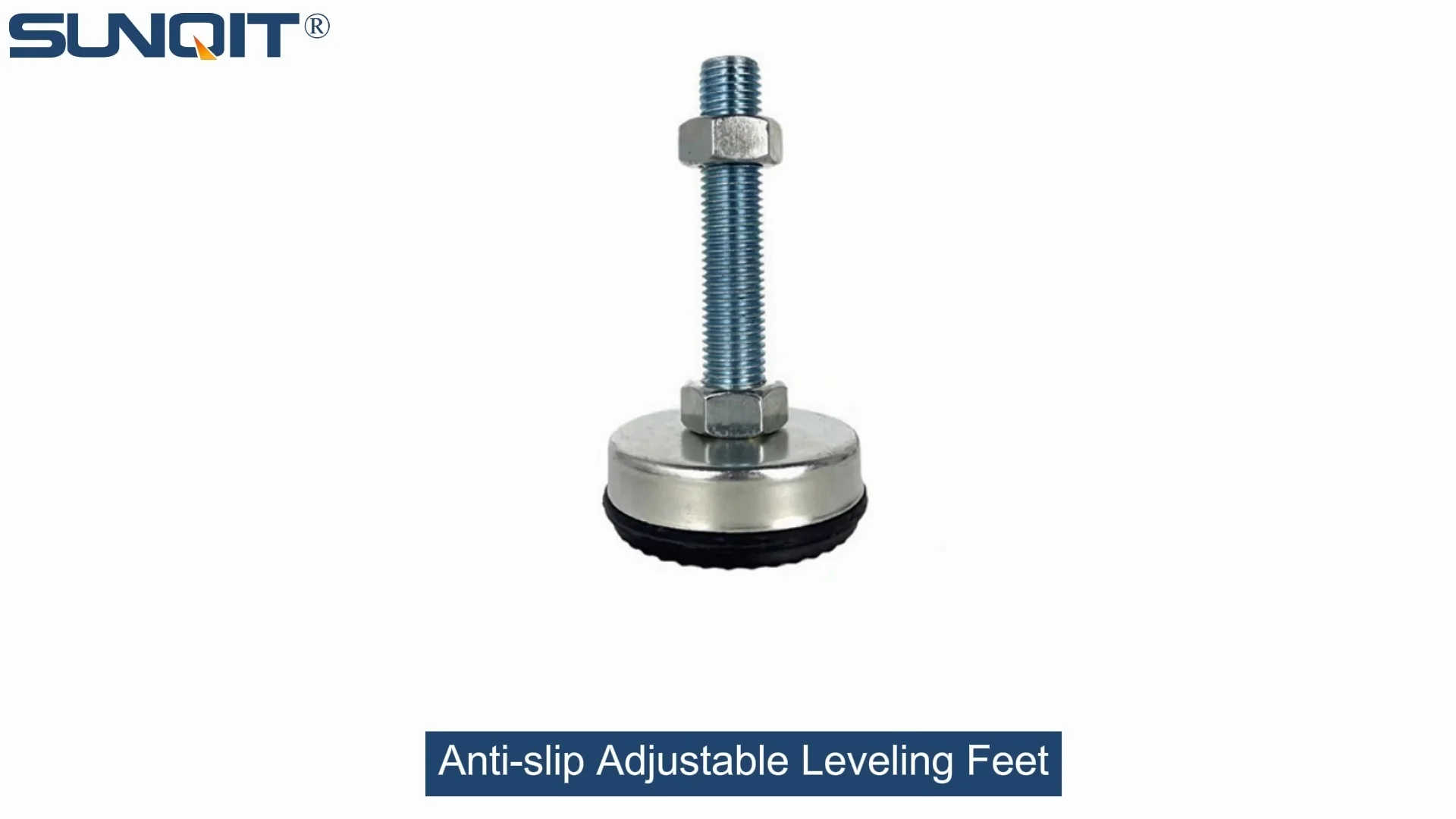
Anti-slip Adjustable Leveling Feet
Anti-slip Adjustable Leveling Feet are designed to keep machines level when placed on uneven or sloped ground, the rubber base will prevent product slip during work.
Walk into any 3C (Computers, Communication, Consumer Electronics) manufacturing plant, and you'll be met with a symphony of precision: robotic arms placing microchips smaller than a grain of rice, workers soldering delicate circuit boards under magnification, and conveyor belts moving components at speeds measured in milliseconds. In this world, where a 0.1mm misalignment can turn a smartphone motherboard into scrap metal, every detail matters. Yet, amid the high-tech machinery and advanced automation, there's one humble component that often goes unnoticed—until it fails: the anti-slip adjustable leveling feet beneath workbenches, esd workstations , and assembly tables. These unassuming devices are the silent guardians of stability, ensuring that the foundation of your production line doesn't just hold up equipment, but protects the integrity of every product that passes through.
The Hidden Cost of Unstable Workbenches in 3C Manufacturing
To understand why anti-slip adjustable leveling feet are non-negotiable, let's start with a scenario all too familiar in under-equipped factories: A worker is soldering a 5G chip onto a circuit board. The lean pipe workbench beneath them wobbles slightly—just enough that their hand trembles as they apply the soldering iron. The result? A cold solder joint, which later causes the device to malfunction during quality checks. Multiply that by hundreds of workbenches and thousands of components per day, and the cost of unstable work surfaces becomes staggering: rework, scrap, delayed shipments, and frustrated employees.
But the risks go beyond defective products. 3C assembly lines often handle electrostatic discharge (ESD)-sensitive components, which is why esd workstations are standard. These workstations are designed to dissipate static electricity, but their effectiveness plummets if they're not level. A tilted ESD mat might not make full contact with the workbench, creating "hot spots" where static can build up and fry sensitive microelectronics. Even worse, an unstable workstation increases the risk of tools or components sliding off—endangering both the product and the worker.
Then there's the issue of floor irregularities. Most factories aren't built on perfectly level ground. Over time, concrete floors settle, machinery vibrations cause uneven wear, and forklift traffic creates small dips and bumps. Without adjustable feet, a workbench placed on such a floor will rock, twist, or lean—compromising every task performed on it. In a industry where profit margins hinge on micrometer-level precision, this isn't just an inconvenience; it's a threat to competitiveness.
What Are Anti-Slip Adjustable Leveling Feet, Anyway?
At first glance, anti-slip adjustable leveling feet might seem simple: a threaded metal stem topped with a rotating base, often made of rubber or plastic. But their design is a masterclass in practical engineering. The stem screws into the bottom of a workbench or workstation, allowing operators to raise or lower each foot individually to compensate for uneven floors. The base—usually coated in a high-friction material like nitrile rubber—grips the floor to prevent sliding, even under heavy loads or vibrations. Some models even include locking nuts to secure the adjusted height, ensuring the feet don't loosen over time.
What makes them ideal for 3C assembly lines is their versatility. They're compatible with almost any work surface, from lightweight lean pipe workbenches (built with aluminum or steel pipes and joints) to heavy-duty ESD workstations loaded with testing equipment. They're also easy to install and adjust—no need for specialized tools or downtime. A worker can tweak the height of a foot in seconds, ensuring the workbench stays level even as the floor shifts slightly over months of operation.

4 Key Benefits for 3C Assembly Lines
1. Precision Alignment for Micro-Assembly Tasks
3C components are getting smaller and more complex. A modern smartphone's camera module, for example, contains over 100 tiny parts, including lenses, sensors, and actuators, all of which must align within 0.01mm to ensure sharp images. When assembling such components, even a 0.5mm tilt in the workbench can throw off visual alignment systems or cause robotic pick-and-place arms to miss their targets. Anti-slip adjustable leveling feet eliminate this risk by keeping the work surface perfectly horizontal. This isn't just about straight lines—it's about creating a stable platform where every measurement, every solder joint, and every component placement is repeatable and accurate.
2. ESD Safety Compliance
ESD damage costs the electronics industry billions annually, and much of it is preventable. ESD workstations rely on a continuous path to ground to dissipate static charges, but this path is broken if the workstation isn't level. A tilted workstation might lift one corner of the ESD mat off the ground, creating a gap in the grounding chain. Anti-slip feet ensure the entire workstation sits flush with the floor, maintaining consistent contact between the mat, the bench, and the ground. Additionally, the rubber base of many leveling feet is conductive, adding an extra layer of ESD protection by grounding the workbench itself.
3. Vibration Dampening for Sensitive Equipment
Assembly lines are noisy places. Conveyor belts hum, robots cycle, and air compressors thump—all generating vibrations that can travel through the floor and into workbenches. For sensitive equipment like optical inspection machines or laser engravers, these vibrations can blur images, distort measurements, or even damage internal components. The rubber bases of anti-slip leveling feet act as shock absorbers, dampening vibrations before they reach the work surface. This is especially critical for quality control stations, where even a slight tremor can lead to false readings or missed defects.
4. Load Distribution for Heavy Machinery
Many 3C workstations aren't just for manual tasks. They're often outfitted with heavy equipment: oscilloscopes, thermal chambers, or automated testing rigs that can weigh 50kg or more. Without proper load distribution, the legs of a workbench can sink into the floor, warp, or even collapse over time. Anti-slip adjustable leveling feet spread the weight evenly across the floor, preventing localized stress and extending the life of both the workbench and the floor itself. This is particularly important for lean pipe workbenches , which are lightweight by design but need to support heavy loads without bending or twisting.

Anti-Slip Feet vs. Casters: When to Choose Stability Over Mobility
You might be wondering: Why not just use casters (wheels) instead? Casters make it easy to move workbenches for cleaning or reconfiguration, which is useful in flexible manufacturing setups. But in 3C assembly lines, mobility often takes a backseat to stability. Casters, even with brakes, can slip or roll under vibration, and their small contact area with the floor makes them prone to sinking into soft or uneven surfaces. They also can't be adjusted for height, meaning a workbench on casters will always follow the floor's irregularities—not compensate for them.
| Feature | Anti-Slip Adjustable Leveling Feet | Casters (with Brakes) |
|---|---|---|
| Stability | High: Rubber base grips floor; no movement under load | Low: Brakes can slip; prone to rolling on vibrations |
| Height Adjustment | Yes: Fine-tune to level uneven floors | No: Fixed height; follows floor irregularities |
| ESD Compatibility | Excellent: Conductive rubber options ground workbenches | Poor: Metal casters may insulate; plastic wheels don't ground |
| Load Capacity | High: Distributes weight evenly; supports 500kg+ per foot | Medium: on small wheel area; risk of sinking |
| Best For | Static workstations, ESD areas, precision assembly | Material transport carts, temporary workbenches |
The solution? Many factories use a hybrid approach: stationary workstations (like ESD assembly tables) get anti-slip adjustable leveling feet for stability, while mobile carts (used for moving components between lines) use casters. This way, you get the best of both worlds—precision where it's needed most, and mobility where flexibility matters.

Choosing the Right Anti-Slip Adjustable Leveling Feet for Your Line
Not all leveling feet are created equal. To maximize their benefits in a 3C assembly line, look for these key features:
- High-Friction Base: Opt for nitrile rubber or polyurethane bases, which offer superior grip on concrete, tile, or epoxy floors. Avoid hard plastic bases, which can slide easily.
- Threaded Stem Length: Choose feet with stems long enough to compensate for your factory's floor irregularities. Most 3C plants need stems at least 50mm long for adjustments.
- Load Rating: Check the weight capacity per foot. For heavy workstations, aim for feet rated to 200kg+ each (remember, a 1000kg workstation needs 4-6 feet, so distribute the load).
- ESD Conductivity: If using on ESD workstations, select feet with conductive rubber bases (resistivity of 10^6-10^9 ohms) to maintain grounding continuity.
- Corrosion Resistance: Factories with humidity-controlled environments (common in 3C manufacturing) should use stainless steel stems to prevent rust.
Real-World Impact: A Case Study
Consider a mid-sized 3C manufacturer producing smartwatch components. Before upgrading to anti-slip adjustable leveling feet, their assembly line struggled with a 3% defect rate in soldering tasks. Workers reported that their lean pipe workbenches wobbled during shifts, especially when nearby conveyors were running. After installing leveling feet on 20 workstations, the defect rate dropped to 0.5% within a month. The plant manager noted: "We didn't realize how much time we were wasting on rework until the wobble stopped. Now, the operators can focus on soldering, not steadying the bench."
Another example: a smartphone repair center using ESD workstations without adjustable feet. Technicians often complained that screens or circuit boards would slide off the tilted workbenches, leading to cracked displays. After retrofitting the workstations with anti-slip feet, slide-related damages decreased by 80%. The rubber bases kept components in place, even when technicians leaned on the bench during repairs.
Conclusion: The Foundation of Quality
In the race to innovate, 3C manufacturers often focus on flashy technologies—faster robots, smarter software, more advanced materials. But as any engineer will tell you, a structure is only as strong as its foundation. Anti-slip adjustable leveling feet are that foundation for your assembly line. They ensure that your lean pipe workbenches stay steady, your esd workstations remain grounded, and your workers can perform their tasks with the precision the industry demands.
So the next time you walk through your factory, take a moment to look down. Those small, unassuming feet under your workbenches might not grab headlines, but they're quietly protecting your bottom line—one level work surface at a time. In 3C manufacturing, where every detail counts, that's not just essential. It's everything.