- Company Articles
- Products and Technology
- Product knowledge
- Why Anti-Static Swivel Stem Caster Wheels with Brake Matter in 3C Manufacturing

Why Anti-Static Swivel Stem Caster Wheels with Brake Matter in 3C Manufacturing
Related Product
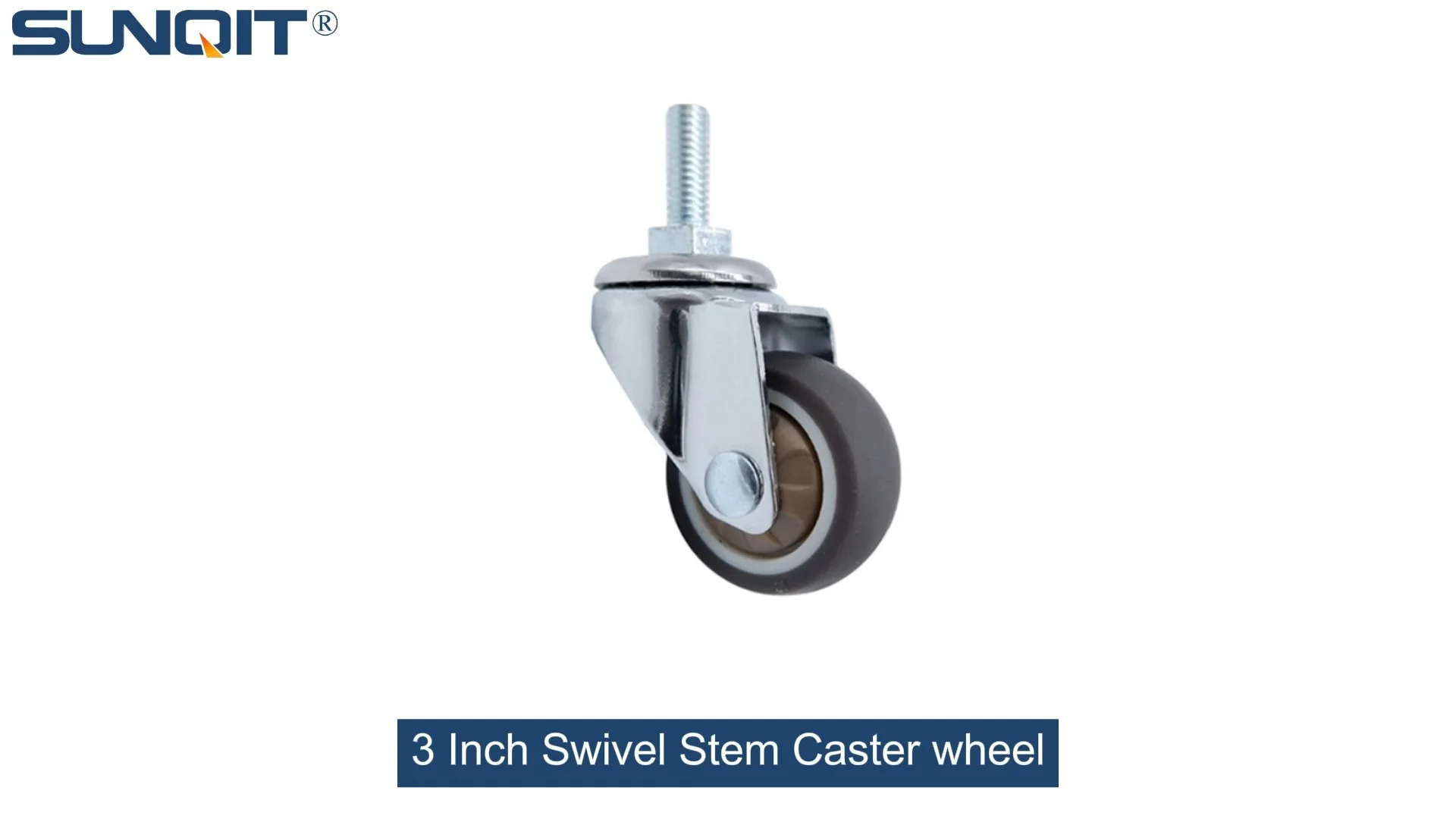
Swivel Stem Caster wheel
360 Degree Swivel Stem Caster. Threaded-post mount design, castors diameter 3 inch.Each swivel caster wheels loading 70KGS. Heavy enough and widely suit for carts, chairs, cabinet, flow rack, workbench, turnover rolley.
In the fast-paced world of 3C manufacturing—where "3C" stands for computers, communications, and consumer electronics—every detail counts. From the tiniest microchip to the largest assembly line, precision isn't just a goal; it's the backbone of survival. But here's the thing: some of the most critical components in this industry aren't the flashy ones you see in finished products. They're the quiet workhorses, the unsung heroes that keep production lines moving, components safe, and workflows efficient. Today, we're shining a light on one such hero: anti-static swivel stem caster wheels with brakes.
At first glance, casters might seem like trivial hardware—just wheels on a stem, right? But in a 3C factory, where a single static discharge can ruin a batch of $100 circuit boards, or a misplaced workstation can throw an entire shift's timeline off track, the choice of casters becomes a make-or-break decision. Let's dive into why these specific casters matter, how they protect sensitive electronics, and why they're indispensable for anyone serious about lean system efficiency and ESD workstation safety.
The Hidden Threat: Static Electricity in 3C Production
Walk into any 3C manufacturing floor, and you'll notice the buzz of activity: conveyor belts hum as PCBs glide past, workers in grounded wristbands assemble smartphones, and robotic arms place microprocessors with hairbreadth precision. What you won't see, though, is the invisible enemy lurking in the air: static electricity.
Static is generated by the simplest of actions—sliding a box across a table, walking across a carpet, even the friction between two plastic components. In most industries, this might be nothing more than a minor annoyance (think: a static shock when you touch a doorknob). But in 3C manufacturing, where components like semiconductors, capacitors, and LCD panels are sensitive to voltages as low as 250 volts (for reference, a typical static shock you feel is around 3,000 volts), static is a silent assassin.
Here's why it's so dangerous: static charges can arc between surfaces, creating tiny electrical fires that burn through delicate circuits. Even if the damage isn't immediately visible—what engineers call "latent defects"—it can weaken components, leading to product failures months after they've left the factory. The cost? According to industry estimates, static-related damage costs electronics manufacturers billions annually. And that's before factoring in the time lost to rework, the reputational hit from faulty products, or the wasted on scrapped materials.
So, how do manufacturers fight back? Enter ESD (Electrostatic Discharge) protection. ESD workstations, grounded flooring, anti-static mats—these are all standard tools. But there's a missing piece in this puzzle: mobility. In today's agile factories, workstations and equipment need to move. Production lines reconfigure daily to meet shifting demand, and tools need to be within arm's reach of workers. That's where casters come in. But not just any casters—ones that can move freely and keep static at bay.
Mobility Meets Control: The Role of Swivel Stem Casters
Let's start with the basics: why swivel stem casters? In a 3C factory, space is often tight. Production lines snake through the floor, workers operate in close quarters, and every square foot is optimized for efficiency. Fixed wheels might work for heavy machinery, but for mobile workstations, tool carts, or temporary assembly tables, swivel casters are non-negotiable.
Swivel stem casters pivot 360 degrees, allowing operators to maneuver equipment with minimal effort. Imagine a worker pushing a cart loaded with circuit boards down a narrow aisle—with swivel casters, they can easily navigate around a conveyor belt, pivot to park next to an ESD workstation, and even spin the cart in place to access components from all sides. This isn't just about convenience; it's about speed. In a lean system, every second saved on moving equipment translates to more time spent on value-adding tasks, like assembling products or testing components.
But mobility without control is chaos. That's where the brake comes in. Picture this: a technician is soldering a microchip onto a PCB, balanced on a mobile workbench. If the workbench rolls even an inch mid-solder, the connection could be misaligned, rendering the board useless. Or worse, the bench could tip, spilling sensitive components onto the floor. A reliable brake mechanism locks the caster wheels in place, turning a mobile workstation into a stable platform when precision is needed. It's a simple feature, but it prevents accidents, reduces waste, and gives workers the confidence to focus on their tasks without worrying about their equipment moving unexpectedly.
So, swivel for mobility, brake for stability—makes sense. But why "stem" casters specifically? Stem casters are mounted directly into a socket or bracket on the bottom of equipment, creating a low-profile, secure connection. This is critical for workstations that need to sit flush with conveyor systems or align perfectly with other tools. Unlike plate-mounted casters, which add height and bulk, stem casters keep equipment closer to the ground, reducing the risk of tipping and making it easier to integrate with existing production setups.

Anti-Static: More Than Just a Feature—A Necessity
Now, let's add the anti-static layer. Standard casters are typically made of rubber or plastic, materials that insulate electricity. As the wheels roll across the floor, friction builds up static charge, which can transfer to the equipment they're attached to. That means even if your workstation has an ESD mat, if the casters are generating static, you're back to square one: sensitive components at risk.
Anti-static swivel stem casters solve this by using conductive materials in their construction—often rubber mixed with carbon or metal fibers. These materials create a path for static charge to flow from the equipment, through the caster, and into the grounded floor. Some models even include a metal stem that directly connects to the workstation's grounding system, ensuring no static buildup goes unaddressed.
To understand the difference, let's compare standard casters and anti-static swivel stem casters with brakes side by side:
| Feature | Standard Casters | Anti-Static Swivel Stem Casters with Brake |
|---|---|---|
| Material | Insulating rubber/plastic; prone to static buildup | Conductive rubber/metal-infused materials; dissipates static |
| Static Protection | None; can transfer static to equipment | Redirects static charge to ground; protects ESD-sensitive components |
| Maneuverability | Limited swivel range; harder to navigate tight spaces | 360° swivel; easy to pivot in confined areas |
| Stability | Basic or no brake; risk of unintended movement | Locking brake; secure positioning during assembly |
| Ideal Use Case | Non-sensitive environments (e.g., warehouse storage) | 3C manufacturing, ESD workstations, lean system production lines |
The takeaway? Standard casters are fine for moving pallets of cardboard boxes, but in a 3C factory, they're a liability. Anti-static swivel stem casters with brakes, on the other hand, are designed to work in harmony with ESD protocols, ensuring that mobility doesn't compromise safety.

Integration with Lean Systems and ESD Workstations
Lean system principles—eliminating waste, optimizing flow, and continuous improvement—are the lifeblood of modern 3C manufacturing. A lean factory doesn't just produce goods; it produces them with minimal downtime, reduced costs, and maximum flexibility. So, how do anti-static casters fit into this picture?
One of the core tenets of lean is "just-in-time" production, which requires equipment and materials to be where they're needed, exactly when they're needed. Mobile workstations with anti-static casters make this possible. Need to reconfigure a production line to assemble smartwatches instead of tablets? Simply unlock the casters, roll the workstations into new positions, lock the brakes, and you're ready to go. No waiting for forklifts, no disassembly/reassembly—just quick, efficient changeover.
ESD workstations, too, rely on these casters to maintain their integrity. An ESD workstation is more than a table with a mat; it's a controlled environment where every surface, tool, and piece of equipment is grounded. If the workstation itself is on casters that generate static, the entire setup is compromised. Anti-static casters ensure that even as the workstation moves, the grounding path remains intact. This is especially critical for "floating" workstations—those that aren't permanently fixed to the floor but still need to meet strict ESD standards.
Real-World Impact: A Day in the Life
Let's walk through a typical scenario at a smartphone assembly plant. The morning shift starts, and the production schedule calls for 500 units of Model X. The line is set up with conveyor belts moving PCBs to ESD workstations, where workers install cameras, batteries, and screens.
Mid-morning, a rush order comes in: 200 units of Model Y, a newer model with a different battery configuration. The floor manager needs to reallocate two workstations to Model Y assembly. With standard casters, this would take 30 minutes—unlocking heavy workbenches, wrestling them into place, re-grounding each station. With anti-static swivel stem casters with brakes? It takes 5 minutes. Workers unlock the brakes, swivel the workstations around the conveyor, lock them into position, and the ESD grounding is already active thanks to the conductive casters. The rush order is completed on time, and the original Model X production stays on track.
Later that day, a quality control tech notices a batch of Model X screens has a minor defect. They wheel their mobile inspection cart—fitted with anti-static casters—to the conveyor, lock the brakes, and start examining each screen. The cart's proximity to the line means defects are caught before the screens are installed, saving hours of rework. None of this would be possible without casters that balance mobility, stability, and static protection.
Another lean principle is "respect for people," and casters play a role here too. Heavy, hard-to-move equipment leads to worker fatigue, which increases the risk of mistakes and injuries. Anti-static swivel stem casters are designed to be lightweight and easy to maneuver, reducing physical strain. When workers don't have to struggle with unwieldy equipment, they're more focused, productive, and less likely to cut corners—all of which boost overall quality.

Conveyor Systems and the Caster Connection
3C manufacturing lines aren't just about workstations—they're a symphony of moving parts, and conveyor systems are the conductors. Conveyors transport components from one stage to the next, ensuring a steady flow of materials. But even the most advanced conveyor can't do it all alone. Mobile workstations and tool carts need to interface seamlessly with conveyors, and that's where anti-static casters prove their worth.
Imagine a conveyor belt carrying PCBs to an assembly station. The worker at that station needs to access tools, spare parts, and testing equipment quickly. A mobile cart with anti-static casters can be positioned right next to the conveyor, within arm's reach. When the conveyor stops for a component changeover, the cart can be rolled aside to make space, then brought back once the line restarts. The swivel stem allows for precise positioning—no more stretching or leaning over the conveyor, which reduces the risk of accidents and errors.
Conveyors themselves sometimes use casters for maintenance. Portable conveyor segments, used to bridge gaps between fixed lines, rely on swivel stem casters to align with existing infrastructure. In these cases, brakes are critical: a misaligned conveyor segment could cause components to jam or fall, leading to delays. Anti-static casters ensure that even during maintenance, static-sensitive components (like those waiting on the conveyor) remain protected.
It's also worth noting that conveyor systems generate their own static. As belts move and components slide, friction builds up. While conveyors often have their own ESD protection, the carts and workstations around them need to match that level of safety. Anti-static casters create a unified ESD-safe zone, from the conveyor belt to the workstation, ensuring no weak links in the chain.
Choosing the Right Casters: What to Look For
Now that we've established why anti-static swivel stem casters with brakes are essential, let's talk about how to choose the right ones for your 3C facility. Not all casters are created equal, and the wrong choice can lead to premature wear, static leaks, or even safety hazards. Here are key factors to consider:
- Load Capacity: 3C workstations can carry heavy equipment—soldering irons, testing machines, bins of components. Ensure the casters are rated for your maximum load (and then some, to account for unexpected weight).
- Floor Compatibility: Factory floors vary—some are smooth concrete, others have anti-fatigue mats or conductive tiles. Choose casters with wheels that grip your floor type to prevent slipping, even when braking.
- Brake Reliability: A brake that sticks or fails is worse than no brake at all. Look for casters with foot-operated brakes that lock both the wheel and the swivel motion (called "total lock" brakes) for maximum stability.
- Conductivity Rating: Anti-static casters should meet industry standards, like ANSI/ESD S20.20, which requires static charge to dissipate at a rate that won't damage components. Ask suppliers for conductivity test reports.
- Durability: 3C factories run 24/7, so casters need to withstand constant use. Look for sealed bearings to prevent dust buildup, and wheels made from wear-resistant conductive rubber.
It's also smart to test casters in your actual environment before committing to a bulk order. Set up a trial workstation with the casters, have workers move it around typical obstacles (conveyor supports, floor drains, uneven seams), and simulate a day's worth of braking and unlocking. If the casters perform well under real conditions, they're a safe bet.
Conclusion: Small Wheels, Big Impact
Anti-static swivel stem caster wheels with brakes might not grace the cover of tech magazines, but in the world of 3C manufacturing, they're indispensable. They protect sensitive components from static damage, enable the flexibility needed for lean system efficiency, and make ESD workstations and conveyor systems work in harmony. They're a reminder that in manufacturing, success lies in the details—the small, thoughtful choices that add up to big results.
So, the next time you see a smartphone, laptop, or smartwatch, take a moment to appreciate the invisible infrastructure that brought it to life. Behind that sleek design is a factory floor where anti-static casters roll quietly, brakes lock securely, and static charges are safely grounded. And in that quiet reliability? That's where the magic of 3C manufacturing really happens.