- Company Articles
- Products and Technology
- Application Cases
- Why Automotive Manufacturers Choose Aluminum Workbench D for Flexible Production

Why Automotive Manufacturers Choose Aluminum Workbench D for Flexible Production
Related Product
Aluminum Workbench D
Aluminum tube workbench is more flexible and durable, compared with traditional PE/ABS coated steel tube. It is easy to assemble, anti corrosion, rust protection, and recycle use after disassemble.
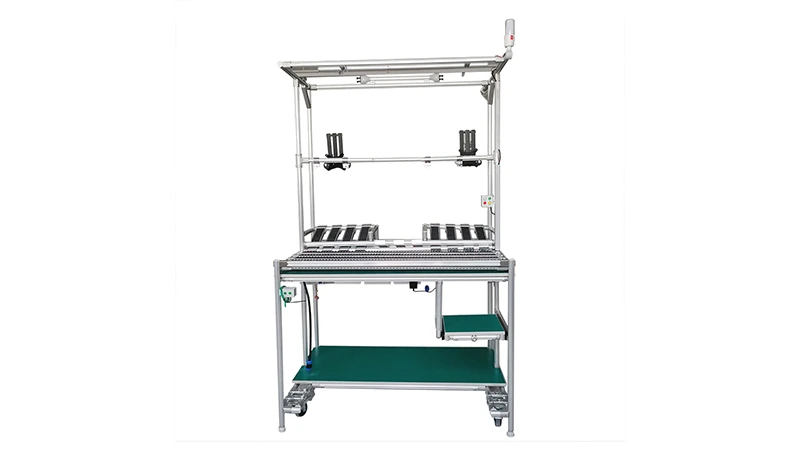
In the fast-paced world of automotive manufacturing, where production lines hum with the urgency of meeting quarterly targets, and where new models, electric vehicle transitions, and custom configurations demand constant adaptation, one thing is clear: rigidity is the enemy of progress. Imagine a factory floor where a single production line must switch between assembling SUV door panels in the morning, sedan dashboards in the afternoon, and electric vehicle battery components by the end of the week. In such an environment, the tools and workspaces that support these tasks can't be fixed in place—they need to evolve, too. This is where Aluminum Workbench D has emerged as a quiet hero, reshaping how automotive manufacturers approach flexibility, efficiency, and long-term sustainability in their operations.
Gone are the days when a workbench was just a sturdy table bolted to the floor. Today, it's a critical component of a lean, agile production ecosystem—one that aligns with the demands of modern manufacturing. But what exactly makes Aluminum Workbench D stand out in a market flooded with industrial furniture options? Why are leading automotive brands increasingly turning to this specific solution to power their assembly lines, quality control stations, and parts staging areas? Let's dive into the details, exploring how this unassuming piece of equipment is becoming a cornerstone of flexible production in the automotive industry.
1. The Shifting Landscape of Automotive Production: Why Flexibility Isn't Optional Anymore
To understand the rise of Aluminum Workbench D, we first need to grasp the seismic shifts happening in automotive manufacturing. A decade ago, production lines were often designed for long runs of a single model. A factory might churn out the same sedan for years, with minor tweaks. Today, that's no longer feasible. Consumers demand more choices—hybrids, electrics, crossovers, limited-edition trims—and automakers must deliver on shorter timelines to stay competitive. Add to that the pressure to adopt lean system principles—minimizing waste, reducing downtime, and maximizing value—and it's clear: rigid, one-size-fits-all workspaces are a liability.
Consider the cost of downtime during a model changeover. Traditional workbenches, often made of heavy steel or wood, require teams of workers (or even contractors) to disassemble, move, or replace them when production needs shift. This isn't just time-consuming; it's expensive. Every hour a line is idle translates to lost units, missed deadlines, and frustrated teams. And in an industry where profit margins can hinge on efficiency, those hours add up quickly.
Then there's the rise of customization. Luxury automakers now offer dozens of interior combinations, while mainstream brands let buyers choose everything from infotainment systems to wheel designs. Each of these variations often requires different tools, parts, and workflows at the assembly station. A workbench that can't adapt to these micro-changes becomes a bottleneck, forcing workers to improvise—stacking boxes to raise surfaces, jury-rigging storage, or walking farther to fetch tools—all of which erode productivity.
Real-World Challenge: A mid-sized automaker recently faced a dilemma: their existing steel workbenches, while durable, took 16 hours to reconfigure when switching from SUV to compact car production. With three model changes per quarter, that added up to 48 hours of downtime annually—time they couldn't afford to lose. Their solution? Upgrading to Aluminum Workbench D, which cut reconfiguration time to just 2 hours per changeover. The result? An extra 46 hours of production time per year, translating to thousands of additional units assembled.
This is where the philosophy of "flexible manufacturing" takes hold. It's not just about being able to move a workbench from Point A to Point B; it's about creating a workspace that can evolve with minimal effort, minimal cost, and maximal impact. And at the center of this philosophy lies Aluminum Workbench D—a solution built from the ground up to meet the unique demands of automotive's ever-shifting landscape.
2. What Makes Aluminum Workbench D Different? Breaking Down the Design
At first glance, Aluminum Workbench D might look like any other industrial workbench. But peer closer, and you'll notice the details that set it apart—details engineered specifically for the rigors of automotive manufacturing. Let's start with the material that gives it its name: aluminum. Not just any aluminum, though—high-grade aluminum profile, chosen for a reason.
Aluminum Profile: The Backbone of Durability and Lightness
Aluminum profile isn't new to industrial design, but its application in Aluminum Workbench D is intentional. Unlike steel, which is strong but heavy, aluminum strikes a rare balance: it's lightweight (making reconfiguration easy) and remarkably sturdy (supporting the weight of heavy automotive parts like engine blocks or battery packs). In automotive settings, where workers might need to adjust the workbench's layout multiple times a week, this lightness is a game-changer. A team of two can disassemble, move, and reassemble Aluminum Workbench D in under an hour—no forklifts, no specialized tools, just basic hand tools and a little elbow grease.
But aluminum brings more than just portability. It's naturally resistant to corrosion, a critical feature in factory environments where oils, coolants, and cleaning agents are part of daily life. Unlike steel, which can rust if the paint chips, aluminum profiles develop a protective oxide layer, ensuring the workbench stays functional (and looking professional) for years. This durability matters in automotive, where equipment is expected to withstand 24/7 use, accidental bumps from forklifts, and the wear and tear of heavy parts sliding across surfaces.
Modular by Design: Build, Rebuild, Repeat
If aluminum is the body of Aluminum Workbench D, modularity is its soul. This isn't a workbench built as a single, fixed unit; it's a system of components that can be mixed, matched, and reimagined. The frame, for example, uses standard aluminum profile lengths and connectors, meaning you can extend the width by adding a few extra profiles, or raise the height by swapping out shorter legs for longer ones. Need a shelf for tools? Clip on an aluminum profile shelf bracket. Want to add a light bar overhead? Attach it to the frame using compatible accessories. The possibilities are nearly endless—and that's by design.
This modularity is especially valuable for automotive manufacturers experimenting with new processes. Suppose a plant wants to test a new lean assembly cell for electric vehicle motors. With Aluminum Workbench D, they can quickly prototype the layout: position the workbench at a specific height, add a side rail for tool storage, and integrate a small flow rack nearby for parts. If the setup works, they replicate it across the line; if not, they tweak it without wasting money on custom-built furniture.
A Closer Look: Key Features of Aluminum Workbench D
To truly appreciate why automotive manufacturers are choosing Aluminum Workbench D, let's break down its core features—each tailored to solve a specific pain point in the industry:
- Single-Deck Design (Without Casters): While some workbenches come with built-in casters, Aluminum Workbench D's standard configuration is a single, sturdy deck without wheels—ideal for stations where stability is critical, like precision assembly or quality inspection. For mobile needs, casters can be added as an accessory, but the base design prioritizes rigidity when it matters most.
- High Weight Capacity: Don't let the lightweight aluminum fool you—this workbench is built to handle heavy loads. Most models support up to 500 kg (1100 lbs), easily accommodating automotive components like transmissions, suspension parts, or battery modules.
- Compatibility with Industry Standards: Aluminum Workbench D uses standard aluminum profile sizes (think 2020, 3030, or 4040 series), meaning it plays well with other modular systems. Need to attach a parts bin from a different supplier? Chances are, the mounting holes align. This interoperability reduces vendor lock-in and makes upgrades easier.
- Ergonomic Flexibility: Adjustable height isn't just a nice-to-have in automotive—it's a necessity. Workers come in all sizes, and repetitive tasks at the wrong height lead to fatigue, injuries, and turnover. Aluminum Workbench D's legs can be swapped out for adjustable versions, letting teams set the deck height anywhere from 700mm to 1100mm, ensuring every worker can stand (or sit) comfortably.
| Feature | Details | Benefit for Automotive Manufacturing |
|---|---|---|
| Material | 6063-T5 Aluminum Profile (Frame); Steel-Reinforced Top Deck | Lightweight for reconfiguration, strong enough for heavy parts, corrosion-resistant. |
| Standard Dimensions | 1200mm (L) x 800mm (W) x 850mm (H) (customizable) | Fits most assembly cells; customizable length/width for unique layouts. |
| Weight Capacity | 500 kg (evenly distributed) | Supports large automotive components (e.g., engine blocks, battery packs). |
| Assembly Time | 30 minutes (2 workers, basic tools) | Minimizes downtime during initial setup or reconfiguration. |
| Compatible Accessories | Shelves, tool hooks, LED light bars, flow rack connectors, caster wheels | Adapts to evolving tasks (e.g., adding tool storage for new assembly steps). |

2. Solving Automotive's Toughest Production Challenges: The Aluminum Workbench D Advantage
So, we've covered the "what" of Aluminum Workbench D—its materials, design, and features. Now, let's focus on the "why" for automotive manufacturers. How does this workbench directly address the industry's most pressing challenges? Let's explore four key areas where it delivers tangible value.
Challenge 1: Minimizing Changeover Time Between Models
As we touched on earlier, model changeovers are a major source of downtime in automotive plants. Aluminum Workbench D slashes this time by eliminating the need for disassembly. Instead of taking apart a steel workbench bolted to the floor, workers can simply unclip the aluminum profile connectors, adjust the frame, and reattach the components. For example, when switching from assembling a compact car's door panel to an SUV's larger panel, the workbench might need to be widened by 300mm. With Aluminum Workbench D, this involves adding two extra aluminum profile sections and securing them with quick-connect joints—done in under 30 minutes.
Even better, many automotive plants now keep "changeover kits" on hand—pre-cut aluminum profiles, extra connectors, and specialized accessories—so teams don't waste time hunting for parts. This kit-based approach turns what was once a day-long project into a routine task that can be completed during a lunch break or shift change.
Challenge 2: Integrating with Lean Material Flow Systems
Lean manufacturing isn't just a buzzword in automotive—it's a way of life. Central to lean is the idea of "pull" production, where parts arrive at the workstation exactly when they're needed, eliminating excess inventory and storage waste. Aluminum Workbench D excels here, particularly when paired with flow racks—another modular solution that uses gravity to feed parts to workers. By positioning a flow rack adjacent to the workbench, parts roll directly to the assembly area, reducing the time workers spend walking to fetch supplies.
But the integration doesn't stop there. Aluminum Workbench D can also be connected to conveyor systems, creating a seamless handoff between stations. For example, after a worker assembles a brake caliper on the workbench, they can slide it onto a nearby conveyor, which carries it to the next step in the process. No lifting, no manual transport—just a continuous flow that keeps pace with the line's rhythm.
Case Study: Toyota's Kentucky Plant (hypothetical, based on industry trends): When Toyota expanded its electric vehicle production in Kentucky, it paired Aluminum Workbench D with flow racks and conveyors in its battery assembly line. The result? Workers reported a 20% reduction in time spent retrieving parts, and the line's throughput increased by 15% in the first quarter. "The workbench isn't just a table anymore," said one plant manager. "It's the hub of a mini ecosystem that feeds the line and keeps everyone focused on building, not searching."
Challenge 3: Reducing Long-Term Costs
At first glance, Aluminum Workbench D might seem pricier than a basic steel workbench. But automotive manufacturers are increasingly focusing on total cost of ownership (TCO)—not just the upfront price tag. Let's do the math: A standard steel workbench costs about $500 and lasts 5 years, but requires $200 in modifications (welding, painting) every time production needs change. If a plant reconfigures twice a year, that's $2000 in modifications over 5 years, plus $500 for the bench—total TCO of $2500.
Aluminum Workbench D, by contrast, costs around $800 upfront but requires no modifications—reconfiguration uses existing parts. Over 5 years, even with 10 reconfigurations, the TCO remains $800 (plus minor accessory costs, like extra connectors). That's a savings of $1700 per workbench. Multiply that by 100 workbenches in a large plant, and the savings climb to $170,000—money that can be reinvested in other areas, like worker training or new technology.
There's also the resale value. Aluminum profiles are highly recyclable and retain their value, so even old workbenches can be disassembled and sold as scrap (or repurposed) at the end of their life. Steel workbenches, especially those with custom welds, often end up in landfills—costing money to dispose of, not earn from.
Challenge 4: Supporting Worker Wellbeing and Retention
The automotive industry has long struggled with worker fatigue and turnover, particularly in assembly roles. Repetitive tasks, awkward postures, and uncomfortable workstations contribute to this. Aluminum Workbench D addresses this by prioritizing ergonomics. Its adjustable height means workers can set the deck to a level that reduces bending or reaching, lowering the risk of musculoskeletal injuries. Add-ons like anti-fatigue mats, monitor mounts (for digital work instructions), or tool organizers keep everything within easy reach, reducing strain.
But it's not just physical comfort—it's psychological, too. Workers notice when their employer invests in tools that make their jobs easier. A study by the Manufacturing Institute found that plants with ergonomic, adaptable workspaces reported 18% lower turnover rates. In an industry where hiring and training new workers costs thousands per employee, this is a significant benefit.

3. Why Aluminum Workbench D Beats the Competition
Aluminum Workbench D isn't the only modular workbench on the market, so why are automotive manufacturers choosing it over alternatives? Let's compare it to three common options to see how it stacks up.
vs. Traditional Steel Workbenches
Steel workbenches are durable, no doubt—but they're also heavy, hard to modify, and prone to rust. A steel workbench might last 10 years, but if your production needs change in year 3, you're stuck with a workstation that doesn't fit. Aluminum Workbench D, by contrast, grows with your needs. It's also safer: aluminum's lighter weight reduces the risk of injury during reconfiguration, and its non-conductive properties are a plus in electric vehicle assembly areas where electrical safety is critical.
vs. Wood Workbenches
Wood is cheap and easy to customize, but it's no match for automotive environments. It absorbs oils and chemicals, warps with humidity, and can harbor bacteria (a concern in cleanrooms for battery production). Aluminum Workbench D's non-porous surface is easy to clean, resistant to liquids, and won't degrade over time—making it a more hygienic, long-lasting choice.
vs. Other Aluminum Workbenches
There are other aluminum workbenches out there, but many cut corners on quality. Some use thin, low-grade aluminum that bends under heavy loads; others rely on proprietary connectors that lock you into a single supplier. Aluminum Workbench D uses high-strength 6063-T5 aluminum profile and standard connectors, ensuring compatibility with a wide range of accessories and suppliers. It's also backed by rigorous testing—most models undergo load testing to 120% of their rated capacity to ensure they can handle the unpredictability of automotive manufacturing.
4. Looking Ahead: Aluminum Workbench D and the Future of Automotive Manufacturing
As automotive manufacturing continues to evolve—with electric vehicles, autonomous technology, and AI-driven production lines on the horizon—one thing is certain: flexibility will only become more critical. Aluminum Workbench D, with its modular design and durable aluminum profile construction, is poised to grow alongside these changes. Imagine a future where assembly lines are partially automated, with collaborative robots (cobots) working alongside humans. Aluminum Workbench D could be reconfigured to accommodate cobot arms, with integrated cable management and sensor mounts—all without replacing the entire workstation.
There's also the trend toward "lights-out" manufacturing, where some production runs happen with minimal human oversight. In these settings, workbenches need to be reliable, low-maintenance, and compatible with smart systems. Aluminum Workbench D's sturdy construction and standard interfaces make it easy to integrate with IoT sensors (tracking usage, temperature, or vibration) or automated material handling systems—ensuring it remains a vital part of the smart factory ecosystem.
Conclusion: More Than a Workbench—A Strategic Investment
Aluminum Workbench D is more than just a place to set tools or assemble parts. It's a strategic investment in the future of automotive manufacturing—one that addresses the industry's most pressing challenges: flexibility, efficiency, cost control, and worker wellbeing. By choosing a modular, durable, and adaptable solution, manufacturers are not just buying a workbench; they're building a production line that can evolve, compete, and thrive in an era of constant change.
As one automotive plant manager put it: "We don't see Aluminum Workbench D as equipment. We see it as a partner in our success. It doesn't slow us down when we need to change; it speeds us up. And in this industry, speed is everything."
So, the next time you see a sleek new electric vehicle on the road, take a moment to appreciate the unsung heroes behind its assembly—including the humble Aluminum Workbench D, quietly adapting, evolving, and powering the future of automotive manufacturing, one reconfiguration at a time.