- Company Articles
- Products and Technology
- Product knowledge
- Why Choose 4080B EU Standard Aluminum Profile for Industrial Applications?

Why Choose 4080B EU Standard Aluminum Profile for Industrial Applications?
Related Product
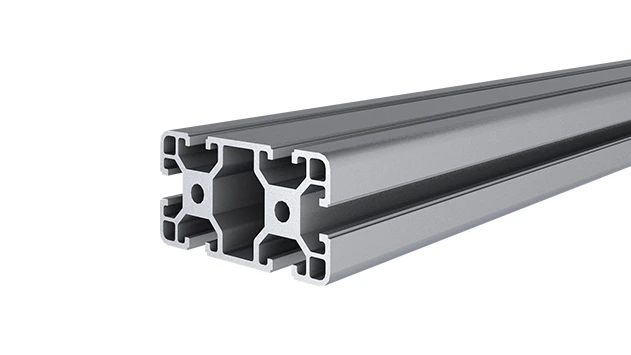
4080B EU Standard Aluminum Profile
4080B is a 4.00x8.00 CM fractional 40 series square extrusion T-slot profile with two side open T-slots, each side with 4.00cm face, two side with 8.00cm face. The profile has align-a-grooves to assist in aligning connecting profiles.
Walk into any modern factory, workshop, or manufacturing facility, and you'll quickly realize that the unsung heroes of efficient operations aren't just the machines or the workers—they're the structures that hold everything together. From assembly line workbenches to material storage racks, from conveyor systems to lean manufacturing setups, these structures need to be strong, adaptable, and reliable. Yet, for too long, many industries have struggled with rigid, one-size-fits-all solutions: steel frames that require welding to reconfigure, flimsy plastic components that crack under pressure, or mismatched parts that slow down workflows. Enter the 4080B EU Standard Aluminum Profile —a versatile, durable, and forward-thinking solution that's transforming how industrial spaces are designed and operated. In this article, we'll dive into why this aluminum extrusion profile has become a go-to choice for engineers, facility managers, and manufacturers worldwide.
What Exactly Is 4080B EU Standard Aluminum Profile?
Before we jump into its benefits, let's break down what makes the 4080B profile unique. At its core, it's an aluminum extrusion profile —a product of forcing molten aluminum through a die to create a specific cross-sectional shape. The "4080" in its name refers to its dimensions: 40 millimeters in width and 80 millimeters in height. The "B" denotes its specific design variant, often differing from other 4080 models (like 4080A) in slot configuration, wall thickness, or weight capacity—details that matter significantly in industrial settings.
But what truly sets the 4080B apart is its adherence to EU standards. These aren't just arbitrary guidelines; they're rigorous benchmarks for quality, safety, and precision. To earn the EU standard label, the profile must undergo testing for material strength, dimensional accuracy, corrosion resistance, and even environmental impact. For manufacturers, this means consistency: every 4080B profile from a reputable supplier will fit with every other, with slots aligned, holes pre-drilled to exact specifications, and structural integrity you can trust.
Made primarily from 6063-T5 aluminum alloy—a material prized for its excellent strength-to-weight ratio—the 4080B profile strikes a rare balance: it's lightweight enough to be maneuvered by a small team but strong enough to support heavy machinery, tools, and materials. This combination makes it ideal for everything from static workbenches to dynamic conveyor systems, and its modular design means it can grow, shrink, or reconfigure as your needs change.
The Backbone of Strength: Why 4080B Excels in Structural Integrity
In industrial applications, "good enough" strength just won't cut it. A workbench holding a 50kg assembly tool needs to stay stable; a material rack stacked with heavy components can't wobble; a conveyor frame supporting roller tracks full of products must resist bending under constant use. This is where the 4080B profile shines, thanks to its thoughtful engineering and material choice.
First, the cross-sectional design: the 40mm x 80mm shape isn't random. Its rectangular structure, combined with internal reinforcing ribs (common in EU standard profiles), distributes weight evenly across the profile, reducing stress points. This makes it far sturdier than smaller profiles like 2020 or 3030, which are better suited for light-duty tasks. For example, a single 4080B beam can typically support up to 200kg of evenly distributed weight—more than enough for most assembly line tools, parts bins, or even small machinery.
Then there's the wall thickness. While exact measurements vary by supplier, most 4080B profiles have a wall thickness of 2.0mm to 3.0mm, thicker than many lightweight aluminum profiles. This extra thickness boosts rigidity, meaning less flex when under load. Compare that to steel, which is strong but heavy: a 4080B aluminum profile weighs roughly 1/3 of an equivalent steel beam, making installation and reconfiguration faster and safer (no need for heavy lifting equipment for every adjustment).
Real-world example: A automotive parts manufacturer in Germany recently switched from steel frames to 4080B-based workbenches for their assembly line. They reported a 40% reduction in installation time and noted that workers could now reposition benches (with the help of caster wheels ) in minutes, rather than hours, when retooling for new car models. And despite daily use with power tools and heavy components, the benches showed no signs of warping or fatigue after two years of operation.

Flexibility Redefined: Modular Design for Ever-Changing Needs
In today's fast-paced manufacturing world, adaptability is key. Product lines change, production volumes fluctuate, and new technologies (like automation or IoT sensors) get integrated—your workspace needs to keep up. The 4080B profile's modular design makes it a champion of flexibility, thanks to one critical feature: T-slots.
Running along the length of the profile are T-shaped slots, which act as universal attachment points for aluminum profile accessories . Need to add a shelf? Slide a bracket into the slot and tighten a bolt. Want to mount a light or a monitor arm? Use a T-nut and screw. Even complex setups—like attaching roller tracks for a material flow system or adding side guards to a conveyor—become DIY-friendly, no welding or drilling required. This modularity is a game-changer for lean manufacturing principles, where minimizing waste (including time wasted on reconfigurations) is paramount.
Consider a electronics manufacturer that produces both smartphones and tablets. Their assembly lines need to switch between small, delicate phone components and larger tablet parts regularly. With 4080B-based workstations, they can quickly swap out tool holders, adjust shelf heights, or even reposition the entire workstation on caster wheels—all without calling in a maintenance crew. As one facility manager put it: "We used to have to design a new workstation from scratch for every product. Now, we just reconfigure the 4080B frames. It's like building with industrial-grade Legos."
And it's not just about reconfiguring existing setups. The 4080B profile is also easy to scale. Need to expand a material rack? Add more vertical 4080B posts and horizontal beams. Want to extend a conveyor system? Connect additional sections with 90° aluminum profile connectors. This scalability reduces upfront costs, too: instead of investing in a custom steel structure that may become obsolete in a year, you can start small with 4080B and add components as your business grows.
EU Standards: Quality, Safety, and Interoperability You Can Trust
The "EU Standard" label on the 4080B profile isn't just marketing—it's a guarantee of quality that matters for both compliance and practicality. Let's break down why this matters:
- Consistency: EU standards mandate strict tolerances for dimensions, slot alignment, and material composition. That means if you order 4080B profiles from two different suppliers (both EU-certified), they'll fit together perfectly. No more "close enough" parts that require filing or force to assemble.
- Safety: Industrial spaces are tightly regulated for worker safety, and the 4080B profile meets EU norms for load-bearing capacity, fire resistance, and chemical resistance. For example, in food processing facilities, where cleanliness is critical, anodized 4080B profiles resist bacterial growth and are easy to sanitize—unlike porous steel that can harbor germs.
- Interoperability: EU standard profiles are designed to work with a vast ecosystem of accessories. From 90° aluminum profile connectors to aluminum guide rails, from caster wheels to hinges, there's a universe of compatible parts available. This means you're not locked into one supplier—you can mix and match accessories from different vendors to get the best solution for your needs.
For businesses operating in the EU, compliance with these standards is often legally required. But even companies outside Europe benefit: using EU-standard components simplifies global supply chains and ensures that your setups meet the same high bar as international competitors. As a supplier in the U.S. told us: "We started importing 4080B profiles because our European clients demanded them. Now, even our domestic customers prefer them—they trust the quality, and the interchangeable parts make inventory management so much easier."
4080B vs. Other Profiles: When to Choose This Workhorse
With so many aluminum profiles on the market—from tiny 2020 to heavy-duty 8080—how do you know if 4080B is right for your application? Let's compare it to some popular alternatives:
| Profile Type | Dimensions (WxH, mm) | Typical Load Capacity (kg/m) | Best For | Limitations |
|---|---|---|---|---|
| 2020 EU Standard | 20x20 | 30-50 | Light-duty shelves, small workbenches, 3D printer frames | Too weak for heavy tools or large materials |
| 3030 EU Standard | 30x30 | 80-120 | Medium shelves, small conveyor systems, lab equipment | Limited height for taller structures |
| 4040 EU Standard | 40x40 | 150-180 | Workbenches, small material racks, assembly stations | May lack height for vertical storage or tall equipment |
| 4080B EU Standard | 40x80 | 200-250 | Heavy workbenches, large material racks, conveyor frames, lean system setups | Overkill for very light-duty tasks (costs more than 2020/3030) |
| 8080 EU Standard | 80x80 | 350-400 | Industrial machinery frames, heavy-duty storage | Bulky and expensive for most general applications |
As the table shows, 4080B hits the sweet spot for most industrial applications. It's strong enough for heavy workbenches and material racks (like the "Material Rack B (3 row and 3 floor)" from many supplier catalogs) but not so large that it wastes space or budget. Its 80mm height makes it ideal for vertical storage—think tall material racks or multi-level workstations—while its 40mm width keeps it streamlined enough for tight spaces.
For example, a furniture manufacturer in Italy uses 4080B to build their "lean system" setups: modular workstations where workers assemble sofas and chairs. The 4080B frames support heavy sewing machines, while T-slots hold tool holders, fabric rolls, and even small conveyor belts for moving parts between stations. When they introduced a new sofa model, they reconfigured the workstations in a day—something that would have taken a week with their old steel frames.
Accessories That Unlock 4080B's Full Potential
A profile is only as good as the accessories that complement it, and the 4080B's T-slots play well with a vast array of aluminum profile accessories . Here are some of the most popular ones and how they enhance 4080B-based setups:
- 90° Aluminum Profile Connectors: These L-shaped brackets lock two 4080B profiles at right angles, creating sturdy corners for frames, shelves, or workbenches. Most are made from aluminum or steel for durability and can be tightened with a hex key—no welding required.
- Caster Wheels: Attach these to the bottom of 4080B frames to turn fixed structures into mobile ones. Heavy-duty caster wheels with brakes are perfect for workstations that need to move between production lines or storage areas.
- Aluminum Guide Rails: For material flow systems, aluminum guide rails (like "Aluminum Guide Rail A" or "Plastic Roller Track Guide Rail Yellow") slot into 4080B's T-slots, creating smooth paths for roller tracks or conveyor belts. This is critical for lean manufacturing, where efficient material movement reduces downtime.
- Workbench Tops: Pair 4080B frames with aluminum honeycomb panels or wooden tops for sturdy work surfaces. Many suppliers offer pre-cut tops that bolt directly into the T-slots, making setup a breeze.
- Adjustable Feet: For uneven floors, adjustable feet (like "Anti-slip Adjustable Leveling Feet") screw into the bottom of 4080B posts, ensuring stability even on rough concrete.
The beauty of these accessories is that they're designed to work together seamlessly. For example, you could build a mobile workbench by: (1) cutting 4080B profiles to your desired height and width; (2) joining them with 90° connectors; (3) adding caster wheels to the base; (4) attaching a honeycomb worktop; and (5) sliding in tool holders via the T-slots. The entire process takes a few hours, not days, and can be modified later if needed.
Durability and Low Maintenance: Built to Last in Harsh Environments
Industrial spaces are tough on equipment. Dust, moisture, chemicals, and constant use can wear down even the sturdiest materials. The 4080B profile, however, is built to withstand these challenges, thanks to aluminum's natural properties and thoughtful finishing.
First, aluminum is inherently corrosion-resistant. Unlike steel, which rusts when exposed to moisture, aluminum forms a thin oxide layer that protects the underlying metal. For extra protection, most 4080B profiles come with anodized finishes. Anodization is an electrochemical process that thickens this oxide layer, making the profile scratch-resistant, UV-stable, and even more resistant to chemicals (like oils, coolants, or cleaning agents common in factories).
Maintenance is also a breeze. Unlike steel, which needs regular painting or coating to prevent rust, 4080B profiles just need an occasional wipe with a damp cloth to remove dust or grime. Even in high-humidity environments (like food processing plants or outdoor warehouses), they remain rust-free and structurally sound. A brewery in Belgium, for example, uses 4080B profiles for their keg storage racks—exposed to steam, water, and cleaning chemicals daily—and reports that the racks look and function like new after five years.
Another advantage: aluminum is non-magnetic and non-sparking, making 4080B suitable for sensitive environments like electronics manufacturing (where static electricity is a risk) or chemical plants (where sparks could ignite fumes). Compare that to steel, which is magnetic and can spark if struck—limiting its use in certain industries.
Cost-Effective in the Long Run: Investing in Quality Pays Off
It's true: 4080B profiles cost more upfront than basic steel or plastic alternatives. But when you factor in long-term costs—installation, maintenance, reconfiguration, and replacement—the math shifts dramatically in favor of aluminum.
Consider installation: Steel frames require welding, which means hiring skilled labor and renting equipment. 4080B, with its bolt-together design, can be installed by a small team with basic tools, cutting labor costs by 50% or more. Reconfiguration costs are even more lopsided: modifying a steel frame often means cutting and rewelding, which is time-consuming and risky (a bad weld can compromise safety). With 4080B, you just loosen a few bolts, adjust the frame, and retighten—no special skills needed.
Then there's longevity. A steel frame might last 5-7 years before rust or warping forces replacement. A 4080B setup, with proper care, can last 15-20 years or more. And when it does reach the end of its life, aluminum is 100% recyclable, meaning you might even get a rebate for scrap metal—unlike steel, which often ends up in landfills.
A case study: A logistics company in Spain replaced all their steel material racks with 4080B-based systems. The upfront cost was 30% higher, but they saved €20,000 in installation labor and avoided €15,000 in annual maintenance (painting, rust repair). Within three years, the switch had paid for itself, and the racks are still going strong after eight years.
Conclusion: 4080B EU Standard Aluminum Profile—The Smart Choice for Modern Industry
In a world where manufacturing and industrial operations demand more flexibility, durability, and efficiency than ever before, the 4080B EU Standard Aluminum Profile stands out as a solution that delivers on all fronts. Its combination of strength, modularity, compliance with EU standards, and long-term cost-effectiveness makes it more than just a building material—it's a strategic investment in your facility's future.
Whether you're building workbenches for an assembly line, material racks for storage, conveyor systems for lean manufacturing, or custom setups for unique industrial needs, 4080B offers the versatility to adapt as your business evolves. Paired with the right aluminum profile accessories—connectors, caster wheels, guide rails—it becomes a blank canvas for innovation, allowing you to design spaces that work for your team, not against them.
So, the next time you're planning a workspace upgrade or a new production line, ask yourself: Do I want a rigid, short-lived solution that holds my operations back? Or do I want a flexible, durable, and future-proof system that grows with my business? For thousands of manufacturers worldwide, the answer is clear: 4080B EU Standard Aluminum Profile isn't just a choice—it's the foundation of smarter, more efficient industrial spaces.