- Company Articles
- Products and Technology
- Product knowledge
- Why Choose Multi-Angle Fixed Aluminum Joints for Modular Workstations?

Why Choose Multi-Angle Fixed Aluminum Joints for Modular Workstations?
Related Product
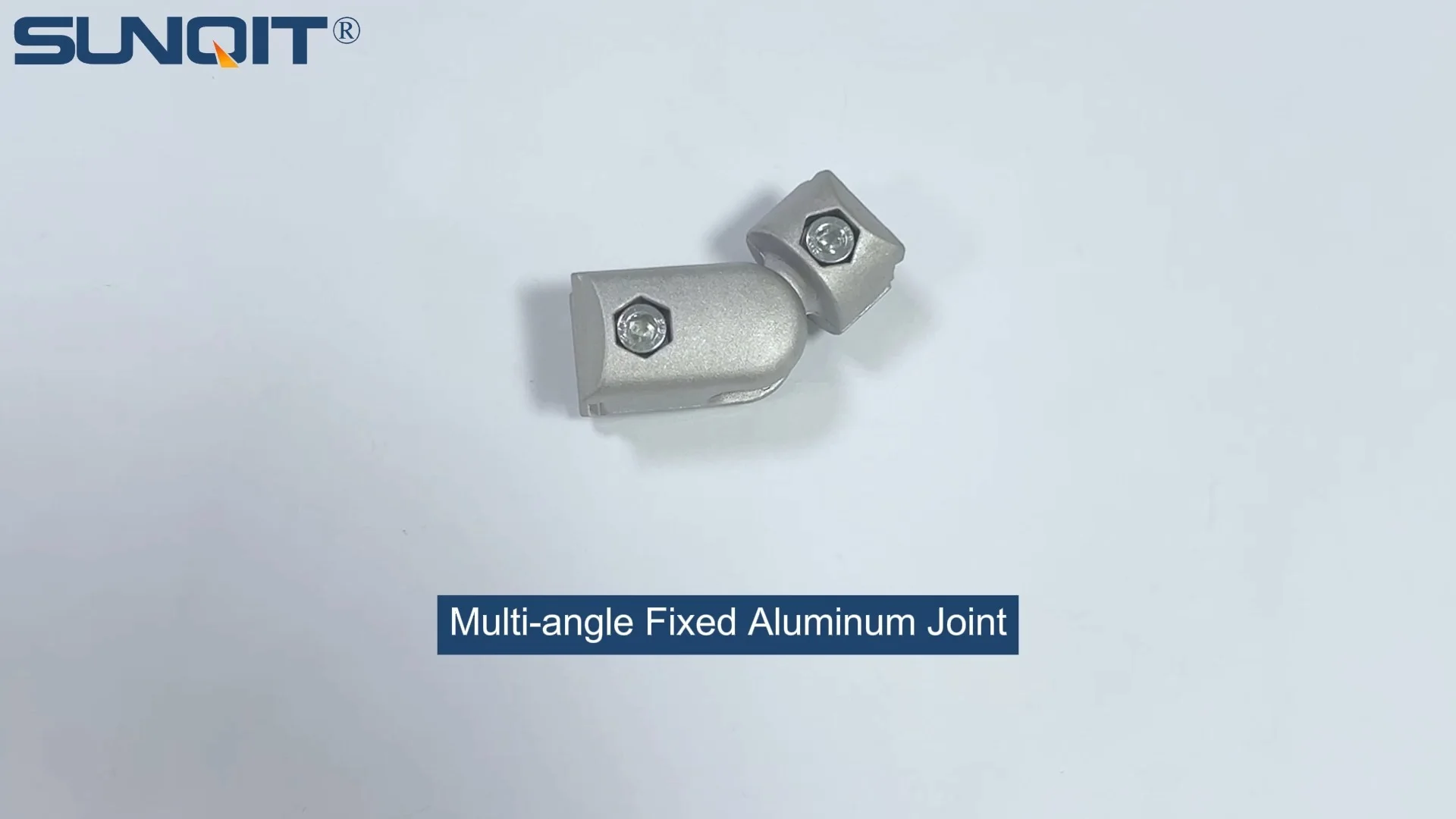
Multi-angle Fixed Aluminum Joint
Aluminum joint pipe connection for two pipe connection and work in mutiple angle.
Walk into any modern manufacturing facility, and you'll notice a shift: gone are the days of, permanent workbenches bolted to the floor or welded metal racks that stay unchanged for years. Today's workshops thrive on flexibility—think production lines that reconfigure overnight for a new product launch, assembly stations that adjust to team size, or material racks that expand as inventory grows. This flexibility isn't magic; it's built into the very structure of the workspace, thanks to modular systems. And at the core of these systems, holding everything together while still allowing for change, are the connectors we often overlook: joints. Among the many joint options available, multi-angle fixed aluminum joints have become a go-to for businesses that refuse to compromise on adaptability, strength, or efficiency. Let's explore why these small but mighty components are transforming how we build and use workstations.
What Are Multi-Angle Fixed Aluminum Joints?
Before diving into their benefits, let's clarify what multi-angle fixed aluminum joints actually are. Simply put, they're specialized connectors designed to link aluminum profiles—the structural backbone of most modular workstations—at various angles, all while maintaining stability and load-bearing capacity. Unlike rigid, single-angle joints (which only connect pieces at 90 degrees, for example) or flimsy plastic connectors that wear out quickly, these aluminum joints are engineered to offer both versatility and durability. They typically feature multiple slots or pivot points that allow aluminum extrusion profiles to be joined at 30°, 45°, 90°, 135°, or even custom angles, depending on the model. Made from high-grade aluminum alloy, they're lightweight yet surprisingly strong, resistant to corrosion, and designed for repeated assembly and disassembly without losing their grip.
Picture this: you're setting up a workbench for electronics assembly. One section needs a 45° angle to mount a small monitor, another requires a straight 180° line for a tool tray, and a third needs a 90° corner to attach a bin for components. With a standard fixed joint, you'd need three different types of connectors. With a multi-angle fixed aluminum joint? One component can handle all those angles, streamlining the process and reducing the number of parts you need to stock. That's the beauty of their design—they simplify complexity.
The Top 5 Reasons to Choose Multi-Angle Fixed Aluminum Joints
1. Unmatched Flexibility for Ever-Changing Workspaces
The biggest draw of modular workstations is their ability to adapt, and multi-angle joints are the enablers of that adaptability. In a busy workshop, no two days are the same. One week, you might be assembling small parts that require a compact, U-shaped workbench; the next, you need to expand into a linear production line to handle larger components. With traditional welded frames, this would mean cutting, welding, and repainting—wasting hours (or days) of productive time. With multi-angle aluminum joints, reconfiguration becomes a task for your team, not a contractor.
Take a small automotive parts manufacturer, for example. When they landed a contract for a new line of sensors, their existing workstations were too narrow to accommodate the larger testing equipment. Instead of building entirely new benches, they used multi-angle joints to adjust the side panels of their existing aluminum profile workstations from 90° to 135°, creating extra space without replacing the entire structure. The process took two team members just three hours, compared to the two days a welding crew would have needed. That's flexibility in action.
2. Strength That Doesn't Compromise on Weight
Aluminum has long been prized in manufacturing for its strength-to-weight ratio, and multi-angle fixed aluminum joints leverage this perfectly. Unlike plastic joints, which can crack under heavy loads, or stainless steel joints, which add unnecessary weight, aluminum joints strike a balance: they're strong enough to support tools, materials, and even heavy machinery on a workbench, yet light enough to make reconfiguration easy. A typical multi-angle aluminum joint can handle loads of 50-100 kg per connection, depending on the model—more than enough for most workshop needs, from holding a desktop CNC machine to supporting stacked material bins.
Consider a material rack in a warehouse. If you're storing metal components or heavy boxes, a flimsy joint could lead to sagging shelves or even collapse—risking damage to inventory and injury to workers. Multi-angle aluminum joints, paired with sturdy aluminum extrusion profiles, create a rack that's both lightweight (easy to move if needed) and rock-solid. One logistics company reported reducing workplace accidents by 30% after switching from plastic-jointed racks to aluminum-jointed ones, simply because the shelves no longer bent or shifted under load.
3. Tool-Free (or Minimal-Tool) Assembly for Faster Setup
Anyone who's ever built furniture knows the frustration of hunting for the right tool, stripping screws, or struggling to align pre-drilled holes. In a workshop, that frustration translates to lost productivity. Multi-angle fixed aluminum joints are designed to eliminate that hassle. Most models use a simple tightening mechanism—like a hand-turn knob or a hex key (included with the joint)—that locks the aluminum profile in place without the need for power tools. This means your team can assemble, disassemble, or reconfigure a workstation in minutes, not hours.
Imagine training a new team member: instead of spending an hour teaching them to use a wrench or drill, you hand them a joint, show them how to slide the aluminum profile into place, and twist the knob until it's tight. That's it. This simplicity reduces training time, minimizes errors, and lets your team focus on what matters—getting work done. A electronics assembly plant in Texas reported a 40% reduction in setup time for new workstations after switching to multi-angle aluminum joints, freeing up their technicians to focus on production instead of construction.
4. Compatibility with a Wide Range of Aluminum Profile Accessories
Modular systems thrive on compatibility, and multi-angle aluminum joints play well with others. They're designed to work seamlessly with standard aluminum extrusion profiles (like the popular 2020, 3030, or 4040 series), as well as a host of aluminum profile accessories—from shelves and bins to lighting brackets and tool holders. This means you're not locked into a single brand or system; you can mix and match components to create exactly the workstation you need.
For instance, if you need to add a roller track to your workbench to slide materials between stations, multi-angle joints can connect the track's aluminum guide rails to the bench frame at the perfect angle. If you want to mount a monitor arm, the joint can secure the arm's bracket to the profile without drilling new holes. This compatibility turns a basic workstation into a fully customized hub, tailored to your team's specific tasks.
5. Cost-Effective in the Long Run (Yes, Even with a Higher Upfront Price)
It's true: multi-angle fixed aluminum joints often cost more upfront than plastic or low-grade steel alternatives. But in the world of manufacturing, cost isn't just about the initial price tag—it's about durability, reusability, and long-term value. Plastic joints may be cheap, but they wear out quickly under repeated use, cracking or losing their grip after a few reconfigurations. Welded steel is strong but impossible to reuse, meaning you'll pay to replace the entire structure when you need to change it. Aluminum joints, by contrast, are built to last. They resist rust, don't degrade in humidity or temperature changes, and can be disassembled and reused dozens of times without losing functionality.
A small appliance manufacturer in Ohio crunched the numbers: they initially bought plastic joints for their workstations, replacing them every 6-8 months at $5 per joint. After switching to aluminum joints ($15 each), they haven't replaced a single one in three years. The upfront cost was higher, but the total savings over time? Over $2,000. Plus, they've reused the joints on four different workstation configurations, avoiding the need to buy new parts each time. When you factor in reusability and durability, aluminum joints often end up being the cheaper choice.

How Multi-Angle Joints Support Lean Manufacturing Systems
In today's manufacturing world, lean principles—eliminating waste, streamlining processes, and continuous improvement—are more than buzzwords; they're essential for staying competitive. Multi-angle fixed aluminum joints align perfectly with these principles, making them a favorite in lean-focused facilities. Here's how:
Reducing Waste: Traditional workstations often result in wasted space (too big for the task) or wasted time (too small, requiring workers to move around more). With multi-angle joints, you can build workstations that fit the task exactly—no more, no less. For example, a lean team assembling smartphones might design a compact, hexagonal workbench using 60° and 120° angles, ensuring every tool and component is within arm's reach, cutting down on unnecessary movement.
Supporting Continuous Improvement: Lean systems thrive on feedback—if a process isn't working, you change it. Multi-angle joints make those changes possible without overhauling the entire workspace. A team might notice that their material flow is bottlenecked at a 90° corner, so they adjust the joint to 135°, smoothing the path for roller-tracked bins. This ability to tweak and refine on the fly turns "good enough" into "better."
Adapting to Small Batch Production: Many lean facilities specialize in small-batch or custom production, which means workstations need to shift between products quickly. A furniture manufacturer using lean principles, for example, might produce 10 custom chairs one week and 15 tables the next. With multi-angle joints, their assembly stations can reconfigure from chair frames to table legs in an hour, avoiding the downtime of switching between fixed workbenches.

Comparing Multi-Angle Aluminum Joints to Other Joint Types
To truly understand why multi-angle fixed aluminum joints stand out, it helps to see how they stack up against common alternatives. Let's break down the key differences:
| Feature | Multi-Angle Fixed Aluminum Joints | Plastic Snap-On Joints | Stainless Steel Welded Joints |
|---|---|---|---|
| Angle Flexibility | 30°-180° adjustable; multiple angles per joint | Limited (usually 90° only) | Fixed (cannot adjust after welding) |
| Load Capacity | High (50-100kg per joint) | Low (10-20kg; prone to cracking under stress) | Very high (but permanent) |
| Assembly Time | 5-10 minutes per joint (tool-free or minimal tools) | 2-5 minutes (snap-on, but weak grip) | 30+ minutes (requires welding equipment/skill) |
| Reusability | High (can be disassembled/reused indefinitely) | Low (plastic weakens after 2-3 uses) | None (permanent welds) |
| Corrosion Resistance | High (aluminum alloy resists rust) | High (but prone to UV damage/yellowing) | High (but heavier and costlier) |
| Best For | Modular workstations, reconfigurable lines, lean systems | Temporary setups, light-duty use (e.g., retail displays) | Permanent, heavy-load structures (e.g., industrial machinery frames) |
As the table shows, multi-angle aluminum joints strike a rare balance: they offer the flexibility of plastic joints without sacrificing strength, and the durability of steel without the permanence. For most modern workstations—where adaptability and reliability are equally important—they're the clear choice.

Real-World Applications: Where Multi-Angle Joints Shine
Multi-angle fixed aluminum joints aren't just theoretical—they're solving real problems in workshops and factories every day. Let's look at a few common applications where they make a tangible difference:
Workbench Customization
Workbenches are the workhorses of any facility, and no two teams use them the same way. A mechanic might need a bench with a 45° angled shelf for tools, while a lab technician requires a flat, level surface with raised edges to contain spills. Multi-angle joints let you build benches that fit these unique needs. For example, a workbench E (single deck-without caster) can be modified with 30° joints to add sloped side panels, preventing small parts from rolling off. Or, a double-deck workbench can use 90° and 135° joints to create a staggered shelf layout, keeping frequently used items at eye level and less critical ones below.
Material Racks and Flow Systems
Efficient material handling is key to a smooth production line, and multi-angle joints excel here. Material rack B (3 row and 3 floor) —a common setup for storing components—can be enhanced with joints that angle the shelves slightly downward, using gravity to keep items rolling forward as the front ones are used. This "flow rack" design reduces the need to reach or bend, speeding up access. Similarly, roller tracks (used to slide bins between stations) can be connected at custom angles using multi-angle joints, ensuring materials flow around corners or up/down gentle slopes without jamming.
Mobile Workstations and Trolleys
Not all work stays in one place. Mobile workstations—equipped with casters—need to be both sturdy and flexible. Multi-angle joints help here by creating lightweight yet rigid frames that can handle movement without shaking apart. A turnover trolley used to transport parts between assembly lines, for example, might use 90° joints for the main frame and 45° joints for diagonal bracing, adding stability without extra weight. When the trolley needs to be repurposed (say, from carrying small parts to larger assemblies), the joints can be adjusted to widen the base or add taller sides—no new trolley required.
Choosing the Right Multi-Angle Aluminum Joint for Your Needs
Not all multi-angle fixed aluminum joints are created equal, so it's important to pick the right one for your application. Here are a few key factors to consider:
Load Capacity: Check the joint's weight rating—don't just guess. If you're building a workbench that will hold a 50kg machine, choose a joint rated for at least 75kg to be safe.
Angle Range: Some joints offer preset angles (30°, 45°, 90°), while others allow infinite adjustment within a range. If you need custom angles, opt for the latter.
Profile Compatibility: Ensure the joint fits your aluminum extrusion profiles. Most are designed for standard T-slot profiles, but sizes (e.g., 20mm vs. 40mm slots) vary.
Environmental Resistance: If your facility is humid, dusty, or exposed to chemicals, look for joints with anodized aluminum finishes, which add extra corrosion resistance.
Supplier Reliability: Choose a reputable aluminum profile supplier that offers warranties and replacement parts. A cheap, low-quality joint might save money upfront, but it'll cost more when it fails.
Final Thoughts: Investing in Adaptability
In a world where change is constant, the tools we use to build our workspaces shouldn't hold us back. Multi-angle fixed aluminum joints are more than just connectors—they're investments in adaptability. They let you build workstations that grow with your business, adjust to new challenges, and evolve with your team's needs. Whether you're running a small workshop or a large manufacturing plant, these joints offer a simple truth: flexibility doesn't have to mean sacrificing strength, and durability doesn't have to mean being stuck in one place.
So, the next time you look at your workstation, take a closer look at the joints. They might be small, but they're the reason your workspace can keep up with you. And if you're still using rigid, outdated connectors? It might be time to make the switch. Your team, your productivity, and your bottom line will thank you.