- Company Articles
- Products and Technology
- Product knowledge
- Why Four Way Straight Lean Pipe Joint Is a Cornerstone of Flexible Manufacturing

Why Four Way Straight Lean Pipe Joint Is a Cornerstone of Flexible Manufacturing
Related Product
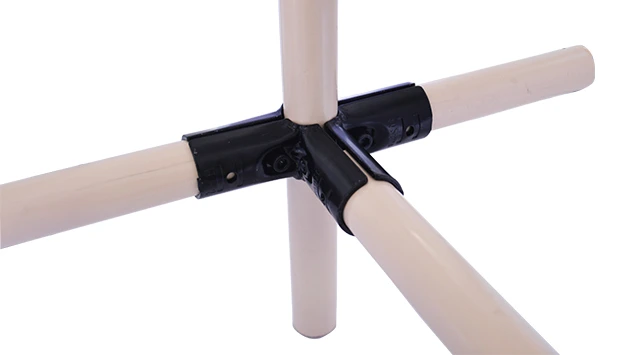
Four Way Straight Lean Pipe Joint
Four way lean pipe joint for 4 pcs 28MM lean pipe connection in straight angle, which used widely in workbench, flow rack, hand trolley frame connection.
In the fast-paced world of manufacturing, where consumer demands shift overnight and production lines must pivot at a moment's notice, flexibility isn't just a buzzword—it's the difference between thriving and falling behind. For decades, factories have grappled with rigid, one-size-fits-all setups that take weeks to reconfigure, drain resources, and stifle innovation. But in recent years, a quiet revolution has been unfolding on factory floors: the rise of lean manufacturing systems built on modular components. At the heart of this revolution lies a deceptively simple part: the four way straight lean pipe joint. Far more than just a connector, this unassuming piece of hardware is the glue that holds flexible manufacturing together, enabling teams to build, adapt, and rebuild production lines with the ease of assembling a puzzle. In this article, we'll explore why the four way straight lean pipe joint has become indispensable, how it integrates with lean systems, and the tangible impact it has on everything from workbench design to flow rack efficiency—proving that sometimes, the smallest components make the biggest difference.
The Manufacturing Paradox: Rigidity vs. Adaptability
Walk into a traditional manufacturing facility, and you'll likely encounter a familiar sight: heavy, welded steel workbenches bolted to the floor, conveyor belts fixed in place with concrete anchors, and material racks that haven't moved an inch in years. These setups are built for stability, not change—and for a long time, that made sense. When production lines churned out the same product for years on end, rigidity was an asset. But today, the rules have changed. Consumers want personalized products; companies need to test new designs quickly; and global supply chains demand agile responses to disruptions. Suddenly, that "stable" setup becomes a liability.
Consider a small electronics manufacturer that decides to launch a new smartphone model. In a traditional setup, reconfiguring the assembly line to accommodate the new device's dimensions could take weeks: cutting new steel frames, rewelding workbenches, and rerouting conveyor systems. By the time the line is ready, competitors might have already launched their own versions, and market share is lost. This is the manufacturing paradox: the very systems designed to maximize efficiency can become the biggest barriers to adaptability.
Enter lean manufacturing. Born from the Toyota Production System, lean is all about eliminating waste—whether that's wasted time, materials, or space—and creating systems that respond to customer needs in real time. Central to lean is the idea of "just-in-time" production, but lean goes beyond inventory: it's about building production environments that are as dynamic as the markets they serve. And that's where modular components like lean pipes, aluminum profiles, and yes, four way straight lean pipe joints, come into play.
What Is a Four Way Straight Lean Pipe Joint, Anyway?
At first glance, the four way straight lean pipe joint might seem unremarkable. It's a small, often metallic connector with four openings, designed to join lean pipes (or "lean tubes") at 90-degree angles. But looks can be deceiving. This joint is engineered with precision: each opening is sized to fit standard lean pipes (typically 28mm in diameter for steel or aluminum variants), and the internal mechanism—often a combination of bolts, clips, or friction-fit designs—locks pipes securely in place while allowing for quick disassembly. Unlike welded joints or permanent fasteners, it's a temporary connection that feels permanent until you need to change it.
But what makes the "four way straight" design so special? Imagine building a structure with only T-joints or elbow joints: you're limited to L-shapes and T-shapes. The four way joint, by contrast, allows for connections in four directions (up, down, left, right), turning a simple pipe into a hub for multiple components. Think of it as a traffic roundabout for lean pipes: it lets materials, tools, and workers flow in multiple directions without bottlenecks. Whether you're building a workbench with shelves on both sides, a flow rack with vertical and horizontal rails, or a conveyor system that splits into multiple lanes, the four way joint is the linchpin that makes these configurations possible.
Materials matter, too. While early lean pipe joints were often made of steel, modern versions frequently use aluminum lean pipe and aluminum alloys. Aluminum brings two critical advantages: it's lightweight (making it easier for workers to handle during reconfigurations) and resistant to corrosion (extending the joint's lifespan in busy, sometimes humid factory environments). Suppliers now offer aluminum lean pipe joints with internal rotary mechanisms, allowing pipes to swivel slightly—adding another layer of flexibility for tasks like adjusting workbench heights or angling flow racks to optimize material movement.

Design Benefits: Why the Four Way Joint Outperforms Traditional Connectors
To appreciate the four way straight lean pipe joint, it helps to compare it to the alternatives. Let's start with welded joints, the old standby of manufacturing. Welding is strong, but it's permanent. Want to add a shelf to a workbench? You'll need a grinder and a welder, and the process will leave unsightly scars (not to mention fumes and fire hazards on the factory floor). Then there are bolted flanges: they're removable, but they require tools, precise alignment, and often multiple people to tighten. A single flange might take 10 minutes to install—fine for a one-time setup, but crippling when you need to reconfigure a line weekly.
The four way joint solves these problems with three key design benefits:
Tool-Free Assembly (or Near-Tool-Free): Most modern four way joints use a "twist-lock" or "cam lever" mechanism. Simply slide the lean pipe into the joint, twist the lever, and it's locked. No wrenches, no screwdrivers, no power tools. A worker can assemble a basic workbench in under an hour, and disassemble it just as quickly. This speed is game-changing for small-batch production or prototype lines, where setups might change daily.
Reusability: Unlike welded joints, which are destroyed when taken apart, four way joints can be reused indefinitely. A joint that once held together a smartphone assembly workbench can later be repurposed for a medical device flow rack or a packaging line turnover trolley. This reusability slashes costs: instead of buying new components for every project, factories can repurpose existing ones, reducing waste and lowering procurement budgets.
Precision and Stability: Despite being temporary, four way joints are surprisingly stable. High-quality joints (like those from reputable lean pipe suppliers) are engineered to withstand the vibrations of conveyor systems, the weight of heavy components, and the daily wear and tear of factory life. Some even include rubber gaskets or locking pins to prevent slippage, ensuring that workbenches and racks stay level and secure—critical for precision tasks like electronics assembly, where a wobbly surface could ruin a product.
These benefits add up to a system that's not just flexible, but also cost-effective. A 2023 study by the Manufacturing Technology Insights found that factories using modular lean systems with four way joints reduced reconfiguration time by 70% and cut setup costs by 45% compared to traditional rigid setups. For small and medium-sized manufacturers (SMEs), which often operate on tight budgets, this isn't just a luxury—it's a lifeline.

From Workbenches to Flow Racks: Real-World Applications
The four way straight lean pipe joint isn't theoretical—it's a workhorse, powering some of the most critical components of modern factories. Let's dive into two key applications where its impact is most tangible: lean pipe workbenches and flow racks.
Lean Pipe Workbenches: Where Workers and Flexibility Meet
A workbench is more than just a table; it's the command center of the factory floor. It's where assemblers spend 8+ hours a day, where tools are organized, and where products take shape. In a traditional setup, a workbench is a static piece of furniture: a wooden or steel top, maybe a few fixed shelves, and zero adjustability. But with four way joints and aluminum lean pipe, workbenches become customizable ecosystems.
Imagine a team assembling laptop motherboards. Each worker has different needs: one prefers their tools at eye level, another needs extra shelf space for components, and a third requires a lower surface to avoid wrist strain. With a modular workbench built using four way joints, these adjustments are trivial. Need a taller shelf? Add a few aluminum lean pipes and four way joints to raise it. Want to mount a monitor arm? Attach it to a vertical pipe using a joint. Even the workbench top can be swapped out—from a standard plywood surface for general assembly to an ESD (electrostatic discharge) mat for sensitive electronics, using ESD workbench accessories that clip into the pipe frame.
But the real magic is in reconfiguration. When the laptop model changes, the workbench doesn't need to be replaced. Workers can disassemble the upper shelves, add new crossbars for larger components, or even split the bench into two smaller units for a new assembly line layout—all in under an hour. For manufacturers that produce multiple product lines (say, a factory making both smartwatches and fitness trackers), this means a single workbench can serve double duty, reducing the need for extra floor space.
Flow Racks: Keeping Materials Moving, Without the Fuss
Flow racks are the arteries of lean manufacturing, designed to move materials from storage to assembly lines with minimal effort (think gravity-fed racks where bins slide down roller tracks). But traditional flow racks are often custom-built for specific bin sizes and weights. Change the bin, and the rack becomes obsolete. Not so with flow racks built using four way straight lean pipe joints.
Here's how it works: The rack's frame is constructed from aluminum lean pipe and four way joints, creating a grid of vertical and horizontal supports. Roller tracks (another modular component) are then mounted to the frame using brackets that clip into the pipes. If you switch to larger bins, you can adjust the vertical spacing between roller tracks by moving the four way joints up or down the frame. Need to add more lanes? Attach new horizontal pipes to the four way hubs and mount additional roller tracks. Even the roller track angle can be tweaked by adjusting the height of one side of the rack—all without cutting or welding.
Take a food packaging plant, for example. During the holiday season, they might use large bins for bulk ingredients; in the off-season, smaller bins for specialty products. With a modular flow rack, the transition takes a morning, not a week. Workers loosen the four way joints, adjust the pipe heights, and remount the roller tracks—done. This flexibility reduces downtime, keeps materials flowing, and ensures that the factory can scale up or down with demand.
The Four Way Joint and Lean Systems: A Match Made in Efficiency Heaven
Lean manufacturing isn't just about tools and components—it's a philosophy centered on continuous improvement, waste reduction, and respect for people. The four way straight lean pipe joint embodies this philosophy by empowering workers to take ownership of their workspace. When employees can adjust their workbenches to fit their needs, or reconfigure a flow rack to reduce bending and reaching, they're more engaged, less fatigued, and more productive. It's a small change, but it aligns with lean's focus on "respect for people" by putting control back in the hands of those doing the work.
From a waste-reduction standpoint, the joint shines, too. Traditional manufacturing setups generate tons of waste: old workbenches thrown away during reconfigurations, custom steel racks that end up in landfills when product lines change. Modular systems built with four way joints drastically cut this waste by reusing components. A 2022 report by the Lean Enterprise Institute found that factories using modular lean systems reduced material waste by 35% compared to those with fixed setups—partly thanks to reusable joints and pipes.
Cost savings are another lean win. Let's break it down: A traditional welded steel workbench might cost $500 and last 5 years, but if you need to replace it every time your product line changes (say, every 2 years), you're spending $250 per year. A modular lean pipe workbench with four way joints costs roughly the same upfront ($500–$600), but because you can reconfigure it indefinitely, it might last 10+ years. Factor in the cost of reconfiguration (welders vs. in-house workers with no tools), and the modular option becomes far cheaper over time. For lean system suppliers, this has made four way joints a cornerstone of their offerings—providing clients with not just products, but long-term solutions to cost and flexibility challenges.
Traditional vs. Lean: A Side-by-Side Comparison
To truly grasp the impact of the four way straight lean pipe joint, let's put traditional and lean setups head-to-head. The table below compares key metrics for a hypothetical electronics assembly line, showing how modular components like four way joints transform efficiency, cost, and adaptability.
| Metric | Traditional Setup (Welded Steel) | Lean Setup (Four Way Joints + Aluminum Lean Pipe) |
|---|---|---|
| Time to Build Initial Line | 2 weeks (requires welders and custom fabrication) | 2 days (assembled by factory workers with no tools) |
| Time to Reconfigure for New Product | 1–2 weeks (demolition, welding, painting) | 4–6 hours (disassemble, adjust joints, reassemble) |
| Cost Over 5 Years | $15,000 (initial build + 2 reconfigurations) | $6,000 (initial build + unlimited reconfigurations) |
| Floor Space Required | Fixed (cannot be downsized; extra space needed for backups) | Variable (can be split or expanded; no need for backup setups) |
| Worker Satisfaction | Low (static, uncomfortable setups; no control over workspace) | High (customizable workbenches; ability to adjust for ergonomics) |
| Waste Generated | High (scrapped steel, welding waste, old components) | Low (reusable joints and pipes; minimal material waste) |
The numbers speak for themselves: the lean setup, powered by four way straight lean pipe joints, cuts time, cost, and waste while boosting worker satisfaction. It's no wonder that 78% of manufacturers now use modular components in at least part of their operations, according to a 2024 survey by the Modular Manufacturing Association.
The Future of Flexible Manufacturing: Beyond the Joint
As manufacturing continues to evolve—with trends like Industry 4.0, automation, and on-demand production reshaping the landscape—the four way straight lean pipe joint is evolving, too. Suppliers are now integrating smart features: joints with built-in sensors that track usage (e.g., "this joint has been reconfigured 20 times, time for maintenance") or RFID tags that help factories manage inventory of lean pipe and accessories. Aluminum extrusion profiles are becoming lighter and stronger, while roller track accessories (like plastic guide rails in yellow or grey) are being designed for smoother, quieter material flow.
But even as technology advances, the joint's core value remains the same: simplicity. In a world of complex AI-driven systems and automated robots, there's something powerful about a tool that any worker can use, that requires no special training, and that solves problems immediately. It's a reminder that lean manufacturing isn't just about high-tech solutions—it's about empowering people to work smarter, not harder.
Looking ahead, the four way straight lean pipe joint will only grow more critical. As manufacturers shift to smaller batch sizes, faster product cycles, and more localized production (to avoid supply chain delays), the need for flexible setups will intensify. Factories won't just need to adapt to change—they'll need to embrace it as a daily reality. And in that reality, the four way joint will be there, quietly holding it all together.
Conclusion: The Cornerstone of a Flexible Future
In the end, the four way straight lean pipe joint is more than a connector. It's a symbol of manufacturing's shift from rigidity to adaptability, from waste to efficiency, and from top-down control to worker empowerment. It's the reason a small startup can compete with industry giants (by reconfiguring lines on a budget), why a medical device manufacturer can pivot to producing ventilators during a crisis, and why factory workers no longer have to accept uncomfortable, unchangeable workspaces.
So the next time you walk into a modern factory, take a closer look at the workbenches, the flow racks, and the conveyor systems. Chances are, you'll spot the four way straight lean pipe joint—small, unassuming, and hard at work. And you'll know: that's not just a piece of hardware. That's the cornerstone of flexible manufacturing.