- Company Articles
- Products and Technology
- Product knowledge
- Why M10 Thread Is Preferred for M10*56 Rubber Leveling Feet

Why M10 Thread Is Preferred for M10*56 Rubber Leveling Feet
Related Product
M10*56 Rubber Leveling Feet
Adjustable leveling feet are designed to keep machines level when placed on uneven or sloped ground. Otherwise known as adjustable equipment feet, they are available to order in a wide variety of size and load capacity combinations.
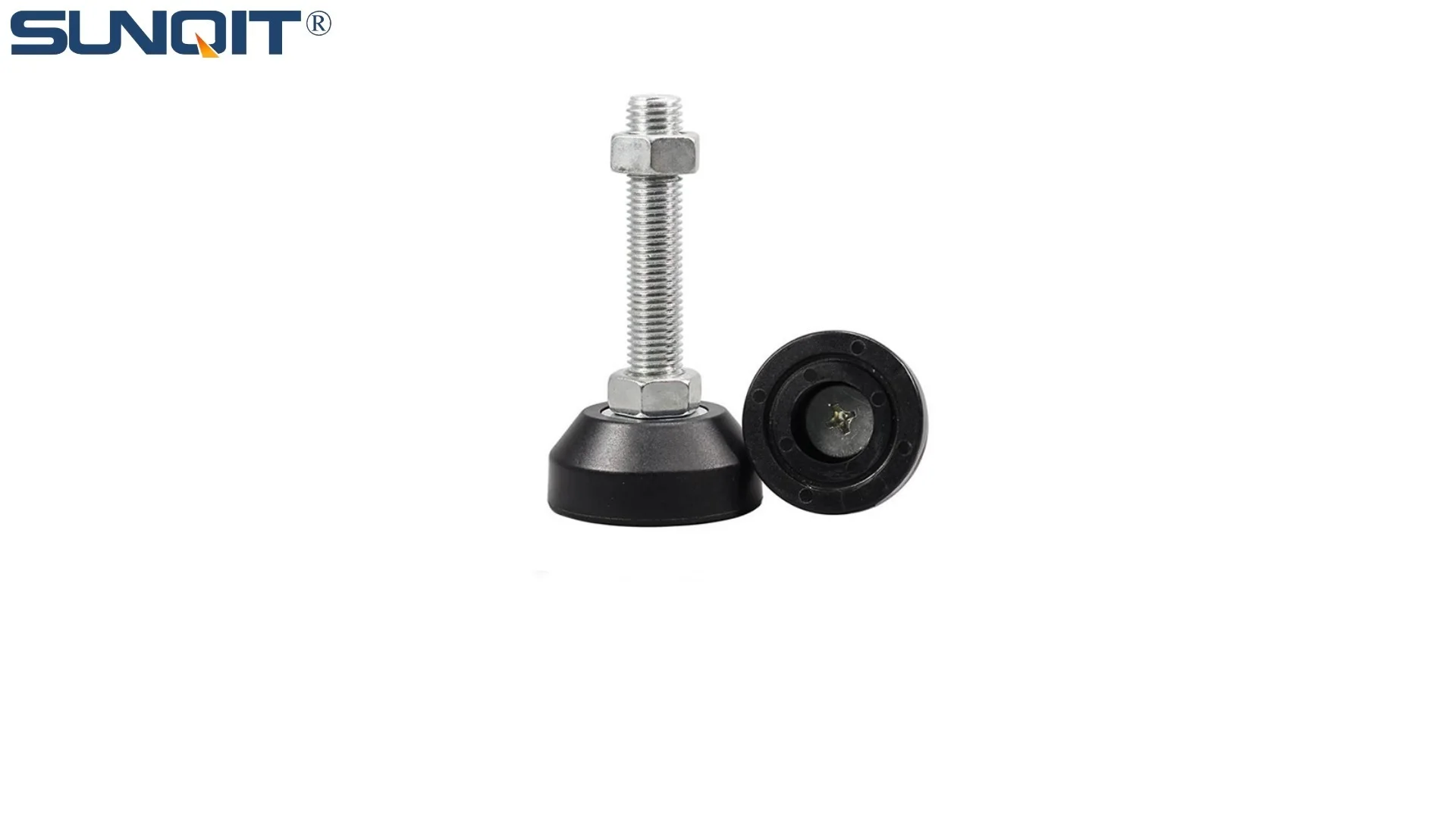
Walk into any busy factory, warehouse, or workshop, and you'll notice something but critical holding everything together: the stability of workbenches, conveyor systems, and equipment. A wobbly workbench isn't just annoying—it can slow down production, compromise safety, or even damage sensitive components. That's where rubber leveling feet come in. These small but mighty components adjust height, absorb vibrations, and keep surfaces steady, even on uneven floors. But not all leveling feet are created equal, and one detail stands out as a workhorse in industrial settings: the M10 thread. Specifically, M10*56 rubber leveling feet have become the go-to choice for engineers, technicians, and facility managers. Why? Let's dive into the reasons behind this preference, from load capacity to real-world compatibility, and explore how this simple thread size keeps the industrial world on solid ground.
What Are Rubber Leveling Feet, Anyway?
Before we get into threads, let's clarify what rubber leveling feet actually do. Imagine a lean pipe workbench in a manufacturing plant—used for assembling electronics, packing goods, or testing equipment. Over time, the floor might settle, or the bench might be moved to a new spot with uneven concrete. Without leveling feet, the bench could rock, making precise work impossible. Rubber leveling feet solve this by combining a threaded metal rod (the "stem") with a rubber base. The rod screws into the equipment's leg, and twisting it raises or lowers the foot, adjusting the height. The rubber base grips the floor, dampens vibrations, and prevents scratches.
But here's the thing: the thread on that metal rod is the unsung hero. It's the connection between the foot and the equipment, dictating how much weight it can hold, how easily you can adjust it, and whether it will fit with standard industrial parts. And when it comes to threads, M10 has emerged as the gold standard for mid-to-heavy-duty applications.
The Thread Matters: Why Size and Design Count
Threads are like the language of mechanical connections—they need to be consistent, strong, and compatible. The "M" in M10 stands for "metric," and the number refers to the thread's outer diameter in millimeters (so M10 is 10mm wide). But there's more to it: thread pitch (the distance between threads), length, and material all play a role. For rubber leveling feet, the thread isn't just about screwing into a hole—it's about reliability . A stripped thread or a loose fit can turn a stable workbench into a hazard, so choosing the right thread size is non-negotiable.
Let's break down why M10 threads, especially in the M10*56 configuration (where 56mm is the length of the threaded stem), have become industry favorites.

1. Load Capacity: The Sweet Spot for Industrial Needs
Industrial equipment isn't light. A typical lean pipe workbench loaded with tools, parts bins, and a laptop can weigh 200–300 kg. Add a worker leaning on it, and that load increases. M10 threads are designed to handle this. Their 10mm diameter provides more surface area for distributing weight compared to smaller threads like M8 (8mm), which are better suited for lightweight furniture or small appliances. An M10 thread, when properly engaged (more on that later), can safely support loads of 500 kg or more per foot—plenty for most workbenches, conveyor frames, or material racks.
Larger threads, like M12 (12mm), can handle even more weight, but they're overkill for many applications. M12 leveling feet are bulkier, heavier, and harder to adjust—you'd need a wrench instead of just hand-tightening. For most industrial setups, M10 hits the sweet spot: strong enough for heavy loads, but still manageable for quick adjustments during shift changes or equipment reconfigurations.

2. Thread Pitch: Balancing Adjustability and Stability
Pitch is the distance between adjacent threads, and it determines how much the leveling foot moves with each full rotation. M10 threads typically come in two pitches: coarse (1.5mm) and fine (1.25mm). Coarse threads (the most common for leveling feet) mean that one full turn raises or lowers the foot by 1.5mm—fast enough to make quick adjustments, but not so fast that you lose precision. Fine threads (1.25mm) offer finer control, useful for sensitive setups like ESD workstations where even a fraction of a millimeter of wobble can affect electronic component assembly.
Why does this matter? In a busy factory, time is money. If you need to level a workbench after moving it, coarse M10 threads let you get the job done in seconds, not minutes. For precision tasks, fine M10 threads let technicians dial in stability without overshooting. This versatility—quick adjustments for most jobs, precision when needed—makes M10 threads adaptable to almost any scenario.

3. Compatibility: Playing Well with Industrial Standards
Industrial equipment is all about standardization. Manufacturers design components to fit together seamlessly, and M10 threads are a cornerstone of this system. Take aluminum profiles , for example—those modular, T-slot frames used to build everything from machine guards to assembly lines. Popular profiles like 4040 (40mm x 40mm) or 3030 (30mm x 30mm) have pre-drilled holes spaced at 20mm or 40mm intervals, and guess what size those holes are? Often M10. This means M10*56 rubber leveling feet screw directly into aluminum profile legs without adapters or custom drilling. It's a plug-and-play solution that saves time and reduces errors.
The same goes for lean pipe workbench systems, which use metal pipes and joints to create modular workstations. Lean pipe legs frequently have M10 tapped holes (holes with internal threads) specifically for leveling feet. Even accessories like caster wheels or height extenders often use M10 threads, so swapping components is easy. When your leveling feet share a thread size with the rest of your equipment, you avoid the headache of hunting for specialty parts or modifying existing setups.
4. The M10*56 Length: Just Enough Adjustment, No Waste
The "56" in M10*56 refers to the length of the threaded stem (56mm). Why 56mm? It's a practical choice. Floors in industrial settings are rarely perfectly flat—they might have cracks, slopes, or uneven patches from years of heavy traffic. A 56mm stem provides enough adjustability (typically 0–50mm of height range, since part of the stem stays screwed into the equipment) to compensate for most floor irregularities. Shorter stems (like 40mm) might not reach high enough, leaving you with a still-wobbly setup. Longer stems (like 70mm) could make the leveling foot unstable, acting like a lever that bends under heavy loads. At 56mm, M10*56 feet strike the balance: enough length to level uneven floors, but short enough to stay rigid and secure.
5. Durability: Threads That Stand Up to Wear and Tear
Industrial environments are tough on equipment. Leveling feet get kicked, bumped, and exposed to oil, coolant, and dust. M10 threads, often made from zinc-plated steel or stainless steel, are built to resist corrosion and stripping. The larger diameter means more metal to withstand wear—unlike M8 threads, which can strip if over-tightened or if debris gets stuck in the threads. Even better, the rubber base (usually made from 60–70 Shore A durometer rubber) is resistant to chemicals and abrasion, ensuring the foot itself lasts for years. When you combine a tough M10 thread with a durable rubber base, you get a leveling foot that survives the chaos of daily industrial life.
How M10 Threads Perform in Real-World Setups
Numbers and specs tell part of the story, but real-world use is where M10*56 rubber leveling feet shine. Let's look at three common scenarios where their design makes a tangible difference:
Scenario 1: The Busy Lean Pipe Workbench
Maria, a production supervisor at an electronics plant, oversees a line of lean pipe workbenches used for assembling circuit boards. Every few months, the line is reconfigured to accommodate new products, which means moving workbenches. "We used to have M8 leveling feet, and they'd strip if we tightened them too much during setup," she says. "Since switching to M10*56 feet, we haven't had a single failure. The threads are tough, and the 56mm stem is long enough to level even the wonkiest spots on our factory floor. Plus, they fit right into our lean pipe legs—no drilling or adapters needed."
Scenario 2: The Precision ESD Workstation
James, a technician at a semiconductor lab, works at an ESD workstation where static electricity and vibration can ruin microchips. "Our old leveling feet had coarse M12 threads—too hard to adjust precisely," he explains. "M10 fine-thread feet (1.25mm pitch) changed everything. I can tweak the height by half a millimeter at a time, so the workstation stays perfectly level. The M10 thread also connects to our aluminum profile frame, which is grounded, so we don't get static buildup. It's the little things that prevent big mistakes, and M10 threads are one of those things."
Scenario 3: The Heavy-Duty Material Rack
Raj manages a warehouse where aluminum profile material racks hold boxes of automotive parts, each weighing 50–80 kg. "Racks with M8 feet would sink into the concrete over time, especially when fully loaded," he notes. "M10*56 feet distribute the weight better—no more dents in the floor, and the racks stay level for months. We even use them on our conveyor supports now. The threads are so reliable that we rarely need to re-adjust them, which saves my team hours of maintenance work."
M10 vs. Other Thread Sizes: A Side-by-Side Comparison
To really see why M10 stands out, let's compare it to two common alternatives: M8 (smaller) and M12 (larger). This table breaks down key factors like load capacity, adjustability, and best uses:
| Thread Size | Typical Load Capacity (per foot) | Thread Pitch (Coarse) | Best For | Limitations |
|---|---|---|---|---|
| M8 | Up to 200 kg | 1.25mm | Light furniture, small shelves, lab equipment (light duty) | Strips easily under heavy loads; limited adjustability on uneven floors |
| M10 | Up to 500+ kg | 1.5mm | Lean pipe workbenches, aluminum profile racks, ESD workstations, conveyor supports (medium-heavy duty) | Not ideal for extremely heavy equipment (e.g., industrial machinery over 1 ton) |
| M12 | Up to 1000+ kg | 1.75mm | Large machinery, industrial presses, heavy storage racks (heavy duty) | Bulkier; harder to adjust by hand; overkill for most workbenches or small equipment |
As the table shows, M10 is the most versatile option. It handles more weight than M8 without the bulk of M12, making it perfect for the majority of industrial setups. Unless you're dealing with extremely light or extremely heavy equipment, M10 threads are the practical choice.
Technical Deep Dive: Thread Engagement and Safety
We've talked about load capacity and adjustability, but there's one more critical detail: thread engagement. This refers to how much of the M10 thread is actually screwed into the equipment's leg or mounting plate. For safety, engineers recommend at least 1.5 times the thread diameter in engagement. For M10, that means 15mm of the stem should be screwed into the mounting point (10mm diameter x 1.5 = 15mm). Why? Because insufficient engagement can cause the thread to strip under load, even if the thread itself is strong.
M10*56 leveling feet are designed with this in mind. The 56mm stem leaves plenty of room to ensure 15mm+ engagement while still offering 40mm+ of adjustability (since you don't need to use the entire stem length). This balance of safety and adjustability is another reason M10 is trusted in high-stakes environments like manufacturing plants, where a failure could lead to downtime or injury.
Why Workers and Technicians Actually Prefer M10
Beyond specs, there's a human reason M10 threads are popular: they make life easier for the people using them. Technicians and facility managers don't just care about load capacity—they care about usability . Here's what they love:
- Easy to adjust by hand: M10 threads are large enough to grip with fingers, so you don't need a wrench for minor tweaks. This saves time during setup or when floors shift slightly.
- Readily available parts: M10 nuts, washers, and replacement feet are stocked by most industrial suppliers. You won't wait weeks for a specialty part if a foot gets damaged.
- Compatible with common tools: A standard 17mm wrench fits most M10 hex nuts, so you don't need a special socket set.
- Consistent performance: Workers know they can rely on M10 threads to stay tight—no surprises during a busy shift.
Debunking Myths: "Bigger Is Always Better"
Some might assume that a larger thread (like M12) is always better, but that's not the case. In fact, over-sizing threads can cause problems: M12 leveling feet are heavier, which adds unnecessary weight to mobile equipment like carts. They also require larger mounting holes, which might weaken the legs of lighter frames (like aluminum profiles). For most applications, M10 provides all the strength you need without the extra bulk. As one maintenance tech put it: "M12 is like using a sledgehammer to hang a picture—effective, but overkill."
Conclusion: M10 Threads—The Unsung Heroes of Industrial Stability
At the end of the day, M10*56 rubber leveling feet have earned their reputation as industrial workhorses because they solve real problems: keeping workbenches steady, absorbing vibrations, and adapting to uneven floors. The M10 thread is the backbone of this success, offering the perfect mix of strength, adjustability, and compatibility with standard components like lean pipe workbenches , aluminum profiles , and ESD workstations . It's not the flashiest part of a factory, but it's one that keeps production lines moving, technicians safe, and equipment working reliably—day in and day out.
So the next time you walk past a stable workbench or a smooth-running conveyor, take a second to appreciate the small but critical component holding it all together: the M10 thread. It's proof that sometimes, the most important innovations are the ones you barely notice—until you need them.