- Company Articles
- FAQ
- FAQ
- Aluminum Workbench A: Your Questions Answered—FAQs for Manufacturers

Aluminum Workbench A: Your Questions Answered—FAQs for Manufacturers
Related Product
Aluminum Workbench A
Aluminum tube workbench is more flexible and durable, compared with traditional PE/ABS coated steel tube. It is easy to assemble, anti corrosion, rust protection, and recycle use after disassemble.
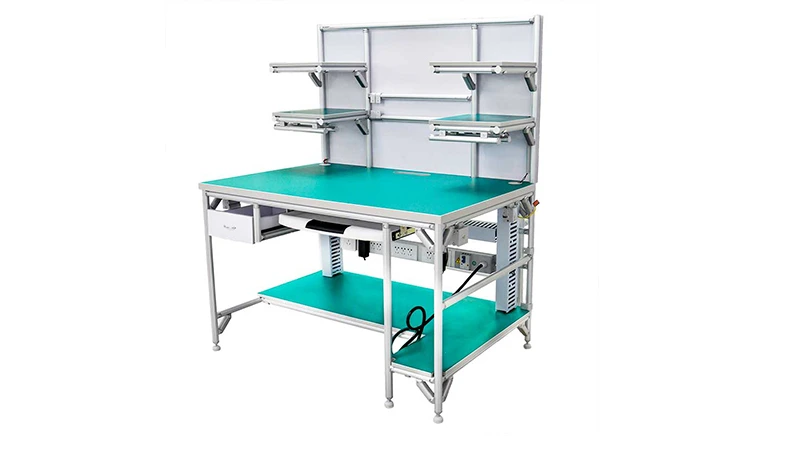
1. What exactly is Aluminum Workbench A, and how is it different from other workbenches?
At its core, Aluminum Workbench A is a modular workstation built from high-grade
aluminum extrusion profile
—those sleek, T-slot aluminum rails you've probably seen in modern factories. But it's more than just a table. Think of it as a building block for your production line: designed to be reconfigured, extended, or customized with accessories (like tool holders, shelves, or ESD mats) without needing a welding torch or a team of engineers.
What sets it apart? Traditional workbenches—whether steel, wood, or even basic aluminum—are often one-and-done. You buy them, bolt them down, and if your needs change (say, you start assembling larger parts or need to add a computer station), you're stuck. Aluminum Workbench A, though, uses the same aluminum profile system that's become the backbone of flexible manufacturing. Its frame is made from lightweight but strong aluminum extrusion profiles, with pre-drilled T-slots that let you snap on accessories in minutes. And unlike some modular workbenches that feel flimsy, this one is built to handle industrial loads—we're talking 300+ pounds on the main deck, even with tools and materials stacked high.
Oh, and let's not forget the "A" in the name. That designates a specific model: single-deck, without casters, optimized for stability in high-precision tasks like electronics assembly or quality inspection. But don't let the "single-deck" fool you—add a few workbench accessories (like under-shelf storage or side-mounted tool racks), and it becomes a multi-functional hub.
What sets it apart? Traditional workbenches—whether steel, wood, or even basic aluminum—are often one-and-done. You buy them, bolt them down, and if your needs change (say, you start assembling larger parts or need to add a computer station), you're stuck. Aluminum Workbench A, though, uses the same aluminum profile system that's become the backbone of flexible manufacturing. Its frame is made from lightweight but strong aluminum extrusion profiles, with pre-drilled T-slots that let you snap on accessories in minutes. And unlike some modular workbenches that feel flimsy, this one is built to handle industrial loads—we're talking 300+ pounds on the main deck, even with tools and materials stacked high.
Oh, and let's not forget the "A" in the name. That designates a specific model: single-deck, without casters, optimized for stability in high-precision tasks like electronics assembly or quality inspection. But don't let the "single-deck" fool you—add a few workbench accessories (like under-shelf storage or side-mounted tool racks), and it becomes a multi-functional hub.
2. Why aluminum? Isn't steel stronger for industrial workbenches?
Great question—and one we hear from manufacturers who've relied on steel workbenches for years. Steel is strong, no doubt. But in today's manufacturing world, "strong" isn't enough. You need strong
and
flexible
and
cost-effective over time. That's where aluminum shines, especially the
aluminum extrusion profile
used in Aluminum Workbench A.
Let's break it down: Aluminum is about 30% lighter than steel, which means you can move the workbench (yes, even without casters) with a couple of people if you need to rearrange your floor plan. No more hiring a forklift or cutting it loose from the concrete. But don't mistake lightness for weakness. The extrusion process—where aluminum is pushed through a die to create those T-slot profiles—creates a structure that's inherently rigid. Aluminum Workbench A's frame can handle the same heavy tools and parts as a steel bench, but without the back-breaking weight.
Then there's corrosion resistance. Steel rusts, especially in humid environments or near cleaning chemicals. Aluminum? It forms a natural oxide layer that protects it, so you won't see rust spots after a spill or a rainy season. And if you work in an industry like food processing or pharmaceuticals, where cleanliness is critical, aluminum wipes down easily—no cracks or crevices for bacteria to hide, unlike wood or even painted steel.
Finally, there's the long game. Steel workbenches last, but when they do wear out, they're hard to recycle. Aluminum is 100% recyclable, and because Aluminum Workbench A is modular, you can replace just a damaged rail or joint instead of the entire bench. Over 5-10 years, that adds up to lower replacement costs and a smaller environmental footprint—two wins for any manufacturer focused on sustainability (and let's be honest, most are these days).
Let's break it down: Aluminum is about 30% lighter than steel, which means you can move the workbench (yes, even without casters) with a couple of people if you need to rearrange your floor plan. No more hiring a forklift or cutting it loose from the concrete. But don't mistake lightness for weakness. The extrusion process—where aluminum is pushed through a die to create those T-slot profiles—creates a structure that's inherently rigid. Aluminum Workbench A's frame can handle the same heavy tools and parts as a steel bench, but without the back-breaking weight.
Then there's corrosion resistance. Steel rusts, especially in humid environments or near cleaning chemicals. Aluminum? It forms a natural oxide layer that protects it, so you won't see rust spots after a spill or a rainy season. And if you work in an industry like food processing or pharmaceuticals, where cleanliness is critical, aluminum wipes down easily—no cracks or crevices for bacteria to hide, unlike wood or even painted steel.
Finally, there's the long game. Steel workbenches last, but when they do wear out, they're hard to recycle. Aluminum is 100% recyclable, and because Aluminum Workbench A is modular, you can replace just a damaged rail or joint instead of the entire bench. Over 5-10 years, that adds up to lower replacement costs and a smaller environmental footprint—two wins for any manufacturer focused on sustainability (and let's be honest, most are these days).

3. How does Aluminum Workbench A actually support a lean system ?
If you're running a
lean system
, you know the enemy is waste—whether it's time wasted searching for tools, space wasted on unused equipment, or effort wasted moving materials across the floor. Aluminum Workbench A is built to attack all three.
Let's start with time. In a traditional setup, if you need to add a shelf for frequently used tools, you might wait days for maintenance to drill holes and mount it. With Aluminum Workbench A, you grab a workbench accessory (like a T-slot shelf bracket), slide it into the profile's T-slot, tighten a knob, and you're done. No downtime, no waiting—your team stays productive.
Space waste? Aluminum Workbench A's modular design means you only use what you need. Need a compact station for a small part assembly? Start with a 4-foot-wide bench. Six months later, if production ramps up, add another 2-foot section using the same aluminum profiles. No more buying a whole new bench just to add a few inches of workspace. And because it's lightweight, you can tuck it into tight spots or line multiple units up in a U-shape for a streamlined workflow—exactly what lean principles demand.
Then there's material flow. A key part of lean is keeping tools and materials "within reach" to cut down on motion waste. Aluminum Workbench A's T-slots let you mount accessories exactly where your operators need them: a tool rail at elbow height, a bin for screws right next to the assembly point, or a monitor arm for digital work instructions above the deck. One electronics manufacturer we worked with reported a 22% drop in "search time" for tools after switching to Aluminum Workbench A—just by rearranging their accessories to match their operators' natural movements.
And here's the kicker: when your product line changes (because let's face it, in manufacturing, it always does), you don't have to scrap the workbench. Reconfigure it. Add a new shelf, swap out the deck for an ESD (anti-static) version, or even mount it on casters (yes, there are accessories for that) if you need mobility. That's the lean dream: equipment that adapts to your process, not the other way around.
Let's start with time. In a traditional setup, if you need to add a shelf for frequently used tools, you might wait days for maintenance to drill holes and mount it. With Aluminum Workbench A, you grab a workbench accessory (like a T-slot shelf bracket), slide it into the profile's T-slot, tighten a knob, and you're done. No downtime, no waiting—your team stays productive.
Space waste? Aluminum Workbench A's modular design means you only use what you need. Need a compact station for a small part assembly? Start with a 4-foot-wide bench. Six months later, if production ramps up, add another 2-foot section using the same aluminum profiles. No more buying a whole new bench just to add a few inches of workspace. And because it's lightweight, you can tuck it into tight spots or line multiple units up in a U-shape for a streamlined workflow—exactly what lean principles demand.
Then there's material flow. A key part of lean is keeping tools and materials "within reach" to cut down on motion waste. Aluminum Workbench A's T-slots let you mount accessories exactly where your operators need them: a tool rail at elbow height, a bin for screws right next to the assembly point, or a monitor arm for digital work instructions above the deck. One electronics manufacturer we worked with reported a 22% drop in "search time" for tools after switching to Aluminum Workbench A—just by rearranging their accessories to match their operators' natural movements.
And here's the kicker: when your product line changes (because let's face it, in manufacturing, it always does), you don't have to scrap the workbench. Reconfigure it. Add a new shelf, swap out the deck for an ESD (anti-static) version, or even mount it on casters (yes, there are accessories for that) if you need mobility. That's the lean dream: equipment that adapts to your process, not the other way around.

4. What kind of workbench accessories can I add, and how easy are they to install?
This is where Aluminum Workbench A really shines: its ecosystem of accessories. Think of it like a smartphone—great on its own, but the real power comes from the add-ons. And unlike some proprietary systems, the accessories here are designed to work with standard
aluminum profile
setups, so if you already have aluminum rails in your facility, you might even be able to reuse some parts.
Let's start with the basics. Need storage? There are under-shelf bins, hanging tool boards, and even overhead racks that clamp directly to the workbench's frame. For organization, there are dividers to split the deck into sections, magnetic tool strips, and cable management clips to keep cords from tangling. If you work with sensitive electronics, ESD mats and grounding kits are a must—Aluminum Workbench A's aluminum frame conducts electricity, so adding an ESD mat (which connects to the frame via a simple clip) creates a static-safe zone.
For heavier tasks, there are reinforced shelves (rated for up to 200 pounds) and bench-mounted vice plates. And if you need to integrate technology, monitor arms, barcode scanner holders, and even small drawers for tablets or laptops can all be added. The best part? Installing them takes minutes, not hours. Most accessories use T-slot nuts or clamping brackets—just slide them into the aluminum extrusion profile's T-slot, tighten a hex key or a knob, and you're done. No drilling, no welding, no calling in maintenance.
One production supervisor at a automotive parts plant told us they recently added a parts bin rack to their Aluminum Workbench A in under 15 minutes—right in the middle of a shift. "We didn't even have to stop production," they said. "Two operators, a hex key, and we had the new bin mounted. That's the difference between this bench and our old steel one—with the old one, we would've had to schedule a maintenance window."
Let's start with the basics. Need storage? There are under-shelf bins, hanging tool boards, and even overhead racks that clamp directly to the workbench's frame. For organization, there are dividers to split the deck into sections, magnetic tool strips, and cable management clips to keep cords from tangling. If you work with sensitive electronics, ESD mats and grounding kits are a must—Aluminum Workbench A's aluminum frame conducts electricity, so adding an ESD mat (which connects to the frame via a simple clip) creates a static-safe zone.
For heavier tasks, there are reinforced shelves (rated for up to 200 pounds) and bench-mounted vice plates. And if you need to integrate technology, monitor arms, barcode scanner holders, and even small drawers for tablets or laptops can all be added. The best part? Installing them takes minutes, not hours. Most accessories use T-slot nuts or clamping brackets—just slide them into the aluminum extrusion profile's T-slot, tighten a hex key or a knob, and you're done. No drilling, no welding, no calling in maintenance.
One production supervisor at a automotive parts plant told us they recently added a parts bin rack to their Aluminum Workbench A in under 15 minutes—right in the middle of a shift. "We didn't even have to stop production," they said. "Two operators, a hex key, and we had the new bin mounted. That's the difference between this bench and our old steel one—with the old one, we would've had to schedule a maintenance window."
5. How does Aluminum Workbench A hold up in tough industrial environments?
Let's get real: Manufacturing floors are not gentle places. There are spills (oil, coolant, cleaning chemicals), heavy tools dropped on the deck, and constant foot traffic. So does Aluminum Workbench A crumble under pressure, or does it keep up?
The short answer: It's built for the grind. The frame uses 2mm-thick aluminum extrusion profile —thicker than the 1.5mm profiles used in some lighter-duty modular furniture. That extra thickness adds rigidity, so even if you lean on the bench or set a heavy motor on it, it won't warp. The deck itself is typically made from aluminum composite or high-pressure laminate (HPL), both of which resist scratches, stains, and heat. One manufacturer in the aerospace industry told us they've had their Aluminum Workbench A for three years, and the deck still looks new—despite daily use with metal parts and occasional coolant spills.
Corrosion is another concern, especially in facilities with high humidity or exposure to chemicals. Aluminum's natural oxide layer helps here, but for extra protection, many manufacturers opt for anodized aluminum frames (a process that thickens the oxide layer) or powder-coated finishes. We've seen Aluminum Workbench A units in food processing plants (where daily washdowns are the norm) and marine parts factories (salty air) hold up without a single spot of rust.
What about the joints? The bench uses aluminum or stainless steel connectors that lock into the T-slots, creating a tight, wobble-free fit. Unlike plastic connectors (which can crack over time) or cheap steel (which rusts), these joints stay secure even with repeated use. One plant manager in Michigan told us they've reconfigured their Aluminum Workbench A over a dozen times in two years, and the joints still tighten as easily as the first day.
The short answer: It's built for the grind. The frame uses 2mm-thick aluminum extrusion profile —thicker than the 1.5mm profiles used in some lighter-duty modular furniture. That extra thickness adds rigidity, so even if you lean on the bench or set a heavy motor on it, it won't warp. The deck itself is typically made from aluminum composite or high-pressure laminate (HPL), both of which resist scratches, stains, and heat. One manufacturer in the aerospace industry told us they've had their Aluminum Workbench A for three years, and the deck still looks new—despite daily use with metal parts and occasional coolant spills.
Corrosion is another concern, especially in facilities with high humidity or exposure to chemicals. Aluminum's natural oxide layer helps here, but for extra protection, many manufacturers opt for anodized aluminum frames (a process that thickens the oxide layer) or powder-coated finishes. We've seen Aluminum Workbench A units in food processing plants (where daily washdowns are the norm) and marine parts factories (salty air) hold up without a single spot of rust.
What about the joints? The bench uses aluminum or stainless steel connectors that lock into the T-slots, creating a tight, wobble-free fit. Unlike plastic connectors (which can crack over time) or cheap steel (which rusts), these joints stay secure even with repeated use. One plant manager in Michigan told us they've reconfigured their Aluminum Workbench A over a dozen times in two years, and the joints still tighten as easily as the first day.
6. How does Aluminum Workbench A compare to other modular workbenches on the market?
It's a crowded field out there, so let's cut through the noise. We've compared Aluminum Workbench A to three common alternatives: basic modular steel workbenches, plastic "lean" workbenches, and other aluminum models made with non-extrusion aluminum (like bent sheet metal). Here's how they stack up:
| Feature | Aluminum Workbench A | Basic Modular Steel | Plastic "Lean" Workbench | Non-Extrusion Aluminum |
|---|---|---|---|---|
| Material | Aluminum extrusion profile | Carbon steel | ABS plastic + steel frame | Bent sheet aluminum |
| Weight (4ft model) | 65 lbs | 120+ lbs | 45 lbs | 80 lbs |
| Customization | Unlimited (T-slot accessories) | Limited (pre-drilled holes only) | Basic (snap-on bins only) | Minimal (no T-slots) |
| Lean System Fit | Seamless (modular, waste-reducing) | Poor (static, hard to reconfigure) | Good (lightweight, but limited) | Fair (rigid design) |
| Durability (Industrial Use) | Excellent (5-10+ year lifespan) | Good (5-7 years, but rusts) | Poor (2-3 years, plastic cracks) | Good (5-7 years, but dents easily) |
| Price (4ft model) | Mid-range ($400-$600) | High ($500-$800) | Low ($200-$350) | Mid-range ($450-$700) |
The takeaway? If you need a workbench that balances durability, flexibility, and cost, Aluminum Workbench A hits the sweet spot. Plastic models are cheaper but won't last in tough environments. Steel is durable but heavy and hard to reconfigure. And non-extrusion aluminum lacks the T-slot versatility that makes Aluminum Workbench A a true lean system asset.
7. Is Aluminum Workbench A worth the investment for small manufacturers, or is it better suited for large facilities?
This is a question we get from small to mid-sized manufacturers (SMMs) all the time: "We don't have the budget of a Fortune 500 company—can we really justify this?" The answer? Absolutely—and in some cases, small manufacturers benefit
more
from Aluminum Workbench A than larger ones.
Here's why: Smaller facilities often have tighter floor plans and smaller teams, which means every square foot and every minute of labor counts. A rigid workbench that takes up space and can't adapt to new orders is a bigger problem when you don't have extra room to spare. Aluminum Workbench A's small footprint (most models start at 4ft wide) and modularity let you make the most of your space. One small electronics assembler in Ohio told us they replaced three old steel workbenches with two Aluminum Workbench A units—freeing up 12 square feet of floor space and cutting their tool-search time in half.
Cost-wise, Aluminum Workbench A is an investment, but it's not a "break-the-bank" one. At $400-$600 for a basic model (before accessories), it's pricier than a $200 plastic workbench but cheaper than a $800 steel one. And because it's modular, you can start small: buy one unit, test it on your busiest line, and add more as you see the benefits. Many small manufacturers use it as a "pilot" workstation—proving its value on one line before rolling it out company-wide.
Plus, small teams often wear more hats. If your maintenance person is also your production scheduler, they don't have time to fuss with complicated installations. Aluminum Workbench A's tool-free assembly (most models come with pre-cut profiles and easy-to-follow instructions) means you can have it up and running in under an hour—no contractor needed. For small manufacturers, that's not just convenient; it's critical.
Here's why: Smaller facilities often have tighter floor plans and smaller teams, which means every square foot and every minute of labor counts. A rigid workbench that takes up space and can't adapt to new orders is a bigger problem when you don't have extra room to spare. Aluminum Workbench A's small footprint (most models start at 4ft wide) and modularity let you make the most of your space. One small electronics assembler in Ohio told us they replaced three old steel workbenches with two Aluminum Workbench A units—freeing up 12 square feet of floor space and cutting their tool-search time in half.
Cost-wise, Aluminum Workbench A is an investment, but it's not a "break-the-bank" one. At $400-$600 for a basic model (before accessories), it's pricier than a $200 plastic workbench but cheaper than a $800 steel one. And because it's modular, you can start small: buy one unit, test it on your busiest line, and add more as you see the benefits. Many small manufacturers use it as a "pilot" workstation—proving its value on one line before rolling it out company-wide.
Plus, small teams often wear more hats. If your maintenance person is also your production scheduler, they don't have time to fuss with complicated installations. Aluminum Workbench A's tool-free assembly (most models come with pre-cut profiles and easy-to-follow instructions) means you can have it up and running in under an hour—no contractor needed. For small manufacturers, that's not just convenient; it's critical.
8. How do I source Aluminum Workbench A and its accessories?
The good news: Aluminum Workbench A is widely available through suppliers that specialize in
aluminum extrusion profile
and lean manufacturing equipment. Because it's built from standard components, you're not locked into a single brand—though we always recommend sticking with suppliers that offer a warranty (most reputable ones cover the frame for 5+ years and accessories for 1-2 years).
Start by checking with your current aluminum profile supplier—many carry workbench lines, including Aluminum Workbench A. If you don't have a go-to supplier, online industrial marketplaces (think Grainger, McMaster-Carr, or even Amazon Business) stock it, though you'll want to read reviews to ensure you're getting a quality model (look for mentions of "thick extrusion profiles" and "sturdy joints").
For accessories, the same suppliers usually offer a full line—from basic shelves to specialized ESD kits. And because the T-slot system is standard, you can also mix and match from different brands (just double-check the profile size; most Aluminum Workbench A models use 20x40mm or 30x30mm profiles). One tip: Buy accessories in bundles (like a "starter kit" with a shelf, tool rail, and bin) to save money—many suppliers offer discounts for multi-accessory orders.
Finally, don't hesitate to ask for a sample or a demo. Most suppliers will send a small section of aluminum extrusion profile or a sample accessory so you can test the fit and feel before buying. It's a small step that can save you from ordering a workbench that doesn't quite meet your needs.
Start by checking with your current aluminum profile supplier—many carry workbench lines, including Aluminum Workbench A. If you don't have a go-to supplier, online industrial marketplaces (think Grainger, McMaster-Carr, or even Amazon Business) stock it, though you'll want to read reviews to ensure you're getting a quality model (look for mentions of "thick extrusion profiles" and "sturdy joints").
For accessories, the same suppliers usually offer a full line—from basic shelves to specialized ESD kits. And because the T-slot system is standard, you can also mix and match from different brands (just double-check the profile size; most Aluminum Workbench A models use 20x40mm or 30x30mm profiles). One tip: Buy accessories in bundles (like a "starter kit" with a shelf, tool rail, and bin) to save money—many suppliers offer discounts for multi-accessory orders.
Finally, don't hesitate to ask for a sample or a demo. Most suppliers will send a small section of aluminum extrusion profile or a sample accessory so you can test the fit and feel before buying. It's a small step that can save you from ordering a workbench that doesn't quite meet your needs.