- Company Articles
- FAQ
- FAQ
- FAQ: Common Questions About 3060 National Standard Profile A Answered

FAQ: Common Questions About 3060 National Standard Profile A Answered
Related Product
3060 National Standard Profile A
Workbench, production line, logistic rack, warehouse rack Industry: Manufacturer workshop, Automobile, Electronic, Assembling, logistic
Introduction
If you've spent any time in manufacturing, warehousing, or industrial design, you've probably heard the term "aluminum extrusion profile" thrown around. These versatile building blocks are the backbone of everything from workbenches to conveyor systems, and one profile that consistently stands out is the 3060 National Standard Profile A. Over the years, I've fielded countless questions about this specific profile—from its dimensions to its real-world applications. In this guide, we'll dive into the most common queries, breaking down technical details with practical examples and a touch of industry insight. Whether you're a seasoned engineer or just starting to explore lean system setups, this FAQ aims to make 3060 National Standard Profile A feel less like a jargon-filled specification and more like a trusted tool in your workflow.
What Exactly Is 3060 National Standard Profile A?
Q: Let's start with the basics—what is 3060 National Standard Profile A, and why is it called that?
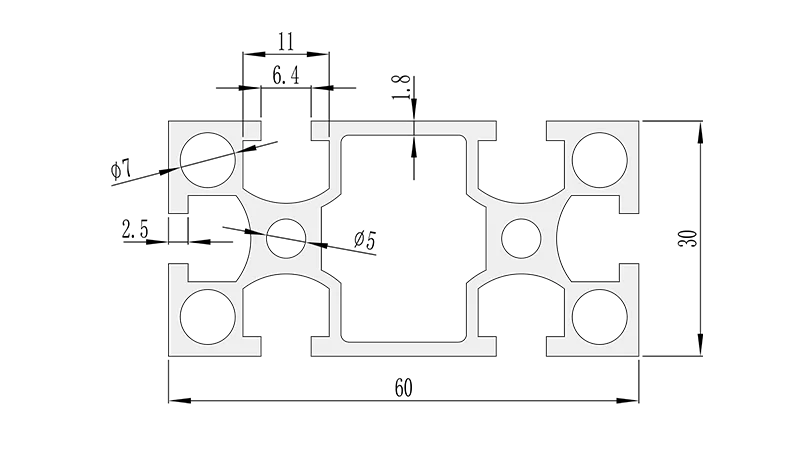
A: Great question! At its core, 3060 National Standard Profile A is a type of aluminum extrusion profile—a long, rigid structure made by forcing heated aluminum through a die to create a specific cross-sectional shape. The "3060" in its name refers to its key dimensions: 30 millimeters in width and 60 millimeters in height. Think of it as a rectangular tube with precision-engineered T-slots running along its length, which are designed to accept bolts, nuts, and accessories without the need for welding or drilling.
The "National Standard" part is crucial, too. It means this profile adheres to strict local manufacturing standards (like GB/T 6892 in China, for example), ensuring consistent dimensions, material quality, and performance across suppliers. This standardization is a game-changer for businesses—you can swap parts between suppliers or expand a system years later, knowing the new profiles will fit perfectly with the old ones.
The "A" designation often denotes a specific variation within the 3060 family, typically differing in details like wall thickness or T-slot spacing. For most users, though, "3060 National Standard Profile A" is the go-to for medium-duty applications where strength, modularity, and cost-effectiveness matter most.
Key Specifications: A Closer Look
Q: What are the technical specs that make this profile unique? Can you share details like material, weight, and load capacity?
A: Absolutely—specs are where this profile truly shines. Let's break it down with a quick table (you'll thank me later when you're comparing suppliers!):
| Specification | Details for 3060 National Standard Profile A |
|---|---|
| Dimensions | 30mm (width) x 60mm (height) cross-section |
| Material | 6063-T5 aluminum alloy (high strength, excellent corrosion resistance) |
| Wall Thickness | Common options: 1.5mm, 2.0mm, or 2.5mm (varies by supplier) |
| Surface Treatment | Anodized (silver, natural), powder-coated (custom colors like black, blue, or yellow), or mill finish (raw aluminum) |
| Weight per Meter | ~0.8kg/m (1.5mm wall), ~1.1kg/m (2.0mm wall), ~1.4kg/m (2.5mm wall) |
| Horizontal Load Capacity* | ~200kg/m (1.5mm wall, supported at both ends), ~300kg/m (2.0mm wall) |
| Vertical Load Capacity* | ~800kg (1.5mm wall, 1m height), ~1200kg (2.0mm wall, 1m height) |
| T-Slot Configuration | Typically 2 or 3 T-slots (standard M6 or M8 compatible) along the length |
| Length Options | Standard: 2.5m, 3m, or 6m; custom cuts available from suppliers |
*Note: Load capacities are approximate and depend on support spacing, installation method, and environmental factors (e.g., temperature, vibration).
What stands out here is the 6063-T5 aluminum alloy. It's a popular choice because it balances strength and ductility—meaning the profile can handle heavy loads without bending, but it's also malleable enough to be cut or machined on-site if needed. The anodized finish is another highlight; it adds a thin, protective layer that resists scratches and corrosion, making the profile suitable for both indoor workshops and semi-outdoor warehouses.
How Does It Compare to Other Aluminum Profiles?
Q: There are so many profiles out there—2020, 3030, 4040… What makes 3060 National Standard Profile A different, and when should I choose it over others?
A: It's easy to get overwhelmed with all the options, but the key is matching the profile to your load and space needs. Let's simplify with a quick comparison:
- 2020 Profiles: These are tiny (20x20mm) and lightweight, ideal for small shelves or light-duty frames (think: 3D printer enclosures). They're too flimsy for most industrial workbenches or material racks.
- 3030 Profiles: A step up (30x30mm), these are great for medium-light applications like small workbenches or machine guards. But they lack the vertical strength of 3060, so they struggle with heavy, multi-layered setups.
- 4040 Profiles: Larger (40x40mm) and sturdier, these handle heavy loads (think: 500kg+). But they're bulkier and more expensive than 3060, so unless you need that extra heft, they're overkill.
3060 National Standard Profile A hits the sweet spot between 3030 and 4040. Its 30x60mm shape gives it more rigidity than a square 3030 profile, especially when oriented vertically (the 60mm height acts like a taller "spine" for better load distribution). I often recommend it for projects like material rack B (3 row and 3 floor)—those multi-tiered racks need uprights that can support rows of heavy parts without bowing, and 3060 fits the bill perfectly without the cost of 4040.
Another angle: space efficiency. If you're building a workbench E (single deck-without caster) in a tight workshop, the 30mm width of 3060 saves precious inches compared to a 4040 profile, while still providing enough surface area for mounting tools or accessories via T-slots.
Real-World Applications: Where Does 3060 National Standard Profile A Shine?
Q: I get the specs, but how does this profile actually get used in day-to-day operations? Can you share concrete examples?
A: Absolutely—nothing beats real-world context! 3060 National Standard Profile A is a workhorse in lean system environments, where modularity and durability are non-negotiable. Here are a few scenarios where I've seen it excel:
1. Workbenches: A standard workbench (like the aptly named "workbench E (single deck-without caster)") often uses 3060 for its frame. The profile's rigidity ensures the bench top stays level even when clamps, tools, and parts are piled on, and the T-slots make it easy to add accessories like tool hooks or monitor mounts.
2. Material Racks: Take material rack B (3 row and 3 floor)—those three rows of three shelves need strong uprights to hold boxes of components or finished goods. 3060 profiles, paired with aluminum profile accessories like gusset plates (gusset alp 3030 works here too!), create a stable structure that can handle 50-100kg per shelf without wobbling.
3. Conveyor Systems: While conveyor rollers themselves are often made of steel or plastic, the frames that support them (especially for medium-duty roller track) rely on 3060. Its T-slots allow for easy attachment of roller track placon mount brackets, ensuring the conveyor stays aligned even when parts are sliding across it all day.
4. Assembly Line Stations: In electronics manufacturing, where precision is key, 3060 profiles form the backbone of assembly stations. They're used to mount ESD workbenches (critical for preventing static damage to circuit boards) and to build custom enclosures around sensitive equipment. The anodized finish also resists the oils and solvents common in these environments, keeping the stations looking clean for years.
One client story that sticks with me: a small auto parts supplier was using wooden shelves that kept warping under the weight of metal components. We swapped in 3060-based racks, and not only did the warping stop, but they could reconfigure the shelves in minutes using 90° aluminum profile connectors whenever their part sizes changed. That's the beauty of modularity—no more rebuilding from scratch!
Essential Aluminum Profile Accessories for 3060
Q: You mentioned accessories earlier—what are the must-have aluminum profile accessories to use with 3060 National Standard Profile A?
A: Accessories are what turn a pile of profiles into a functional system—they're like the "glue" that holds everything together (without the mess of actual glue!). Here are the ones I recommend keeping in your toolkit:
1. Connectors: These are non-negotiable. The 90° aluminum profile connector is your best friend for right-angle joints (e.g., attaching a horizontal shelf to a vertical upright). For angled connections, the 45° aluminum profile connector works wonders—think of a sloped material chute where parts slide down gently. Pro tip: Look for "internal rotation" joints if you need adjustability; some connectors let you pivot the profile slightly before locking it in place.
2. End Caps: Small but mighty! 3060 National Standard Profile A has open ends, and end caps (like 3060 aluminum profile end cap) keep dust, debris, and fingers out of the T-slots. They also give the finished system a polished look—no more sharp, unfinished edges.
3. Gusset Plates: For high-stress joints (e.g., the corners of a heavy workbench), gusset plates (gusset alp 3030 or 3060-specific) add extra reinforcement. They're like adding a "brace" to a bookshelf—simple, but they prevent the frame from racking under load.
4. Caster Wheels: If you need mobility (e.g., a turnover trolley), pair 3060 with caster wheels and caster accessories like mounting plates. Just make sure the casters are rated for your total load—most medium-duty casters (200kg+ per set) work well with 3060 frames.
5. T-Slot Nuts and Bolts: These tiny components are the secret to the profile's modularity. Slide a T-slot nut into the profile's slot, align your accessory (like a shelf bracket), and tighten the bolt—it's that easy. Opt for stainless steel nuts and bolts if you're in a humid environment to prevent rust.
The best part? Most aluminum profile accessories are cross-compatible with other national standard profiles, so if you later add 2040 or 4040 profiles to your setup, you won't need a whole new set of connectors.
Installation Tips: Avoiding Common Pitfalls
Q: I'm planning to build a system with 3060 National Standard Profile A—any installation tips to ensure it goes smoothly?
A: Installation is straightforward, but a few tricks will save you time and frustration. Let's walk through the process:
1. Measure Twice, Cut Once (But Leave Room for Adjustments): Aluminum extrusions are precise, but even a 1mm error can throw off a whole frame. Use a miter saw with a fine-tooth blade for clean cuts, and if possible, order pre-cut lengths from your supplier—they have industrial saws that accuracy. If you must cut on-site, mark the profile with masking tape first to avoid chipping the anodized finish.
2. Don't Over-Tighten Connectors: It's tempting to crank down on bolts to "make sure it's tight," but aluminum T-slots can strip if over-tightened. Use a torque wrench set to 4-5 Nm (for M6 bolts) or 6-7 Nm (for M8 bolts)—this ensures a secure fit without damaging the profile.
3. Use a Level Early and Often: A wobbly frame is a weak frame. As you assemble, check horizontal and vertical alignment with a spirit level. If a section is off, loosen the connectors, adjust, and retighten—don't wait until the entire system is built to fix it!
4. Plan for Cable Management (If Needed): If your setup includes tools or lights, run cables through the T-slots using cable clips or T-slot cable channels. This keeps wires organized and prevents tripping hazards. I once saw a workshop where they drilled holes through the profiles to run cables—what a waste! The T-slots are already designed for this.
5. Test Loads Gradually: Once your system is built, don't pile on full loads immediately. Start with 50% of the expected weight, check for bending or shifting, then increase gradually. This is especially important for material racks or workbenches that will hold heavy equipment.
One last tip: keep a small parts bin with extra T-slot nuts, bolts, and end caps handy. It's amazing how often a nut gets dropped or a cap goes missing mid-assembly, and running to the supplier mid-project is a huge time-suck.
Longevity and Maintenance: Making Your Investment Last
Q: Aluminum profiles seem durable, but do they require any maintenance? How long can I expect 3060 National Standard Profile A to last?
A: Aluminum is inherently low-maintenance, but a little care goes a long way. Let's start with lifespan: in a typical indoor workshop, 3060 National Standard Profile A will easily last 10-15 years. In harsh environments (high humidity, chemical exposure), the anodized finish can extend that to 20+ years. I've seen profiles in automotive plants that are over a decade old and still look brand new—they just needed a quick wipe-down now and then.
As for maintenance, here's what I recommend:
1. Clean Regularly: Dust and grease can build up in T-slots, making it hard to insert nuts or accessories. Wipe the profiles with a damp cloth (mild soap and water for stubborn grime) every few months. Avoid abrasive cleaners—they'll scratch the anodized finish.
2. Inspect Connectors Annually: Vibrations from machinery or frequent use can loosen bolts over time. Do a quick check with a hex key once a year to tighten any loose connectors. This is critical for safety—you don't want a shelf full of parts suddenly collapsing!
3. Protect from Impact: Aluminum is strong, but it can dent if hit with heavy tools or equipment. If your profile is near high-traffic areas (like forklift paths), add corner guards or rubber bumpers. I once had a client who mounted plastic roller track guide rail yellow along the edges of their 3060-based workbench—simple, cheap, and it prevented countless dings.
4. Address Corrosion Early: While anodized aluminum resists rust, if the finish gets scratched down to the raw metal, small spots of corrosion can form. Treat these immediately with a dab of clear nail polish or aluminum touch-up paint to seal the area.
The best part? Unlike steel, aluminum doesn't rust through—even with minor scratches, the metal itself forms a thin oxide layer that prevents further damage. So even if your profile takes a few knocks, it'll keep performing reliably for years.
Customization Options: Tailoring 3060 to Your Needs
Q: Can 3060 National Standard Profile A be customized? What if I need a specific length, color, or hole pattern?
A: Customization is where suppliers really flex their muscles, and 3060 National Standard Profile A is no exception. Here's what's possible:
1. Lengths: Most suppliers stock standard lengths (2.5m, 3m, 6m), but they'll happily cut to your exact—down to the millimeter. Just be aware that very short cuts (under 300mm) might cost extra due to setup time.
2. Colors: Beyond the standard silver (anodized) or black (powder-coated), you can get almost any color under the sun with custom powder coating. I've seen everything from bright red for safety zones to company-branded blue. Just note that custom colors require a minimum order quantity (often 50+ meters), so they're best for large projects.
3. Holes and Cutouts: Need pre-drilled holes for mounting a specific accessory? Suppliers can CNC-drill holes at precise locations. This is a huge time-saver—no more measuring and drilling on-site! Just provide a drawing with hole positions, and they'll handle the rest.
4. Special Finishes: For food-grade environments (like pharmaceutical or food packaging plants), you can get profiles with a sanitized, easy-to-clean finish. Some suppliers also offer brushed or polished finishes for applications where aesthetics matter (e.g., retail displays built with lean system principles).
A word of caution: customization adds lead time and cost. If you're in a hurry, stick to standard options. But if your project has unique requirements, it's almost always worth the investment—you'll end up with a system that fits your workflow perfectly, not just "close enough."
Choosing a Supplier: What to Look For
Q: There are so many suppliers claiming to sell 3060 National Standard Profile A—how do I pick a reliable one?
A: Supplier selection is critical—low-quality profiles can bend, have inconsistent dimensions, or fail prematurely. Here's my checklist for vetting suppliers:
1. Certifications: Look for suppliers who can provide material certificates (like RoHS compliance for electronics or GB/T 6892 for aluminum extrusions). This ensures the aluminum alloy is pure and meets national standards—no cheap fillers that weaken the profile.
2. Sample Availability: A good supplier will send you a free or low-cost sample of 3060 National Standard Profile A. Inspect it closely: Are the T-slots smooth (no burrs)? Is the anodized finish even (no streaks or discoloration)? Does the profile sit flat on a table (no warping)?
3. Lead Times and Minimum Orders: If you need a small batch (e.g., 10 meters for a prototype), avoid suppliers with 50-meter minimums. Similarly, ask about lead times—most standard profiles ship within 3-5 days, but custom orders can take 2-4 weeks.
4. Technical Support: The best suppliers don't just sell profiles—they help you solve problems. Ask if they have engineers on staff who can review your designs (e.g., "Will 3060 profiles work for my 3-row material rack, or do I need 4040?"). I once worked with a supplier who caught a design flaw in my client's workbench E setup—they suggested adding gusset plates to prevent sway, saving us from a costly rebuild later.
5. Reviews and References: Check online reviews or ask for references from other customers in your industry. If a supplier has a history of late shipments or poor quality, it will show up here.
Finally, don't be afraid to negotiate! Many suppliers offer discounts for bulk orders, and some will match or beat competitor prices if you mention a quote you've received elsewhere. Just make sure you're comparing apples to apples—cheaper profiles might have thinner walls or lower-grade aluminum, which isn't a deal in the long run.
Final Thoughts: Is 3060 National Standard Profile A Right for You?
Q: After all this, how do I decide if 3060 National Standard Profile A is the best choice for my project?
A: Let's boil it down to three questions:
1. What's your load requirement? If you're supporting 100-300kg per linear meter (horizontal) or 500-1200kg (vertical), 3060 is a strong candidate. If you need more, go with 4040; if less, 3030 or 2020 works.
2. Do you need modularity? If you anticipate reconfiguring your setup (e.g., adding shelves, moving a workbench, or expanding a conveyor), the T-slots and aluminum profile accessories of 3060 make it infinitely adaptable. If it's a permanent, one-and-done structure, steel might be cheaper—but you'll lose the flexibility.
3. Is space a concern? 3060's 30mm width is narrower than 4040, making it ideal for tight workshops or mobile setups (like turnover trolleys). If space isn't an issue, the decision comes down to cost vs. strength.
For most industrial and lean system applications, 3060 National Standard Profile A hits the mark. It's strong enough for heavy loads, flexible enough for custom setups, and affordable enough for small to medium businesses. I've used it in everything from electronics assembly lines to brewery equipment frames, and it rarely disappoints.
If you're still on the fence, start small—build a simple workbench or a single shelf with 3060 profiles and a few accessories. You'll quickly see why it's a staple in workshops around the world.